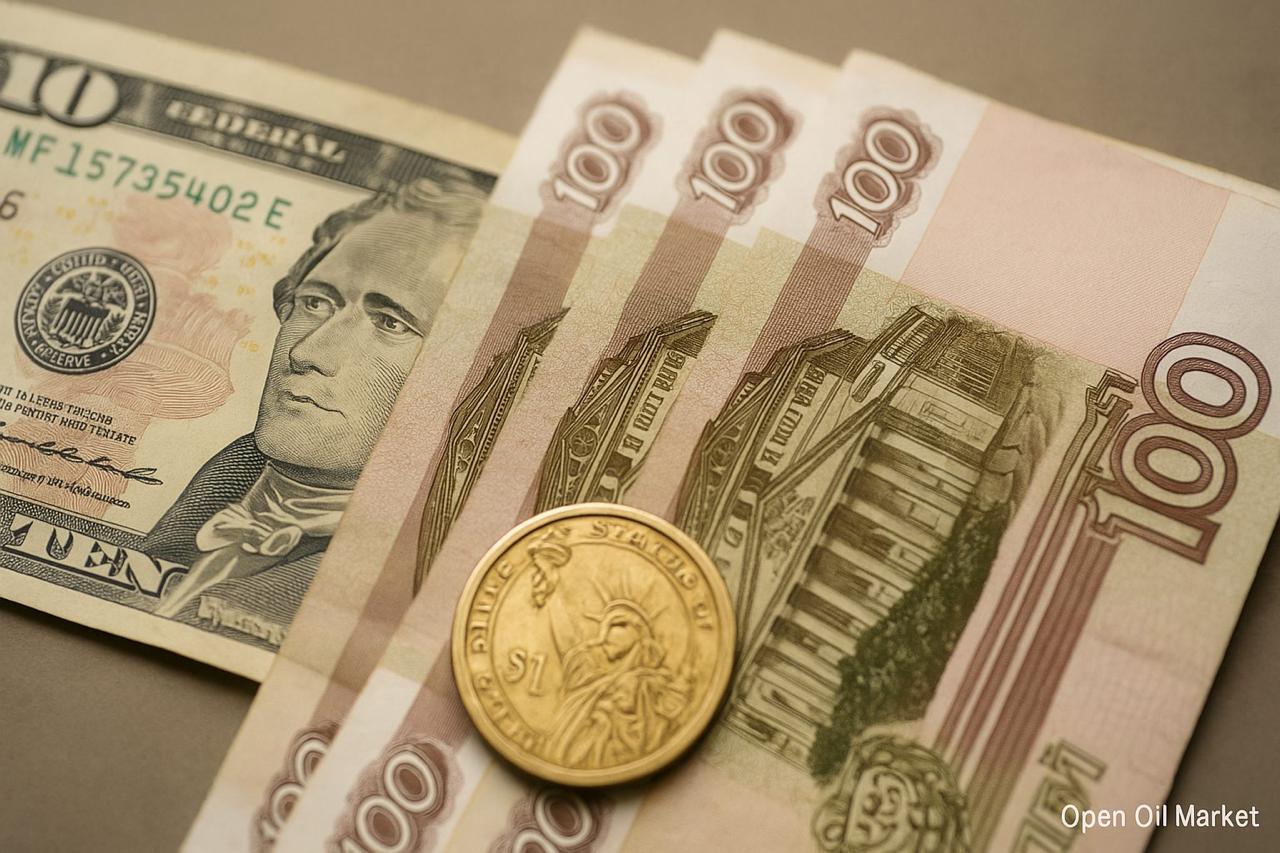
Why the Rouble is Strengthening While Searches for "Dollar Depreciation" Hit Record Highs: Macro-Economic Reasons, the Influence of the Central Bank of Russia's Policy, and What This Means for Investors in 2025.
Unexpectedly Strong Rouble at Year-End
At the end of 2025, the Russian rouble is displaying unexpected strength. The exchange rates of major foreign currencies have dropped significantly: the US dollar has fallen to around 75-77 roubles, and the euro to 90 roubles, marking their lowest values in the past two and a half years. This rapid appreciation of the rouble has attracted considerable public attention; according to Google, the number of search queries regarding “dollar depreciation” has soared to a historic high for the quarter. Typically, by December, the rouble weakens (due to increased imports during the holiday season and budgetary expenditures), but the current situation defies stereotypes. Investors and ordinary citizens are concerned as they attempt to understand the reasons behind the strengthening of the national currency and whether now is the time to rush to exchange offices for dollars.
Trade Surplus and Import Limitations
One of the fundamental reasons for the rouble's strengthening is Russia's significant positive trade balance. Exports significantly exceed imports, ensuring a stable inflow of foreign currency into the country:
- High Export Revenues. Thanks to the export of energy resources and other goods, Russia continues to generate substantial revenue in foreign currencies. Even considering sanctions and falling oil prices, export volumes remain considerable. Moreover, non-oil and gas exports have recently shown growth, further increasing currency inflow.
- Decline in Imports. The volume of goods imported into Russia remains relatively low. Sanctions and government measures, such as increased recycling fees and other restrictions, are inhibiting the import of foreign goods (cars, equipment, etc.). The import substitution strategy is creating additional barriers for foreign products. Additionally, domestic demand has weakened: economic growth has slowed, real incomes have increased modestly, and the upcoming VAT hike is expected to limit purchasing power and the need for imported goods. As a result, the demand for foreign currency from importers remains low.
- Dollarization of Settlements. The share of settlements in national currencies has increased. Russia and its trading partners are increasingly transitioning to roubles, yuan, and other "alternative" currencies in foreign trade. Many transactions for exported goods are now conducted without involving the dollar or euro. This reduces the direct demand for reserve currencies in the domestic market. Simultaneously, the country's reliance on the rouble's exchange rate fluctuating with oil prices has diminished due to the budget rule mechanism.
- Cryptocurrency as "Hidden Export." A new factor has emerged: part of international settlements is being conducted through cryptocurrencies. According to officials, significant amounts for imported supplies may now be settled in cryptocurrency. This effectively means that Russian exporters, for example, of energy resources are receiving digital assets instead of goods and dollars, which can later be converted. Such hidden exports contribute additional currency revenue and diminish the need for official dollars for import payments, thus supporting the rouble's strength.
Monetary Policy and Financial Factors
Another group of reasons relates to the financial system and the policies of regulators. Tight monetary conditions within the country significantly support the rouble:
- High Interest Rates of the Central Bank of Russia. The Central Bank's key rate is currently at a double-digit level (around 17% annually). These high rates have made rouble-denominated instruments extremely attractive to investors and depositors. Banks offer interest rates on deposits of 15-20% annually, and reliable bonds provide high coupons – all of which stimulate savings in roubles rather than in foreign currencies. Both the public and businesses are less inclined to purchase dollars or euros, which do not yield income, when there is an opportunity to gain significant returns in roubles.
- Influx of Roubles from Exporters. Exporters, receiving revenues in foreign currencies, sell a significant portion on the domestic market. Partly, this is a legislative requirement, partly a rational decision: converting dollars into roubles to place them under high interest rates or finance domestic expenses. Given the high rates, even exporters are eager to exchange currency for roubles quickly to earn interest rather than hold funds in “depreciating” dollars.
- Reduction in Capital Outflow. Russia's financial market has become more "closed." After 2022, the external debt of the country and corporations has significantly decreased, and access to external capital markets is restricted. Foreign investors have primarily exited the Russian market. As a result, the demand for foreign currency for servicing external debts or transferring funds abroad has markedly decreased. Strict capital movement restrictions (though recently eased for individuals) also play a role: roubles mainly remain within the country. The exchange rate is now mainly determined by the balance of exporters and importers, without the previous pressure from financial speculators or panic among the public.
- Currency Interventions under the Budget Rule. An additional factor has been the policies of the Ministry of Finance and the Central Bank regarding the currency market. In recent months, the government has actively sold foreign currency from the National Welfare Fund through "mirror operations" as part of the budget rule. Since December 5, the volume of currency sales has significantly increased – according to the Ministry of Finance, to the equivalent of around 14.5 billion roubles daily, which is approximately 1.5 times higher than in the autumn. Essentially, the regulator is daily releasing a substantial portion of dollars and euros into the market while exchanging them for roubles. This creates an oversupply of currency and prevents the dollar from rising, thereby supporting the strength of the rouble.
- Dollar Weakness in the Global Market. The strengthening of the rouble is not occurring in a vacuum – external factors are also contributing. The American dollar has weakened globally by the end of 2025: investors expect an imminent reduction in the Federal Reserve's interest rates and a loosening of monetary policy. The DXY index (the dollar's exchange rate against major world currencies) has dropped to its lowest levels in recent years. The dollar is depreciating against many currencies, and the rouble is no exception. Additionally, the anticipated shift in power in the US towards an administration favouring a weaker dollar (analysts believe the new financial authorities may pursue this course) is pressuring the US currency. Thus, external factors are also benefiting the rouble.
- Geopolitical Expectations. Finally, market sentiments are influenced by geopolitics. At the end of the year, cautious hopes for a de-escalation of international tensions have emerged, partly due to diplomatic signals. While there are no specific peace agreements yet, some market participants have factored in expectations for a more favourable scenario in the future. This has decreased the frenzied demand for currency as a "safety net" among both the public and businesses. Any positive news (such as expanded cooperation with major partners like India or hints at possible negotiations to resolve the conflict) supports the rouble. However, experts emphasise that the geopolitical factor is more psychological – it may have accelerated the current strengthening, but it alone cannot sustain the rouble for long without support from other fundamental reasons.
Pros and Cons of a Strong Rouble for the Economy
Such a sharp appreciation of the national currency has a dual effect on the economy – there are both winners and losers from a strong rouble.
- Benefits for Citizens and Importers: The strengthening of the rouble slows down inflation. Prices for imported goods (electronics, cars, clothing, fruits, etc.) either cease to rise or decrease in rouble terms. This supports the real purchasing power of the population and reduces costs for companies importing raw materials and components. Travelling abroad and paying for services in foreign currencies (tourism, education, foreign services) become cheaper for Russians. A strong rouble, in general, increases trust in the national currency and financial stability – savings in roubles depreciate more slowly, positively impacting domestic consumption.
- Drawbacks for the Budget and Exporters: The Russian economy is historically export-oriented; thus, an excessively strong rouble negatively impacts exporters. Companies selling their goods abroad for dollars or euros (oil and gas, metallurgy, chemistry, etc.) receive fewer roubles when converting their revenues. Their profitability declines, potentially leading to reduced investments, development spending, and even decreased production volumes. The government budget receives lower rouble revenues from export duties and taxes: oil and gas revenues in roubles sharply decreased with the rouble's strengthening, exacerbating the budget deficit. Consequently, an overly strong rouble poses a challenge for economic growth: export-oriented sectors, driving the economy, lose profitability. If the situation drags on, negative consequences for employment in these sectors and treasury revenues may occur. The government is virtually forced to balance between the goal of suppressing inflation (which a strong rouble helps with) and supporting export-oriented sectors (which require a weaker rouble for comfortable operation).
How Authorities are Reacting to the Strengthening Rouble
The unusual currency dynamics have not gone unnoticed by the country's leadership. Russian authorities openly acknowledge that an exceedingly strong rouble creates problems. The Head of the Ministry of Economic Development, Maxim Reshetnikov, described the current strengthening of the rouble – almost a quarter since the start of the year – as one of the main challenges for the economy, noting that "a strong rouble is a new reality we will have to accommodate." In business circles and the government, a debate has unfolded about the need for a currency corridor or other measures to weaken the rouble; however, the Ministry of Finance has opposed direct currency management. Finance Minister Anton Siluanov stated that the floating exchange rate currently reflects the balance of supply and demand and generally corresponds to the parameters of the payment balance. In simple terms, the authorities do not plan to artificially revert to a fixed rate – the economy is urged to adapt to a strong rouble.
Nevertheless, indirect measures to regulate the situation are being implemented. As noted, since December, the Ministry of Finance has increased foreign currency sales from reserves, seeking to mitigate exchange rate fluctuations and partially compensate for the seasonal rise in demand for currency towards the end of the year. At the same time, the Central Bank has begun to gradually ease previously introduced currency restrictions. From December 8, the regulator lifted the remaining limits on currency transfers abroad for Russian citizens and "friendly" non-residents. Previously, individuals were allowed to send no more than $1 million abroad each month – this restriction has now been removed. The Central Bank explained this decision by the stability of the currency market. Some experts believe that lifting limits is a step towards a more market-based formation of the exchange rate: it enhances the flexibility of settlements, reduces the incentive to use grey capital outflow schemes, and, crucially, allows for "venting" the overheated currency market by slightly increasing capital outflows.
Furthermore, stimulating imports is being discussed. M. Oreshkin, economic aide to the president, remarked that to facilitate a return to a weaker rouble in the long term, the government may need to employ an aggressive policy to boost imports in specific segments – essentially increasing demand for currency intentionally. For now, however, official statements convey confidence that the situation is under control. Regulators indicate that they have sufficient tools to prevent excessive strengthening or sharp volatility of the rouble if necessary. Overall, the policy aims to smooth out extreme fluctuations, without interfering with market trends: a strong rouble is seen as an ally in the fight against inflation, but authorities are also trying to prevent a scenario where the exchange rate becomes "too good to be true," which could harm the budget.
Outlook: How Long will the Rouble Remain Strong?
The main question for investors and businesses is whether the current exchange rate of around 75-80 roubles per dollar will be sustained for an extended period. The consensus among most analysts is: in the short term, until the year's end, the rouble will remain relatively strong in the absence of external shocks. All the aforementioned factors – from export revenues to the Central Bank's policy – contribute to this. Many investment firms have adjusted their forecasts and now expect to finish the year with an exchange rate in the range of 75-78 ₽ per $ and 90 ± 5 ₽ per €. It is possible that just before the New Year holidays, the rouble may weaken slightly due to a seasonal uptick in consumer and corporate expenses (including on imported goods) and capital outflow, but significant deviations are not anticipated. The regulator will continue to sell foreign currency, stabilising heightened demand, so sharp fluctuations in the exchange rate are unlikely.
In 2026, experts expect a gradual weakening of the rouble. Keeping the national currency this strong constantly is both difficult and disadvantageous to the economy itself. The basic scenario from major banks and analytical centres anticipates a return of the dollar to the level of 85-95 roubles over the year. Some forecasts for the end of 2026 suggest a range of around 90-100 roubles per dollar. The reasons include changes in the very factors that currently support the rouble. Firstly, a loosening of monetary policy is expected: if inflation in Russia continues to slow, the Central Bank may begin to gradually lower the key rate. Predictions indicate that in the first half of 2026, the rate may drop from its current heights (17%) to 14-15%. The cheaper rouble loans and lower deposit rates will reduce the attractiveness of the rouble for speculative transactions and again increase the propensity of businesses and the public to purchase foreign currency.
Secondly, the scale of currency interventions is expected to decrease. The Ministry of Finance does not plan to continue selling foreign currency indefinitely: the volumes sold under the budget rule in the new year are likely to be reduced, especially if oil prices recover slightly. This will remove part of the support currently enjoyed by the rouble from the government. Thirdly, an increase in imports is possible. The economy cannot indefinitely satisfy all demand solely through domestic production – sooner or later, companies will begin to procure more equipment, components, and goods from abroad, particularly as they adapt to sanctions. Additionally, the VAT increase effective January 1, 2026, may prompt businesses to purchase imported goods in advance, increasing demand for currency. Furthermore, the population traditionally spends more during the Winter holidays, including trips abroad, which temporarily raises demand for dollars and euros.
Finally, geopolitical factors should not be overlooked. Should a de-escalation occur – for example, through hypothetical peace agreements and subsequent partial lifting of sanctions – the rouble may receive another impetus for strengthening. Some optimistic forecasts suggest that under favourable circumstances, the exchange rate could temporarily return to 70-75 ₽ per $ in the first quarter of 2026. However, even the authors of such scenarios acknowledge that this would be a one-time, emotional strengthening; in the long term, fundamental economic factors will prevail, and an overly strong rouble will retreat. Conversely, if the geopolitical situation remains tense or worsens – with new sanctions or risks to exports – this will accelerate the rouble's depreciation.
In general, the consensus is this: the current extraordinarily strong rouble is a phenomenon supported by a combination of unique factors, and it is unlikely to persist unchanged throughout the next year. Most likely, the rouble's exchange rate will gradually drift towards a more "comfortable" range for the economy. Experts do not anticipate a sharp collapse of the national currency – barring any unforeseen circumstances, the rouble's depreciation will be gradual. In other words, while a dollar at 100 roubles may return, it is unlikely to happen abruptly tomorrow; rather, it will be the result of a gradual process throughout 2026. Meanwhile, a return to extremely low values (50-60 ₽ per $, as seen a few years ago) is also not on the horizon – too much has changed in the economy. Most likely, we can expect relative stability of the rouble in winter and moderate depreciation as we approach spring and summer of 2026.
Should You Buy Dollars Now: Recommendations for Investors
The main practical question on many minds is whether now is the time to rush and buy dollars (or euros), taking advantage of their "low" price. The answer depends on your objectives, but panic purchasing of currency now is unlikely to be justified. Here are several considerations for private investors and savings holders:
- Don’t rely on currency as a quick profit mechanism. In recent months, the rouble has strengthened significantly, and those who purchased dollars at peak prices have incurred losses. For instance, buying $1,000 at the end of 2024 would have cost over 100,000 roubles, while today those dollars are worth about 75-80 thousand. That’s a depreciation of around 25%. Additionally, during this time, the opportunity cost of investing that same amount into a rouble deposit earning high interest has been missed. Thus, savings in foreign currency are losing to rouble instruments when the rouble rises. There is no guarantee that the situation will reverse sharply in the coming weeks. Therefore, purchasing dollars “in hopes of a rate increase” now appears speculative and risky.
- Rouble assets currently yield high returns. Thanks to high rates on deposits and bonds, you can achieve double-digit returns in roubles. This yield already offsets potential future depreciation of the rouble by several percentage points. Simply put, even if in a year the dollar appreciates from 75 to 90 roubles (+20%), a deposit at 20% per annum would yield comparable profits, mitigating the impact of currency appreciation. If the exchange rate remains close to current figures, the advantages of rouble instruments will be evident. Given this, most financial advisors currently do not recommend keeping all savings in foreign currency – rouble instruments have become too attractive.
- Buying currency makes sense for specific purposes. If you have planned expenses in dollars or euros – such as an overseas trip, paying for education, or purchasing imported goods – the current rate is indeed favourable for conversion. Currency has become cheaper, allowing you to save. In such cases, it is sensible to acquire the required amount gradually to mitigate exchange rate fluctuations. For instance, if your trip is a couple of months away, you might buy currency in small increments each week. This strategy yields a comfortable average purchase rate.
- Dollars as a “safety cushion” – only as part of diversification. It is always beneficial to hold a portion of your savings in different assets. If you are concerned about the long-term stability of the rouble, there’s nothing to stop you from acquiring a share of currency as a precaution. However, approach this without frenzy: convert a reasonable portion into dollars – one you can comfortably afford to lose, while also being able to insure against worst-case scenarios. At the same time, avoid hastily selling all your rouble investments. The optimal strategy is to diversify your capital: for instance, a portion in roubles in deposits/OFZ, a part in foreign currency in cash or in accounts, and some in other assets (precious metals, stocks, etc.). This diversification will allow you to feel secure regardless of how the situation unfolds.
- If you already have currency in your portfolio. Many Russians have savings partly held in dollars or euros from previous times. Now, with the dollar having depreciated, questions arise concerning the future of these holdings. Financial experts recommend not putting all eggs in one basket. It makes sense to take advantage of the strong rouble and rebalance your portfolio: for instance, convert a portion of your currency savings back into roubles and invest them at high interest rates. This will increase the overall yield of your capital. The remaining portion of currency can serve as long-term insurance. Future adjustments in proportions can be made depending on market conditions.
Conclusion: the current situation in the currency market rather calls for calm and measured actions than haste. The rouble is strong now due to objective reasons. It is not advisable to rush and exchange all your rouble savings for dollars out of fear of “missing the moment” – there is a significant risk of incurring losses later or losing out on benefits. Conversely, there is no need to entirely refuse currency: it still serves as a protective asset against unforeseen upheavals. The optimal approach for a wide range of investors is to coolly assess their needs and horizons. Use the strong rouble to leverage maximum benefits (high interest rates, cheaper imports), while concurrently adhering to the principle of diversification, maintaining a moderate share of savings in reliable foreign currency. This strategy will enable you to feel secure regardless of how the rouble performs.