Crypto News for Monday, 8 June 2026: Bitcoin and Ethereum Under ETF Outflow Pressure, Growing Role of Stablecoins, Top-10 Cryptocurrency Dynamics and Key Benchmarks for Global Investors
The cryptocurrency market heads into Monday, 8 June 2026, in a state of heightened volatility. Following a sharp sell-off in Bitcoin and Ethereum, investors’ attention has shifted to three key factors: outflows from spot crypto ETFs, the strengthening of stablecoins as a theme in the global financial system, and the competition digital assets face from the rapidly growing artificial intelligence sector and mega-listings on the equity market.
For global investors, this week is a test of the crypto market’s resilience. Bitcoin remains the primary indicator of risk appetite, Ethereum shows sensitivity to declining liquidity, and stablecoins are effectively evolving into a distinct class of digital monetary infrastructure. Against this backdrop, the top 10 cryptocurrencies by market capitalisation remain crucial for assessing market structure, capital flows and institutional sentiment.
At the time of writing, the global cryptocurrency market capitalisation is estimated at approximately $2.13 trillion. Daily trading volumes remain significant, but the composition of turnover reveals an important shift: the overwhelming majority of trading activity is concentrated in stablecoins. This signals that the market is not simply buying or selling risk, but actively moving capital into digital dollar cash, awaiting fresh signals from macroeconomics, ETF flows and regulators.
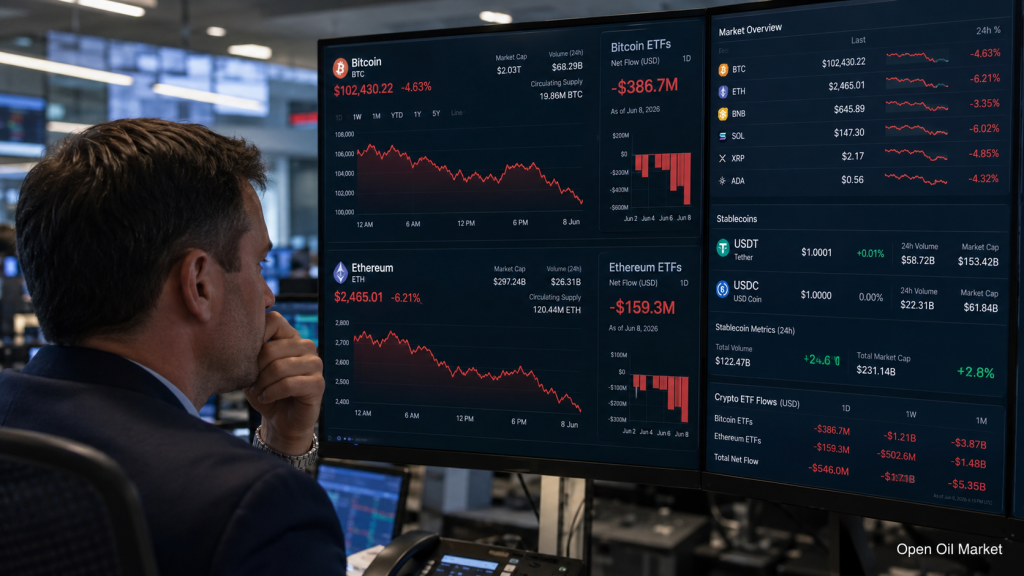
Bitcoin is trading around $61,000–$62,000, Ethereum around $1,600. These levels matter less in isolation than as a reflection of a broader process: after a period of institutional growth expectations, the crypto market now faces a deficit of new demand. Investors are paying closer attention not to pronouncements about the long-term potential of digital assets, but to real capital inflows, ETF liquidity and the resilience of major holders.
Bitcoin: ETF Outflow Pressure Becomes the Key Demand Indicator
The top cryptocurrency story for investors remains Bitcoin under pressure following a series of outflows from spot ETFs. This is particularly significant for the market because ETFs have become one of the main channels for institutional access to cryptocurrencies. When fund inflows rise, Bitcoin receives support from traditional capital. When investors withdraw funds, the market quickly loses depth and becomes more sensitive to selling.
A separate psychological factor is the partial sale of Bitcoin by Strategy. The transaction size was small relative to its total reserves, but the very fact of a sale became a symbolic event. For investors, this signals that even the largest corporate holders may adjust positions when tax, market or balance-sheet logic shifts.
Key factors for Bitcoin in the coming days:
- the trajectory of inflows and outflows from spot Bitcoin ETFs;
- the behaviour of US Treasury yields and the dollar exchange rate;
- investor interest in AI companies and major IPOs;
- regulatory expectations for the US crypto market;
- the resilience of demand from long-term holders.
Ethereum: Market Weakness Hits the Infrastructure Asset
Ethereum has also come under heavy pressure. For investors, ETH matters not only as the second-largest cryptocurrency by market cap but also as the foundational infrastructure for DeFi, asset tokenisation, stablecoins and smart contracts. However, in periods of declining liquidity, the market often sells Ethereum faster than Bitcoin because ETH is perceived as a more technological and therefore riskier asset.
Ethereum’s weakness shows that investors are temporarily shifting away from the ‘infrastructure growth’ narrative towards a more cautious risk-management model. Until the market sees a recovery in ETF inflows, renewed activity in DeFi and an improved macroeconomic picture, ETH may remain more volatile than Bitcoin.
Top 10 Cryptocurrencies: Market Structure Remains Concentrated
The top 10 cryptocurrencies by market capitalisation reflect not only the popularity of individual coins but also the balance between three segments: investment assets, blockchain infrastructure and stablecoins. In the current market structure, the role of USDT and USDC is especially notable: investors actively use stablecoins as a unit of account, a safe-haven asset within the crypto ecosystem and a tool for waiting out new trading signals.
| Rank | Cryptocurrency | Role for Investors |
|---|---|---|
| 1 | Bitcoin (BTC) | Primary reserve asset of the crypto market and indicator of institutional demand |
| 2 | Ethereum (ETH) | Core infrastructure for smart contracts, DeFi and tokenisation |
| 3 | Tether (USDT) | Largest dollar-pegged stablecoin and primary liquidity tool |
| 4 | BNB (BNB) | Ecosystem asset of Binance and associated blockchain services |
| 5 | USDC (USDC) | Regulated dollar stablecoin, important for institutional markets |
| 6 | XRP (XRP) | Asset tied to payment infrastructure and cross-border transfers |
| 7 | Solana (SOL) | High-performance blockchain network for applications, DeFi and tokens |
| 8 | TRON (TRX) | Network with high stablecoin transfer activity |
| 9 | Hyperliquid (HYPE) | Asset linked to derivatives and trading infrastructure |
| 10 | Dogecoin (DOGE) | High-liquidity memecoin, sensitive to retail demand |
Stablecoins Become a Political and Monetary Theme
One of the most important trends of 2026 is the transformation of stablecoins from an internal crypto exchange tool into an element of global financial infrastructure. Dollar-pegged stablecoins reinforce the dollar’s role in the digital economy, particularly in countries with unstable currencies, limited access to banking services or high inflation.
For investors, this creates a dual effect. On the one hand, the growth of stablecoins boosts crypto market liquidity and simplifies settlements. On the other, it intensifies central bank scrutiny, as widespread use of digital dollars can affect bank deposits, monetary policy and payment system oversight.
Regulation: Europe and the UK Tighten Control Over Digital Assets
The regulatory agenda remains a major factor for cryptocurrencies. In the UK, discussions continue over rules for systemically important stablecoins. The core question is how restrictive the requirements for the custody and backing of digital currencies should be – enough to avoid stifling a new market, yet without creating risks for the banking system.
In Europe, the tax and legal framework for digital assets is being strengthened. Plans by individual countries to tax cryptocurrency income show that the market is gradually becoming part of the ordinary financial system. For long-term investors, this is an important signal: crypto assets gain more institutional legitimacy but simultaneously lose some of their former regulatory freedom.
AI and Mega-Deals Compete with Cryptocurrencies for Capital
Another important factor is the reallocation of capital towards artificial intelligence, tech stocks and major IPOs. When investors see rapid growth in the AI sector, some liquidity shifts from cryptocurrencies into public and private technology companies. This is especially noticeable in periods when Bitcoin shows no independent momentum and ETF outflows are recorded.
For the crypto market, this means the old ‘digital gold’ narrative is no longer sufficient. Bitcoin and Ethereum must compete not only with bonds, gold and equities but also with a new cycle of technological growth. Institutional investors will compare cryptocurrencies according to clear criteria: liquidity, volatility, regulatory clarity, return on capital and market depth.
What is Happening with Altcoins: The Market Chooses Liquidity
Altcoins remain the most sensitive segment of the market. Solana, XRP, BNB, TRON, Hyperliquid and Dogecoin can show sharp movements, but in an environment of declining overall risk appetite, investors prefer liquid assets. This means capital concentrates in major coins, while weaker projects without sustainable token economics receive less attention.
What Altcoin Investors Are Watching
- real network activity and transaction count;
- protocol revenue and business model sustainability;
- liquidity on major exchanges;
- the share of institutional capital;
- clarity of regulatory status.
In such an environment, projects with a clear infrastructural role – payments, stablecoins, smart contracts, derivatives, real-world asset tokenisation and corporate blockchain solutions – appear most resilient.
Outlook for Investors on 8 June 2026
The cryptocurrency market enters a new week without a confirmed reversal. Short-term stabilisation of Bitcoin above psychologically important levels could support sentiment, but for a full recovery the market needs fresh ETF inflows, reduced dollar pressure and clearer signals on regulation in the US, Europe and the UK.
The base case for Monday is cautious trading with elevated volatility. Investors will track whether crypto ETF outflows continue, whether Bitcoin and Ethereum can hold current levels, and whether demand for stablecoins as a safe-haven tool within the crypto market persists.
What Investors Should Focus On
For global investors, the key task now is not to predict Bitcoin’s short-term move, but to assess the quality of demand. If the market rises on low liquidity, such growth may be unstable. If the recovery is accompanied by ETF inflows, rising volumes and a declining share of forced liquidations, that would be a stronger signal.
On 8 June 2026, the main benchmarks for investors are:
- the trajectory of Bitcoin ETF and Ethereum ETF flows;
- Bitcoin’s behaviour in the $60,000–$62,000 zone;
- Ethereum’s resilience around $1,600;
- the rising or falling share of stablecoins in trading turnover;
- news on stablecoin regulation in the US, Europe and the UK;
- capital rotation between cryptocurrencies, AI companies and equity markets;
- the state of the top 10 cryptocurrencies by market capitalisation and liquidity.
The key takeaway for investors: cryptocurrencies remain a high-risk but systemically important segment of the global market. Bitcoin retains its role as the primary indicator of trust in digital assets, Ethereum remains an infrastructure bet on the blockchain economy, and stablecoins are becoming a bridge between the crypto market and traditional finance. It is around this trio – Bitcoin, Ethereum and stablecoins – that the crypto market agenda will be shaped on Monday, 8 June 2026.