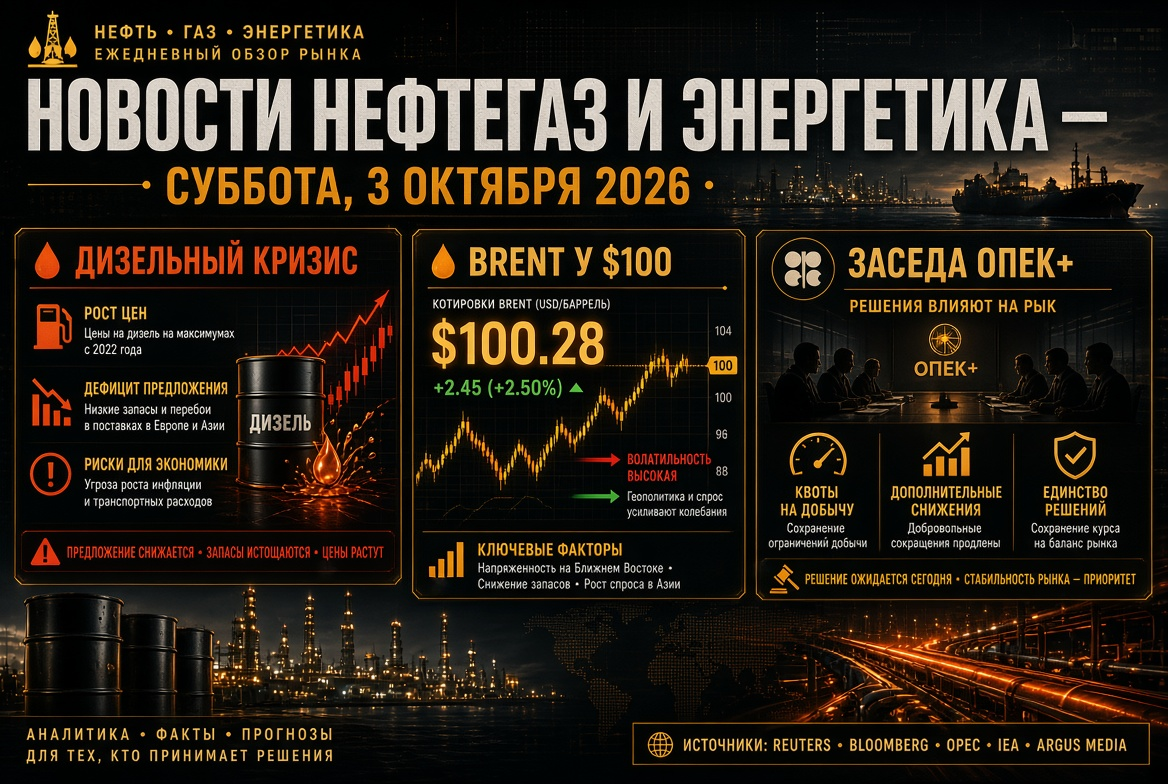
Top Oil, Gas and Energy Market News for Monday, 8 June 2026: OPEC+ Decision, Oil, Gas, LNG, Refineries, Petroleum Products, Electricity, Renewables and Coal
Monday, 8 June 2026, begins for the global energy sector in a state of heightened volatility. The dominant theme for investors, oil companies, refineries, petroleum product traders and gas market participants is the attempt to balance the formal increase in OPEC+ production quotas, constraints on actual supply, logistical tensions and rising fuel costs. Oil, gas and energy news today is concentrated around several key areas: oil, gas, LNG, electricity, coal, renewables, petroleum products and refining.
On the global market, the divergence between producers' paper decisions and the physical availability of raw materials is widening. Investors are increasingly scrutinising not only the price of Brent and WTI, but also inventories, transport routes, refinery margins, the resilience of power systems and demand from industry, aviation, data centres and emerging economies.
OPEC+ Remains the Main Driver of the Oil Agenda
The central event for the oil market has been the decision by seven OPEC+ countries to raise their production targets for July. Formally, this appears as a signal of readiness to support the global market with additional supply. However, what matters more to investors is how quickly the extra barrels can reach consumers and offset the deficit caused by logistical disruptions and restrictions in key exporting regions.
For the oil and gas sector, this means the risk premium remains high. Even with the announced quota increase, the market will assess not only production volumes but also the availability of tanker fleet, insurance, port infrastructure condition, alternative pipeline routes and the ability of producers to meet stated parameters. As a result, oil remains an asset where political risk directly translates into the price of crude, petroleum products and energy company shares.
- for oil producers, revenue support from high prices persists;
- for refineries, the importance of stable feedstock supply grows;
- for consumers, the risks of expensive diesel, gasoline and jet fuel increase;
- for investors, interest intensifies in companies with access to their own logistics and inventories.
Oil: Market Remains Sensitive to Any Supply Signals
The global oil market enters the week with an extremely tight balance. On one hand, some market participants are pricing in the possibility of a gradual stabilisation of supply. On the other, physical inventories have already decreased notably, and processors are competing for available crude parcels. This creates a situation where even a moderate news item about disruptions can sharply alter expectations for Brent, WTI and regional grades.
Flows from the Atlantic Basin are particularly important. The US, Brazil, Canada and other suppliers are gaining additional significance as sources to replace shortfalls. For oil companies, this opens a window of higher export margins, but simultaneously increases pressure on domestic inventories. In such an environment, the market will closely watch inventory statistics, refinery utilisation, crude exports and grade spread dynamics.
For global investors, the key conclusion is straightforward: oil remains not only a commodity asset but also an indicator of global economic resilience. If prices stay elevated for too long, pressure will shift to inflation, transport costs, consumer demand and the monetary policy of major central banks.
Refineries and Petroleum Products: Refining Margins Remain One of the Strongest Themes
Tension persists in the petroleum products market. Refineries face expensive feedstock, unstable supply and high demand for middle distillates. Diesel, jet fuel, gasoline and fuel oil are becoming not just derivatives of the crude price but independent indicators of shortage in global energy.
For processors, the current situation is ambiguous. On one hand, high crack spreads support refinery profitability. On the other, feedstock shortages, supply disruptions and rising operating costs limit the ability to increase output. Jet fuel remains especially sensitive: Europe has not yet recorded widespread shortages, but high prices are already impacting airline economics and may lead to the cancellation of unprofitable routes.
For fuel companies and wholesale buyers of petroleum products, this necessitates tight control over purchase prices, logistics and delivery timelines. The most resilient players will be those with access to multiple suppliers, the ability to quickly switch between regions and inventory management based on a risk-mitigation scenario rather than minimum levels.
Gas and LNG: Energy Security Takes Precedence over Short-Term Price
The gas market remains the second most important focus after oil. Europe continues to rely on supply diversification, LNG, pipeline gas from reliable sources and storage filling. At the same time, competition with Asia for flexible liquefied natural gas cargoes keeps the risk of sharp price movements alive.
For gas companies and investors, the key trend is rising capital expenditure on LNG infrastructure. The global energy sector increasingly views gas not only as a transition fuel but also as a tool of energy security. New export projects in the US, Qatar and other regions are becoming strategic assets, as they allow consumer countries to reduce dependence on a single route or supplier.
However, gas does not offer a simple solution. LNG requires long-term contracts, terminals, shipping, regasification capacity and developed networks. Therefore, countries with limited infrastructure are forced to simultaneously use coal, renewables, nuclear power and energy efficiency measures.
Electricity: Data Centres, Industry and Heat Increase Grid Strain
The electricity sector is becoming one of the fastest-changing parts of the global energy industry. The growth of data centres, artificial intelligence, cryptocurrency mining, air conditioning and industrial electrification is increasing grid load. For investors, this means energy infrastructure is becoming as important as oil or gas production.
The most vulnerable points are power systems with rapid growth of large consumers and insufficient capacity reserves. Data centres and mining facilities can consume vast amounts of electricity, and their sudden disconnections can create technical risks for grid balance. Consequently, system operators are tightening requirements for connection, voltage stability and the behaviour of large industrial consumers during peak hours.
For power companies, this opens investment opportunities in grids, energy storage, gas-fired generation, nuclear projects and hybrid systems. For investors, not only tariffs matter but also the company's ability to ensure grid reliability amid rising demand.
Renewables and Storage: Growth Continues, but Infrastructure Constraints Become More Apparent
Renewables remain one of the largest areas of capital expenditure in global energy. Solar generation, wind power, battery storage and grid modernisation continue to receive support amid expensive fossil fuels. But the market is maturing: investors increasingly assess not just installed capacity but also grid connection, storage costs, availability of copper, lithium, aluminium and project timelines.
The key problem for renewables is not demand but integration. The more solar and wind generation enters a power system, the greater the need for storage, flexible capacity and peak load management. Therefore, battery manufacturers, grid operators and balancing software developers are becoming an important part of the investment narrative.
For the global market, this means the energy transition does not instantly eliminate oil, gas and coal, but creates a more complex structure: traditional resources provide reliability, renewables reduce import dependence, while storage and grids become the connective element of the new energy system.
Coal: A Return as an Energy Security Tool, but Not as a Long-Term Favourite
Coal is again in the spotlight, particularly in Asia and the US. High gas prices, LNG supply risks and rising summer electricity demand are forcing some countries to retain coal generation in their energy mix for longer. For developing economies, coal remains an affordable and manageable source of baseload power.
However, the long-term investment picture remains complex. In Europe, coal continues to lose ground to renewables, gas, nuclear power and grid solutions. In Asia, demand is more resilient but increasingly depends on domestic production in China and India rather than seaborne imports. This reduces predictability for coal companies' export markets.
For investors, coal today is more of a tactical energy security play than a universal long-term bet. High prices may support producers' cash flows, but regulatory, environmental and infrastructure risks remain significant.
Corporate Energy Sector: Companies with Logistics, Inventories and Flexibility Prevail
Corporate news from the oil, gas and energy sector shows a common trend: large companies are restructuring their asset portfolios, sharpening focus on core production, refining, gas, LNG and resilient power generation. In an environment of expensive capital and geopolitical risk, the market is increasingly unwilling to pay for vague strategies and values clear cash flow generation more than ever.
The strongest positions are held by companies with the following advantages:
- own oil and gas production in stable regions;
- access to export infrastructure and alternative routes;
- modern refineries with high conversion depth;
- control over petroleum product logistics;
- diversification across oil, gas, electricity and renewables;
- low debt burden and sustainable free cash flow.
For fuel companies, traders and industrial buyers, this means supply chains become a strategic advantage. Price matters, but in the current market, resource availability, delivery guarantee and counterparty financial stability carry at least equal weight.
What Investors Should Watch on 8 June 2026
The key takeaway for investors: the global energy sector remains in a phase of structural transformation, where short-term oil and petroleum product shortages combine with long-term growth in investment in gas, electricity, grids, storage and renewables. Oil, gas and energy news for Monday, 8 June 2026, shows that the market can no longer be assessed solely through the Brent price. A broader perspective is needed: logistics, inventories, refineries, gas storage, LNG contracts, coal generation, grid resilience and capital expenditure by the largest energy companies.
The day's focus is on the OPEC+ quota decision, actual oil availability, refining margins, the cost of diesel and jet fuel, the gas market situation in Europe and Asia, and the strain on electricity systems from data centres and summer demand. For conservative investors, companies with strong balance sheets, diversified resource bases and infrastructure control look most attractive. For riskier strategies, interest may lie in refineries, LNG projects, grid equipment manufacturers, energy storage and companies benefiting from rising electricity demand.
The energy market enters a new week with no signs of simple normalisation. On the contrary, oil, gas, electricity, renewables, coal and petroleum products are increasingly interconnected in a single investment picture, where winners are not the largest players but the most flexible and infrastructure-protected participants in the global energy sector.