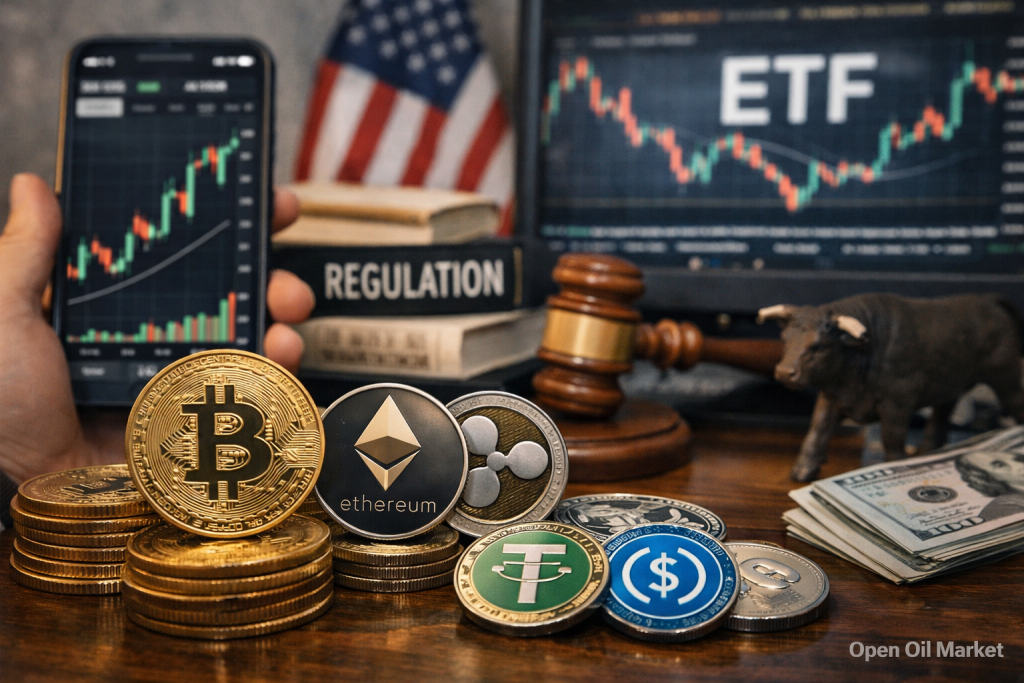
Cryptocurrency News, Saturday, 27 September 2025: Bitcoin Holds at $110,000 after Record Options Expiry, Ethereum Above $4,000, Market Awaits Approval of New ETFs. Overview of the Top 10 Cryptocurrencies and Key Market Trends for Investors.
As of the morning of 27 September, the cryptocurrency market is showing mixed dynamics following a recent correction. The total market capitalisation has stabilised around $4 trillion, with volatility remaining moderate. Bitcoin has retained most of its positions after the September pullback, while leading altcoins are consolidating amid profit-taking. Macroeconomic risks, such as the threat of a US government "shutdown," are temporarily restraining risk appetite; however, institutional investors continue to show interest in digital assets.
Bitcoin Maintains Position Above $110,000 Following Major Options Expiry
By the morning of 27 September 2025, Bitcoin (BTC) is trading around ~$111,000, continuing to consolidate after a recent correction. The flagship cryptocurrency is holding above the psychological threshold of $110,000, remaining below its all-time high (~$124,500, achieved in August). Over the past week, BTC has declined by about 2%, but is still approximately 3% above levels at the start of the month. Bitcoin's market capitalisation is estimated at about $2.3 trillion, which represents around 60% of the total cryptocurrency market capitalisation.
By the end of September, BTC's price is influenced by a reduced risk appetite in global markets. Investors are concerned about the looming threat of a US government shutdown on 1 October (if Congress fails to approve a budget), which intensifies uncertainty and causes some market participants to reduce their investments in risky assets, including cryptocurrencies. Moreover, on 26 September, a record expiry of Bitcoin options occurred, totalling approximately $22.6 billion — such a large event caused a short-term spike in volatility, but BTC managed to remain within its current range (~$107–112,000).
The current range of ~$107–110,000 serves as an important support zone. As long as the prices stay above this level, large investors are taking advantage of the dip to accumulate positions. According to exchanges, significant buy orders are actively absorbing price dips, indicating that "whales" remain confident in Bitcoin's continued growth in the coming months.
Ethereum Holds at $4,000 After Pullback
Ethereum (ETH), the second-largest cryptocurrency by market capitalisation, is undergoing a period of price correction after summer growth. In August, the Ether price surged to nearly $4,800, nearing its historical high. However, by the end of September, ETH prices have retreated and now balance around the psychologically significant mark of $4,000. This week, Ether briefly dipped below $4,000 for the first time in almost two months, but buyers quickly pushed the price back above that level. As of the morning of the 27th, ETH is trading at approximately $4,020, which is about 3% lower than a week prior.
Despite the pullback, Ethereum retains its status as the second-largest crypto asset with a capitalisation of about $540 billion (around 13-14% of the market). The network's fundamental indicators remain strong: the Ethereum platform dominates in decentralized applications and DeFi, and institutional investors are showing increasing interest. In 2025, the first spot ETFs for Ether launched in the US, simplifying access for large players to this asset. Although the influx of funds into ETH funds slowed down in September, it remained substantial at the end of the third quarter, indicating that many investors believe in Ethereum's long-term potential and are using dips to increase their positions.
Altcoins Under Pressure Amid Profit-Taking Following Rally
The altcoin market is experiencing pressure in the second half of September, primarily moving downwards as it corrects after an impressive rally in previous months. The prices of most major alternative coins in the top 10 have declined by 2-5% in recent days. The combined market capitalisation of altcoins (excluding BTC) has fallen below $1.7 trillion, although it still stands significantly higher than levels at the beginning of the year. Many popular altcoins are currently consolidating, with investors locking in some of the profits made over the summer.
Nevertheless, a number of digital assets are holding significant portions of the heights achieved or even showing selective growth due to specific positive news. For instance, XRP is trading around $2.80 and is close to multi-year highs (~$3.00). This token has benefited from legal clarity regarding its status in the US following Ripple's court win against the SEC — investor confidence has improved, and XRP has returned to the top three by market capitalisation. Binance Coin (BNB), despite regulatory pressure on the company, remains above $900 (slightly below its recent peak of ~$1,000). Solana (SOL) has also drawn attention: last week, its price exceeded $200 for the first time in two years amid rumours of the imminent approval of the first US ETF based on Solana. SOL is currently trading around $195, remaining close to its local maximum.
Conversely, some previously rapidly growing altcoins are experiencing a deeper correction. Cardano (ADA), which saw a notable price increase in August on expectations of ETF launches, has fallen from ~$0.98 to ~$0.78 as investors take profits. TRON (TRX), particularly popular in Asia, is trading around $0.33 with little change over the month — its stability is assured by widespread use of the Tron network for stablecoins. Overall, the altcoin segment is currently in wait-and-see mode: players are assessing the next steps of regulators and the overall economic situation before resuming active purchases of secondary cryptocurrency assets.
Institutional Investors Remain Confident in the Crypto Market
One of the key trends of 2025 is the growing interest of institutional investors in cryptocurrencies. Despite the recent price declines, large players are not leaving the market; rather, they are using the downturn to increase their positions. According to industry data, funds focused on Bitcoin and Ethereum saw fresh capital inflows this week after a brief outflow in early September. In particular, US spot Bitcoin ETFs attracted significant new investments, breaking the profit-taking wave observed in the first half of the month. Asset managers view current price levels as attractive for increasing stakes in crypto assets, especially with the fourth quarter approaching.
The range of instruments available to large investors is also expanding. In 2025, the first exchange-traded funds (ETFs) based on Bitcoin and Ethereum were approved in the US, simplifying access for institutions to gain exposure to the crypto market. Regulators are now considering applications for launching ETFs on other cryptocurrencies — such as Solana and Cardano — as well as multi-asset funds that include tokens like XRP. At the same time, clearer regulations for the crypto industry are being introduced in several regions (US, Europe, Asia), reducing legal risks. Combined, these factors are enhancing confidence: even under temporary pressure from negative factors, institutions maintain long-term optimism regarding cryptocurrencies as an asset class.
Market Sentiment and Volatility
The recent correction has affected market participants' sentiment. The "Fear and Greed" Index for cryptocurrencies, which was in the "Greed" zone during the height of the summer rally, has now dropped to approximately 45 points — indicating a moderately negative sentiment ("Fear Mode"). Investor caution has increased: after rapid summer growth, market participants are soberly assessing the risks and the likelihood of new pullbacks. External factors (the threat of a US shutdown, uncertainty in monetary policy, regulatory disputes) have also temporarily cooled enthusiasm.
However, panic sentiment is far from present. Volatility in leading cryptocurrencies, although heightened, remains within reasonable limits: daily fluctuations in Bitcoin's price are around 2-3%, which is significantly lower than recent price spikes. Experienced traders note that such periods of "cooling" — marked by moderate fear and declining euphoria — often precede new waves of growth, giving the market time to gain strength. Thus, despite short-term caution, medium-term expectations remain positive.
Forecasts and Expectations for the Fourth Quarter
The fourth quarter is historically often favourable for the crypto market. Many analysts believe that after the September pause, the market is capable of entering a new growth phase. Bold predictions are also emerging: some reviews suggest a target of around ~$200,000 for Bitcoin and $7-8,000 for Ethereum by the end of 2025. Of course, such estimates are only achievable under favourable macroeconomic conditions.
Among potential drivers are the continuing easing of monetary policy. The US Federal Reserve lowered the base rate by 0.25% in September, and further cuts are expected before the end of the year. Cheaper money and an influx of liquidity traditionally stimulate demand for risky assets, including cryptocurrencies. If new inflation and employment data indicate an economic slowdown, the Fed may continue to ease — consequently, a favourable backdrop could be created for a rally in Bitcoin and altcoins in the fourth quarter.
However, obstacles may still arise on the path to new peaks. Ongoing "quantitative tightening" (the reduction of the Fed's balance sheet) and large-scale US Treasury bond sales absorb excess liquidity, limiting the capital inflow into crypto assets. Furthermore, geopolitical tensions and unexpected regulatory moves (court decisions, new laws) could induce short-term spikes in volatility. Nevertheless, structural factors are viewed positively. Many experts indicate that the current consolidation resembles previous cycles: after changes in monetary policy, the crypto market stagnated for some time before making a sharp upward motion, outpacing traditional assets. If this trend repeats, investors may well witness new records in the value of digital assets in the final months of 2025.
Top 10 Most Popular Cryptocurrencies
As of the morning of 27 September 2025, the top 10 cryptocurrencies by market capitalisation are as follows:
- Bitcoin (BTC) — the first and largest cryptocurrency. BTC is trading around $111,000 after a recent pullback; capitalisation exceeds $2.3 trillion (≈60% of the market).
- Ethereum (ETH) — the leading altcoin and platform for smart contracts. ETH is priced around $4,000, hovering near an important psychological mark; capitalisation is around $540 billion (≈14% of the market).
- Tether (USDT) — the largest stablecoin pegged to the US dollar at a 1:1 ratio. Widely used for trading; capitalisation is around $165 billion, price consistently ~$1.00 (≈₽95).
- Ripple (XRP) — the token of the Ripple network for cross-border payments. XRP is trading around $2.80; capitalisation ~ $165 billion. Legal clarity of XRP's status in the US has restored investor confidence, bringing the token back into the top three in market capitalisation.
- Binance Coin (BNB) — the coin of the largest cryptocurrency exchange Binance and the native token of the BNB Chain. BNB price is around $900 (close to its peaks); capitalisation ~ $120 billion. Despite regulatory pressure on the company, the token remains in the top 5 thanks to its wide use in the exchange ecosystem and DeFi.
- Solana (SOL) — a high-performance blockchain platform for dApps. SOL is about $195 (capitalisation ~ $95 billion), having recovered to early 2022 levels. Interest in Solana is fuelled by expectations of an ETF launch and growth in its ecosystem of projects.
- USD Coin (USDC) — the second largest stablecoin, backed by reserves in dollars (issuer — Circle). USDC price holds at $1.00; capitalisation ~ $65 billion. The stablecoin is popular among institutions and in DeFi due to the transparency of reserves and regulation in the US.
- Dogecoin (DOGE) — the most famous meme cryptocurrency created as a joke. DOGE trades around $0.23 (capitalisation ~ $35 billion) and is supported by a loyal community as well as periodic surges in media attention. Despite high volatility, Dogecoin continues to remain in the top ten cryptocurrencies, demonstrating remarkable resilience in investor interest.
- TRON (TRX) — a blockchain platform for smart contracts and multimedia dApps, particularly popular in Asia. TRX is around $0.33; capitalisation ~ $30 billion. Tron is in the top 10 largely due to the active use of its network for issuing stablecoins (a significant portion of USDT circulates on Tron).
- Cardano (ADA) — a blockchain platform with a research-driven approach to its development. ADA is around $0.78 (capitalisation ~ $25 billion) after pulling back from recent highs. The project attracts attention with plans for ETF launches and an active community that believes in long-term growth.
Cryptocurrency Market as of the Morning of 27 September 2025
- Prices of major cryptocurrencies:
- Bitcoin (BTC): $111,000
- Ethereum (ETH): $4,020
- XRP: $2.80
- BNB: $910
- Solana (SOL): $195
- Tether (USDT): ₽95.00
- Market metrics:
- Total capitalisation of the cryptocurrency market: ~$4.0 trillion
- Bitcoin's share: ~61%
- Fear and Greed Index: 45 (Fear Mode)
- Leaders in change over the past 24 hours:
- Gainers: Chainlink (LINK) — +7%
- Decliners: Polygon (MATIC) — -5%