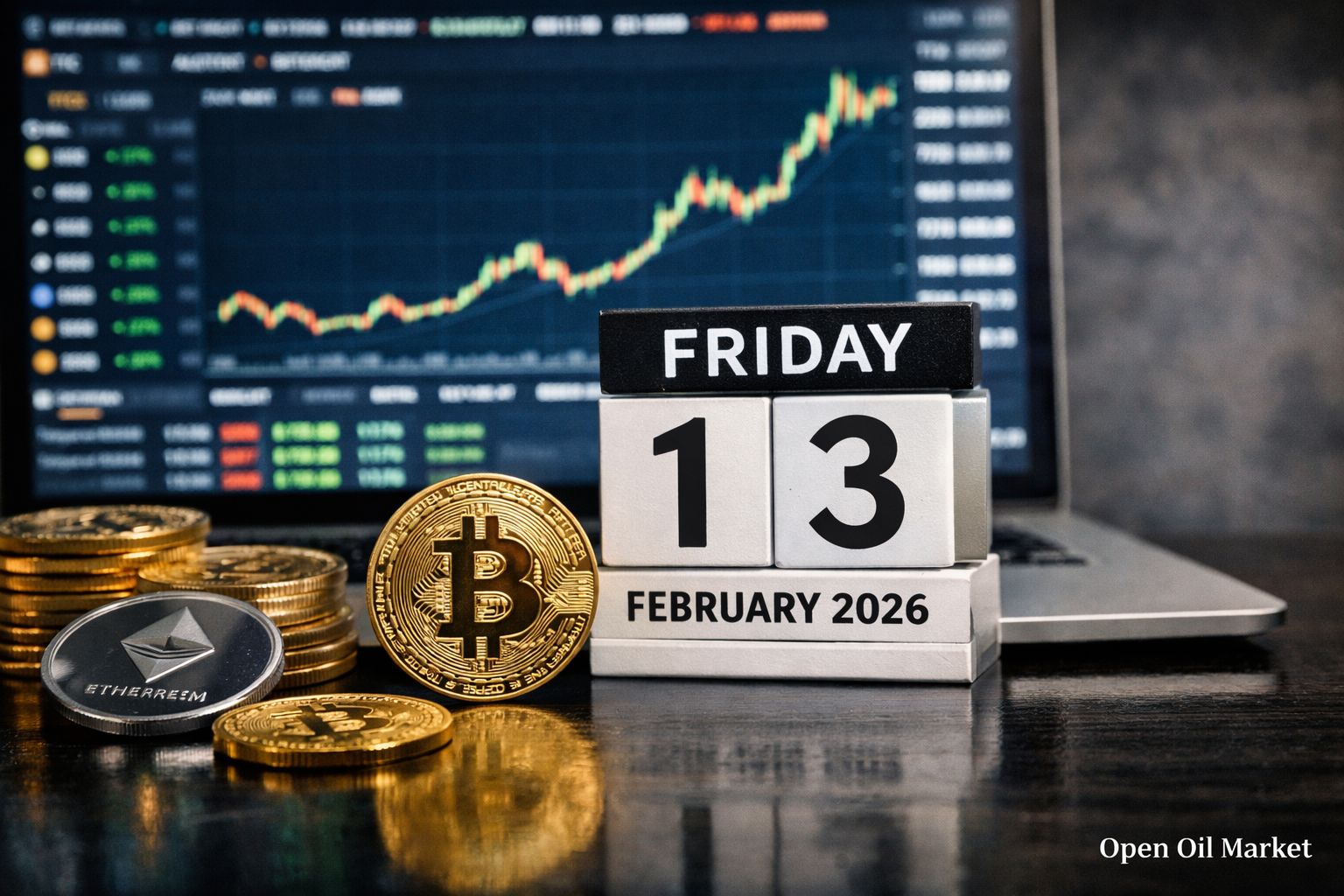
Current Cryptocurrency News for Friday, 13 February 2026: Bitcoin and Ethereum in the Spotlight, Rising Infrastructure Risks, the Impact of Regulation and Institutional Investors on the Global Crypto Market. Analysis of Liquidity and Volatility, Top 10 Cryptocurrencies.
The past few weeks have been marked by deleveraging: participants have been reducing margins in derivatives, tightening limits, and returning to liquidity controls. The macro backdrop has made the crypto market sensitive to expectations concerning financial conditions, thus shifts in sentiment on global platforms are quickly reflected in digital assets. The outcome is increased intraday amplitude and the spread of volatility from Bitcoin to altcoins. For long-term investors, this cryptocurrency news is primarily important as an indicator of the quality of settlements, market depth, and liquidity access during periods of stress.
- Liquidity. Thin order books increase the likelihood of sharp impulses, especially outside the US session.
- Leverage. As volatility accelerates, liquidations amplify price movements and degrade pricing quality.
- Segmentation. The most liquid instruments are concentrated around Bitcoin and Ethereum; some altcoins are "falling" deeper.
Key Topic of the Day
Infrastructure risk is once again "re-evaluated upwards." BlockFills announced a temporary pause on withdrawals and deposits, attributing the decision to market and financial conditions. At the same time, it was stated that positions in spot and derivatives can still be opened and closed. The timeline for normalising transfers remains unspecified at the time of writing.
In parallel, a case of erroneous asset allocation on one of the Asian exchanges demonstrated that an "accounting error" can rapidly become a stress event for trust: even if the blockchain level remains unbroken, the internal settlement circuit and risk checks become a critical point. The takeaway for investors is straightforward: risk shifts from charts to an operational plane, and the value of a "reliable counterparty" increases.
- Reliability premium is rising: the market differentiates not only between tokens but also the quality of platforms, custodians, and stablecoins.
- Risk of chain reaction is amplifying: withdrawal restrictions increase the likelihood of forced sales for margin.
- Communication is becoming a valuable asset: transparency regarding operation statuses and clear rules reduce the chances of panic.
Regulatory News
Cryptocurrency regulation is moving from broad frameworks to checked procedures. In the US, a clearer market structure for tokens and inter-agency coordination is under discussion, including work on taxonomy and regimes that will allow certain operations to occur "on-chain" while upholding obligations. In the EU, the implementation of MiCA is strengthening requirements for staff competencies and internal policies of crypto service providers — this elevates the market entry threshold but decreases the risk of misselling and enhances the comparability of standards throughout the region.
In Asia, supervisory discussions are increasingly focusing on the resilience of exchange infrastructure and internal controls, especially following notable operational incidents. For the global market, this means that cryptocurrency regulation will increasingly assess not "promises" but control procedures, event logs, and the quality of responses to emergencies.
- USA: movement towards a clearer framework for the digital assets market and a compatible taxonomy for tokens.
- EU: standardisation of competency and compliance requirements in line with MiCA.
- Asia: increasing focus on systemic risks at exchanges and the quality of internal controls.
Institutional Investments
In the institutional segment, a regime shift is evident: after several weeks of significant outflows from investment products related to digital assets, capital exit rates have slowed. This does not signify a trend reversal but rather a transition from panic-driven reductions to a more selective rebalancing. In this phase, block purchases are rare, yet demand for hedging and instruments with clearer legal frameworks is increasing. For investments in cryptocurrencies, this indicates a higher premium for infrastructure transparency.
Typical reactions from major players include:
- Reduction of net leverage and transfer of risk to options and structured hedges.
- Tightening of limits on counterparties, margins, and collateral conditions.
- Concentration of volumes in the most liquid pairs around Bitcoin and Ethereum.
Technological Updates
The technological layer of the blockchain is crucial as a foundation of trust: when markets are jittery, the stability of node software and network predictability become competitive advantages. This week saw the release of Bitcoin Core 29.3, featuring a set of fixes and stability enhancements — the market values such "routine" releases during stress periods.
In the Ethereum ecosystem, attention remains on scaling and reducing friction for Layer 2 solutions: the security of integrations and consistent data standards are vital. For some altcoins, the technological criterion is increasingly manifested in "operational maturity": the resilience of validator software and the network's ability to weather spikes in demand when both load and fees rise simultaneously.
- Bitcoin: stability of client software as an element of trust in the network.
- Ethereum: quality of scaling and security of ecosystem interconnections.
- Altcoins: focus on fault tolerance and operational maturity.
Analytics and Forecasts
The base scenario for the upcoming weeks hinges on three factors: (1) the speed of liquidity normalisation among intermediaries, (2) dynamics of forced liquidations in derivatives, and (3) how quickly regulators materialise statements into actionable rules. Following waves of liquidations, the market typically undergoes two phases: initially, a "cleaning" of leverage, followed by selective purchases of higher-quality assets. This supports heavyweights and amplifies divergence in dynamics within altcoins, particularly between infrastructure blockchain projects and speculative coins.
Three working scenarios for portfolio management:
- Stabilisation: amplitude decreases, infrastructure normalises.
- Repeated stress: new restrictions on intermediaries and pressure on credit products.
- Selective growth: demand shifts to projects with sustainable blockchain use and clear risk, as well as the most liquid base assets.
Risks and Recommendations
The main risk on Friday is the combination of market volatility with infrastructure constraints. This is an environment where the "right asset" may not compensate for the "inappropriate platform." Therefore, recommendations for investing in cryptocurrencies today primarily focus on the contours of risk and operational discipline. If investments in cryptocurrencies comprise a significant portion of the portfolio, scenario planning for unforeseen delays and restrictions on transfers becomes paramount.
- Diversify infrastructure: separate storage, trading, and lending across different providers.
- Reduce leverage: during stress phases, the probability of margin surprises and liquidations increases.
- Check withdrawal regimes: limits, timelines, compliance checks, and "plans B" in case of delays.
- Assess stablecoin risk: reserves, legal structures, and reporting transparency.
- Signals of deterioration: increase in reports of withdrawal freezes, settlement failures, widening spreads.
- Signals of improvement: recovery of intermediary operations and return of market depth.
Top 10 Most Popular Cryptocurrencies
Below is a guide to the largest and most liquid assets in the crypto market (without prices). The list serves as a navigation tool for investors worldwide: it helps correlate the roles of assets — from foundational networks to stablecoins and "cultural" coins — and aids in swiftly understanding how cryptocurrency news can differentially impact market segments.
| Name | Brief Description | Key Feature |
|---|---|---|
| Bitcoin (BTC) | The market flagship and foundational "reserve" asset of the industry. | A marker of sentiment and liquidity across the crypto segment. |
| Ethereum (ETH) | Smart contract platform for DeFi, tokenisation, and applications. | L2 ecosystem and strong network effects for developers. |
| Tether (USDT) | The largest dollar stablecoin for transactions and hedging. | High turnover and extensive exchange integration. |
| BNB (BNB) | Token of the BNB Chain ecosystem and associated services. | Utility role within the ecosystem (fees, applications). |
| XRP (XRP) | A token associated with payment and settlement scenarios. | High tradability and focus on cross-border cases. |
| USDC (USDC) | Dollar stablecoin with a compliance-focused approach. | Popularity in institutional and corporate scenarios. |
| Solana (SOL) | High-performance network for mass applications. | Emphasis on speed, scale, and ecosystem products. |
| TRON (TRX) | A network widely used for stablecoin transfers. | High transactional activity in payment flows. |
| Dogecoin (DOGE) | A "meme asset" with a large community and high recognisability. | Social demand dynamics and strong retail factor. |
| Bitcoin Cash (BCH) | A network historically aimed at more convenient payments. | Focus on transactional scenarios and practicality of transfers. |