Cryptocurrency News for Friday, 27 February 2026: Bitcoin Dynamics, ETF Impact, Altcoin Volatility and the Top 10 Most Popular Cryptocurrencies
The global cryptocurrency market is entering the end of the week with heightened sensitivity to macroeconomic indicators: upward impulses are more akin to technical bounces and short squeezes than to a sustained trend. For investors, this represents a typical phase of "re-evaluation of expectations": capital is not exiting the asset class entirely but is becoming more tactical, with shorter holding horizons. In practice, this is reflected in increased intraday volatility, uneven dynamics across sectors, and a growing role of derivatives.
What this means for your portfolio:
- Cryptocurrency news is interpreted through the lens of liquidity and risk appetite rather than the "stories" of individual tokens;
- Quality is paramount: prioritising liquid assets and clear catalysts (ETF/regulation/network upgrades);
- Altcoins react more strongly: both upwards during a "short squeeze" and downwards when risk-off sentiment increases.
Bitcoin: ETF Flows as the Main "Barometer" for Institutional Sentiments
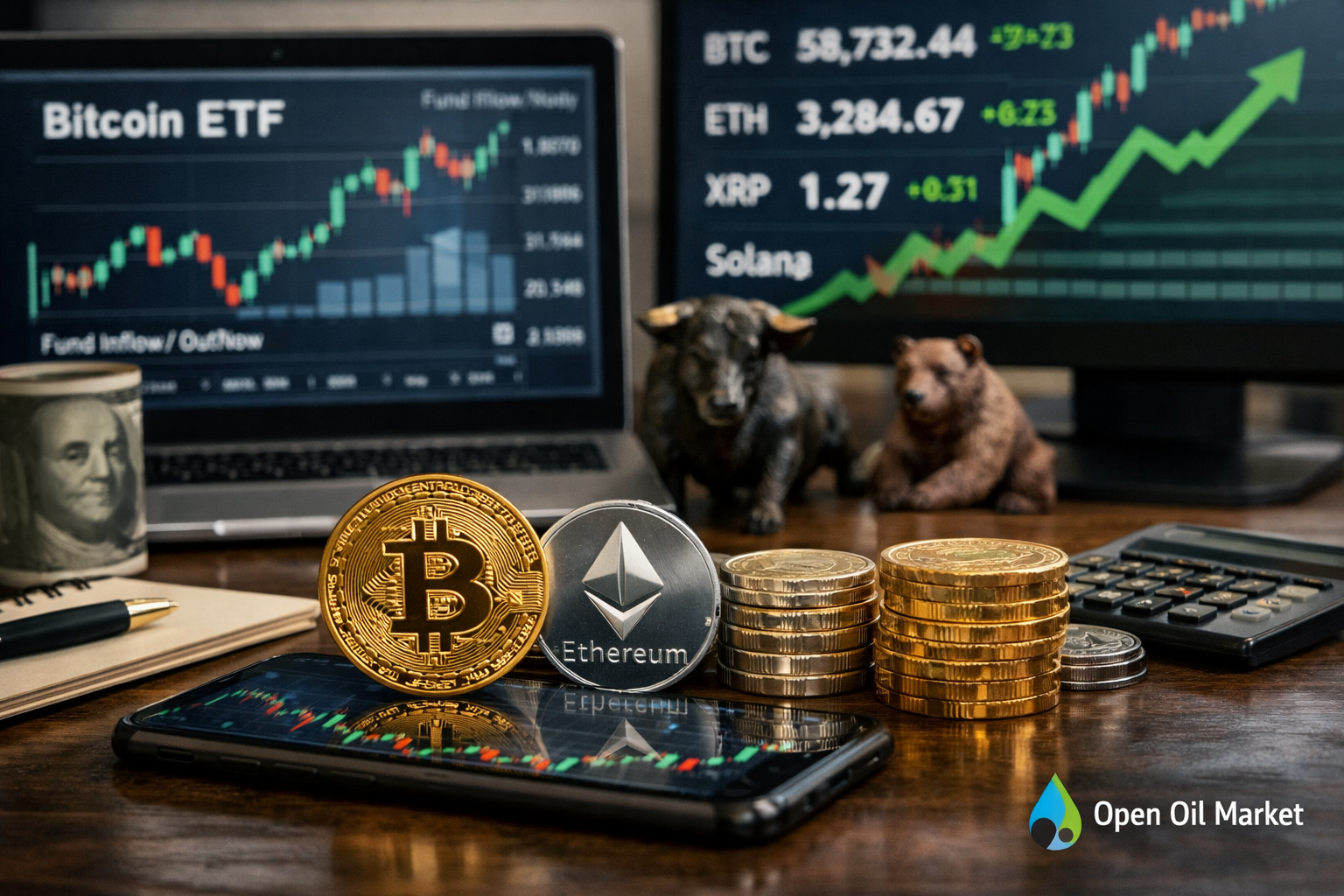
Bitcoin remains a magnet for liquidity: even when the dynamics appear to be "sideways", it is BTC that sets the pace for the entire cryptocurrency market. A key factor in 2026 is that a significant portion of demand/supply is traversing the infrastructure of exchange-traded products. Flows into spot ETFs effectively become a daily indicator: a series of outflows can quickly trigger sell-offs in the market; conversely, days with substantial inflows can indicate a return of risk appetite, albeit unevenly.
It is crucial for investors to monitor not the "noise" of headlines but rather three key metrics:
- Consistency of inflows/outflows (multiple weeks in succession are more significant than a single day);
- Price reaction to the flows (if inflows do not lead to price increases, the market is "heavy");
- Sentiment spreads between BTC and altcoins (if BTC remains stable while altcoins lag, the risk remains high).
Ethereum: Focus on Scaling and Security in the 2026 Roadmap
Ethereum continues to position itself as the foundational layer for financial applications and tokenisation, yet in 2026, investors are viewing ETH with pragmatism: scaling speed, quality of user experience, and protocol security are of primary concern. Developments within the roadmap and prioritisation of upgrades heighten expectations that the network will increase throughput and resilience—partly through raised limits, development of censorship-resistant mechanisms, and long-term preparations for post-quantum risks.
This signals important market implications: fundamental changes in Ethereum typically affect the entire L2, DeFi sector, and infrastructure tokens. In practical terms, this may indicate:
- Interest shifts towards ecosystem assets during stabilisation periods in the broader market;
- Increased competition among L2s for liquidity and users;
- A more stringent selection of projects: mere "narrative" no longer suffices; metrics are needed.
Altcoins: Rotation Occurs Through Liquidations and "Short" Movements Rather Than Long-Term Trends
Altcoins are demonstrating uneven movement as February draws to a close: portions of the market are buoyed by forced short position closures, while others remain under pressure due to declining risk appetite. For investors, this environment suggests that "good-looking" daily candles may arise from liquidations rather than fundamental demand. In such conditions, strict risk limits and disciplined rebalancing are especially vital.
Practical tactics for investors include:
- not confusing short squeezes with the onset of a sustainable growth cycle;
- differentiating the "core" (BTC/ETH) from "satellites" (altcoins) with distinct stop-loss rules and allocations;
- maintaining a liquidity reserve: in a volatile market, this serves as an option for opportunities.
Regulation and Compliance: Stablecoins Transition to "Payment Infrastructure" Mode
On a global scale, cryptocurrency regulation is becoming more application-oriented: the focus is shifting towards stablecoins, reserves, disclosures, and issuer requirements. This alters the risk structure for investors and businesses: on one hand, the "institutional suitability" of the market is increasing; on the other, the cost of compliance is rising, augmenting segmentation across jurisdictions.
Key consequences for the cryptocurrency market are:
- Stablecoins are becoming closer to traditional payment instruments—reducing the risk of "bank runs" within the crypto ecosystem;
- The role of regulated platforms and custodians is increasing;
- For DeFi, there is a heightened demand for transparent reserves and verifiable liquidity.
Institutional Investors: Interest Persists but Has Become More "Portfolio-Based"
A significant portion of demand for cryptocurrencies in 2026 is coming through institutional channels—rendering the market both deeper and more "capricious". Deeper because the infrastructure (ETFs, custodians, risk protocols) is developing, and capricious because decisions are made on a portfolio basis: if macro conditions worsen, crypto exposure is adjusted downward along with other risk assets; if liquidity improves, it is swiftly reallocated.
What this means for investors:
- Strong movements in BTC can occur "without news"—driven by flows and hedging;
- Correlations with equity indices periodically intensify;
- Growth of "quality" flows enhances long-term market resilience, even if short-term volatility exerts pressure.
Top 10 Most Popular Cryptocurrencies: Market Structure and Each Asset's Role
Below is a guideline for the "core" of the cryptocurrency market, which frequently serves as the foundation for global portfolios. The list reflects the most common set of the largest and most liquid assets; specific ranks may vary depending on the market cycle, but the logic of roles remains intact.
Top 10 (practical classification for investors)
- Bitcoin (BTC)—the basic risk benchmark, the "digital reserve" of the market.
- Ethereum (ETH)—the key platform for smart contracts and ecosystem asset in DeFi/L2.
- Tether (USDT)—the primary dollar stablecoin for trading liquidity.
- USD Coin (USDC)—a stablecoin with strong compliance profile and institutional usage.
- XRP (XRP)—an asset focused on payments and infrastructure scenarios.
- BNB (BNB)—an ecosystem token of a major exchange infrastructure and network services.
- Solana (SOL)—a high-performance network that often benefits during "altcoin rotation" phases.
- Cardano (ADA)—a smart contract platform focusing on formal approaches and sustainable development.
- Dogecoin (DOGE)—a high-beta asset sensitive to sentiment and liquidity.
- TRON (TRX)—a network widely used for stablecoin transactions and remittances.
Risks and Scenarios: What Investors Should Watch for as the Week Concludes
A key question for the upcoming sessions is whether the cryptocurrency market can solidify a recovery following sharp movements, or if volatility will remain "saw-like". In such a configuration, it is beneficial for investors to work scenario-wise rather than trying to speculate on a single outcome.
Base scenarios:
- Stabilisation: BTC holds its range, ETF flows stabilise, while altcoins progress selectively.
- Risk-off: deteriorating macro sentiments prompt renewed outflows, with altcoins declining more rapidly than the "core".
- Upward momentum: a series of inflows and short liquidations accelerate growth, but require stringent take-profit strategies.
Practical risk management: stagger your entries, secure some profits during rallies, maintain drawdown limits on the portfolio, and avoid overloading altcoins in periods of uncertainty. For long-term investors, 2026 increasingly appears to be a narrative centred on infrastructure (ETFs, regulation, protocol upgrades), rather than merely price "stories".