Cryptocurrency News as of 2 January 2026: Bitcoin Dynamics, Key Altcoins, Institutional Investments, Global Trends in the Crypto Market, and Prospects for Investors.
Global Trends in the Cryptocurrency Market
At the beginning of 2026, the cryptocurrency market continues to exhibit strong interest from both institutional and retail investors. New exchange-traded funds (ETFs) for Bitcoin and Ethereum have attracted record capital inflows, while traditional banks and payment systems are expanding their support for digital assets and stablecoins. The realms of decentralized finance (DeFi), NFTs, and Web3 applications are actively developing, stimulating the emergence of innovative projects.
- Approval of Bitcoin and Ethereum ETFs has drawn record levels of institutional investment.
- The traditional financial sector (banks, payment systems) is increasing support for cryptocurrencies and stablecoins.
- The active development of decentralized finance (DeFi), non-fungible tokens (NFTs), and Web3 applications is leading to the introduction of new projects.
Bitcoin: Record Levels and Risks
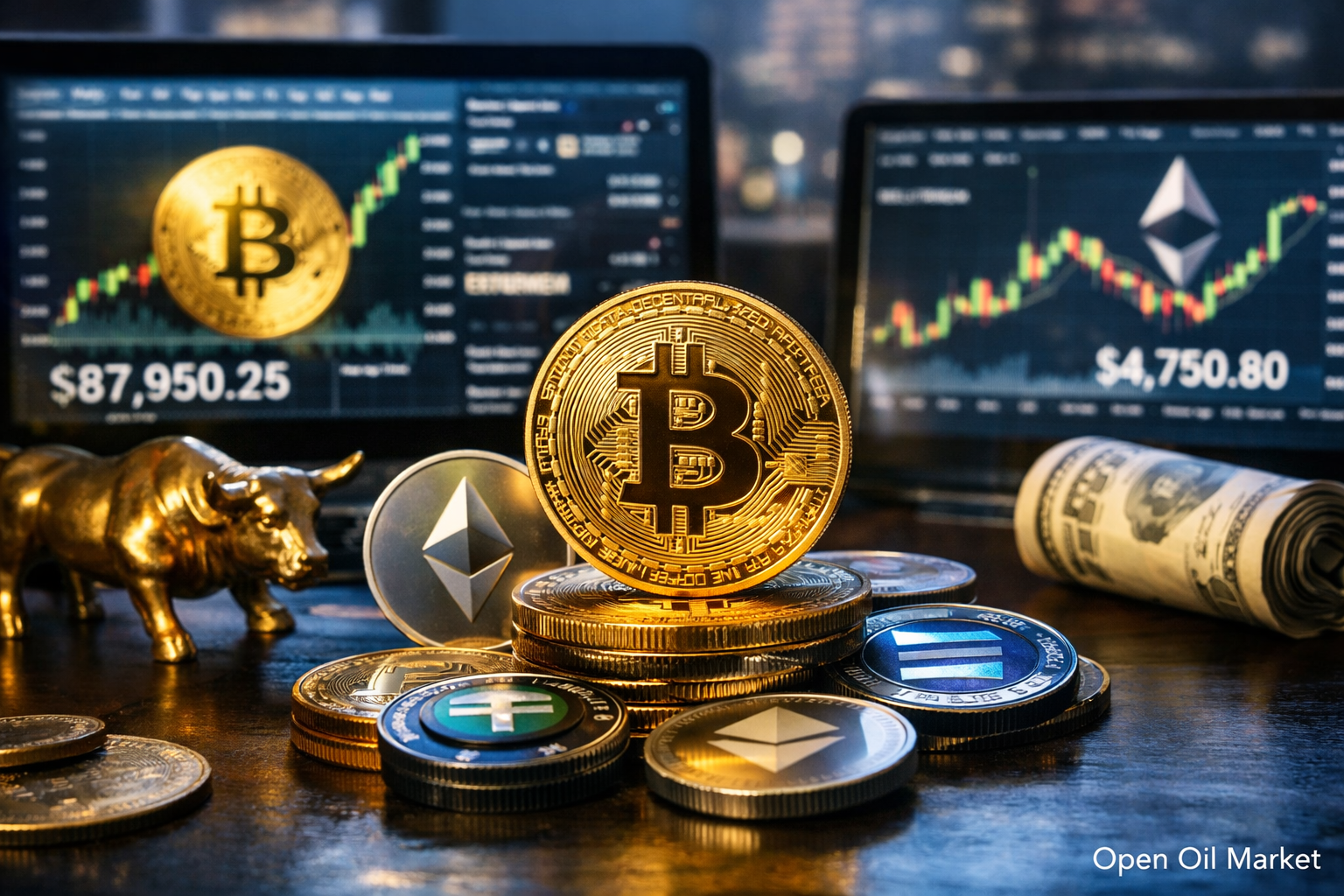
Bitcoin remains at historical highs, around $88,000. The limited supply of 21 million coins, growing institutional demand, and expectations of a monetary policy easing support its price growth. However, high volatility may lead to sharp corrections with shifts in market sentiment.
- Limited supply: only 21 million BTC, scarcity supports price growth.
- Institutional investments: large funds and corporations are actively increasing their positions in Bitcoin.
- Macroeconomics: expectations of lower interest rates encourage demand for risk assets, including cryptocurrencies.
- High volatility: despite growth, sharp pullbacks may occur due to changes in market conditions.
Ethereum: Opportunities and Challenges
Ethereum continues to be the second largest cryptocurrency by market capitalisation and the leading platform for smart contracts. The network's transition to an energy-efficient Proof-of-Stake model has reduced operational costs and allowed ETH holders to earn rewards through staking. Most DeFi and NFT applications are built on Ethereum, and the introduction of Ethereum ETFs is attracting additional capital. For further growth, scalability of the network and reduction of transaction fees remain critical.
- Transition to PoS: significantly reduced energy consumption of the network, creating opportunities for staking profits.
- Dominant status: the majority of DeFi and NFT applications are deployed on the Ethereum platform.
- Infrastructure development: raising capital through Ethereum ETFs and active work on Layer-2 solutions.
- High fees: still limit user activity, but technological improvements are being implemented.
Altcoins and DeFi: Main Trends
The dynamics of alternative cryptocurrencies remain mixed. Smart contract platforms such as BNB, Solana, and Cardano are expanding their ecosystems, attracting new developers. New blockchains (e.g., Solana, Avalanche) are appealing for their high transaction speeds and low fees. Stablecoins (USDT, USDC) provide stable market liquidity, while an increase in Total Value Locked (TVL) in DeFi protocols supports demand for native tokens. Memecoins (Dogecoin, Shiba Inu) retain popularity among communities, but their prices are extremely volatile.
- Smart contract platforms (BNB, Solana, Cardano, etc.) are strengthening their ecosystems by attracting developers.
- New blockchains (Solana, Avalanche, etc.) attract projects due to high transaction speeds and low fees.
- Stablecoins (USDT, USDC) play a central role, providing stable market liquidity.
- Decentralised finance (DeFi): growth in TVL supports demand for ecosystem tokens.
- Memecoins (Dogecoin, Shiba Inu) remain popular among communities, although their prices are highly volatile.
Regulation and Institutional Recognition
A legal framework for the crypto industry is being established worldwide. In the USA, spot ETFs for BTC and ETH have been approved, and new laws (e.g., the CLARITY Act) are being discussed to enhance market transparency. Europe has adopted the MiCA regulation, which establishes uniform rules for cryptocurrencies across the EU. In Asia, countries such as Japan, Singapore, and South Korea are creating a favourable infrastructure for cryptocurrency exchanges and services. Major financial organisations such as BlackRock, Fidelity, and JPMorgan are expanding their cryptocurrency products and services. Central banks (China, EU countries, etc.) are actively testing their own digital currencies.
- USA: approval of spot ETFs for Bitcoin and Ethereum, development of new regulations (the CLARITY Act).
- EU: the MiCA regulation establishes a unified framework for the crypto market in EU countries.
- Asia: Japan, Singapore, and South Korea are creating a favourable environment for cryptocurrency exchanges and services.
- Financial giants: BlackRock, Fidelity, JPMorgan are expanding their cryptocurrency products and services.
- Central banks and CBDCs: central banks are testing the issuance of digital currencies for their countries.
Top 10 Most Popular Cryptocurrencies
- Bitcoin (BTC) – the first and most capitalised cryptocurrency, often referred to as 'digital gold'.
- Ethereum (ETH) – the leading platform for smart contracts, the foundation for most DeFi and NFT applications.
- Tether (USDT) – the largest stablecoin, pegged to the US dollar, widely used in trading.
- Binance Coin (BNB) – the utility token of the Binance exchange, used for paying commissions on the platform and within the BNB Chain ecosystem.
- XRP (XRP) – cryptocurrency from Ripple for fast international payments.
- USD Coin (USDC) – a regulated dollar-pegged stablecoin, used for payments and in DeFi.
- Solana (SOL) – a high-performance blockchain for decentralised applications with low fees.
- TRON (TRX) – a platform for decentralised applications and digital content, known for its high throughput.
- Dogecoin (DOGE) – a 'meme coin' popular due to community support and celebrity endorsements, featuring high volatility.
- Cardano (ADA) – a blockchain with a scientific approach, focused on security and scalability of decentralised applications.
Forecast for 2026
Analysts believe that cryptocurrencies will continue to strengthen their role in the global economy in 2026. Integration of blockchain technologies with traditional finance, widespread adoption of tokenisation of real assets, and the emergence of innovative technological solutions are anticipated. Institutional support and clearer regulations will reduce uncertainty and facilitate further market growth. Key expectations for 2026 include:
- Market integration: crypto-assets are increasingly being incorporated into financial and payment systems;
- New sectors: active growth in tokenisation of real assets and the emergence of solutions for an AI-based economy;
- Regulation: transparent rules will broaden participation from institutional investors;
- Technologies: next-generation blockchains and Layer-2 solutions will lower fees and accelerate transactions;
- Portfolio diversification: investors will balance their investments between major cryptocurrencies and promising altcoins.