Cryptocurrency News for 17 March 2026: Bitcoin, Ethereum, and Major Cryptocurrencies Market Analysis, Institutional Demand, Stablecoins, and the Top 10 Digital Assets
The cryptocurrency market approaches trading on Tuesday, 17 March 2026, in a more constructive state than it was a week prior. The main focus for investors continues to be the resurgence of institutional demand for digital assets: Bitcoin reaffirms its status as the market's key benchmark, Ethereum garners additional attention amid an expanded range of exchange products, while major altcoins gradually return to the radar of capital. Against this backdrop, cryptocurrencies are once again perceived not just as a speculative segment, but as part of a broader financial infrastructure related to stablecoins, tokenization, and global liquidity flows.
For global investors, not only is the mere fact of growing interest in cryptocurrencies significant, but also how the structure of this demand is changing. In previous cycles, the market was primarily driven by retail participants, whereas now ETFs, regulated platforms, custodial solutions, and large corporate players are becoming increasingly prominent. This is why the cryptocurrency news for 17 March 2026 should be viewed not as a collection of disparate reports, but as part of a deeper transformation of the digital financial market.
Bitcoin Again Sets the Tone for the Entire Crypto Market
Bitcoin remains the primary barometer of sentiment in the digital asset market. At the start of a new week, investors again focus on whether BTC can solidify its recovery following a volatile start to March. This is fundamentally important for the market: a strong Bitcoin not only supports the sector’s capitalisation but also lays the groundwork for a shift in interest towards Ethereum, Solana, XRP, and other prominent altcoins.
From a market logic standpoint, the current phase appears to be a transition from a defensive behaviour model to a more selective risk appetite. This indicates that investors are now not just evaluating Bitcoin as digital gold, but are also using it as an indicator of their readiness to increase positions in the broader crypto segment. Should this trend persist, BTC will remain the key driver of cryptocurrency news on Tuesday.
Institutional Demand and ETFs Again Become Central Factors
One of the most important narratives in recent days has been the renewed inflow of capital through exchange-traded crypto products. For the global market, this is a sign of maturity: digital assets are increasingly being included in portfolios through familiar channels for institutional investors. This format of participation lowers entry barriers, simplifies compliance, and enhances trust among major market participants.
From an investment perspective, this reshapes the very structure of the crypto market. A significant portion of demand is now generated not by impulsive retail trading, but by more systematic allocations. For investors, this means:
- Bitcoin and Ethereum are acquiring a more stable demand base;
- Market liquidity is becoming deeper;
- Reactions to macroeconomic events increasingly resemble the behaviour of traditional asset classes;
- Cryptocurrencies are becoming more actively integrated into the global capital distribution system.
This is why cryptocurrency news in March 2026 cannot be analysed in isolation from ETFs, the stock market, and major asset management firms. It is no longer a peripheral market, but a segment tightly connected to global investment flows.
Ethereum Strengthens its Position as an Infrastructure Asset
Ethereum remains the second most significant cryptocurrency and simultaneously the primary infrastructure asset of the digital economy. On 17 March, it is important not only to observe the dynamics of ETH itself but also to note the changing perceptions of the Ethereum network among institutional investors. Growing interest in staking, tokenization, and infrastructural solutions enhances the perception of Ethereum as a foundation for long-term financial applications.
If Bitcoin is viewed as the primary macro asset of the crypto market, Ethereum is increasingly regarded as the technological and financial foundation of the sector. For investors, this implies that ETH remains a crucial asset in strategies focused on:
- Tokenization of real assets;
- Development of DeFi infrastructure;
- Staking and yield models within blockchain ecosystems;
- Institutional implementation of smart contracts.
In the short term, Ethereum might benefit from the overall market recovery; however, in the medium term, its investment narrative is increasingly centred on its infrastructural value rather than solely speculative demand.
Stablecoins Transition from Supportive Segment to Strategic Theme
Stablecoins are becoming one of the most important themes in the global cryptocurrency market. Not long ago, they were primarily viewed as trading infrastructure for exchanges, but their role has noticeably expanded. USDT, USDC, and other major stablecoins are increasingly utilized in cross-border transactions, corporate transfers, settlement models, and new forms of digital payments.
For investors, this signals a significant shift: cryptocurrencies are no longer viewed as merely a market of volatile assets. A second layer of the industry is increasingly forming — one focused on payments and infrastructure. This could very well become the next major growth phase for the sector.
Key takeaways on stablecoins for 17 March 2026:
- Stablecoins are becoming a bridge between traditional finance and blockchain;
- Regulation in this area will directly influence future market leaders;
- The increase in stablecoin turnover enhances the resilience of the entire crypto economy;
- The success of ecosystems increasingly depends not only on the token itself but also on the quality of payment infrastructure.
Regulation Takes Centre Stage and Reshapes the Market Competitive Landscape
Cryptocurrency regulation in 2026 no longer seems like a distant topic. For the global market, it is a current and practical factor affecting the valuation of assets, exchanges, issuers, and stablecoin platforms. The spotlight remains on European MiCA regulations, the UK’s approach to stablecoins, and overarching efforts of major jurisdictions to integrate digital assets into the formal financial system.
For investors, this means that future winners will not solely be the most technologically advanced projects, but also those able to operate within stringent compliance conditions. The market is gradually splitting into two groups:
- Major regulated platforms and assets with stable access to institutional capital;
- Higher-risk segments with limited access to banking and financial infrastructure.
This shift is particularly crucial for assessing the long-term prospects of major cryptocurrencies. Regulatory resilience is becoming a factor that can sustain capitalisation as effectively as technological innovations or short-term market hype.
Tokenisation of Real Assets Becomes a New Growth Point
One of the most significant trends of 2026 remains the tokenisation of traditional financial instruments. The interest in 24/7 trading models, shortening settlement cycles, and the digital representation of stocks, bonds, and other assets positions blockchain as part of the broader modernization of the global financial architecture.
For the crypto market, this is particularly important for two reasons. Firstly, the topic of tokenisation extends the applicability of blockchain far beyond traditional cryptocurrencies. Secondly, it enhances the significance of infrastructural networks, primarily Ethereum and several other ecosystems vying to establish themselves as foundational layers for digital finance.
Investors should note that tokenisation is no longer an abstract concept, but a theme that is increasingly permeating the strategies of exchanges, asset management firms, and infrastructure providers. This is why cryptocurrencies today are assessed not just as a separate market but as a technological foundation for the future financial system.
Top 10 Most Popular Cryptocurrencies: What the Market is Watching
For the majority of global investors, the largest market segment remains the key reference. The top assets define overall risk appetite, liquidity and capital distribution. At this stage, the following largest and most talked-about cryptocurrencies are in the spotlight:
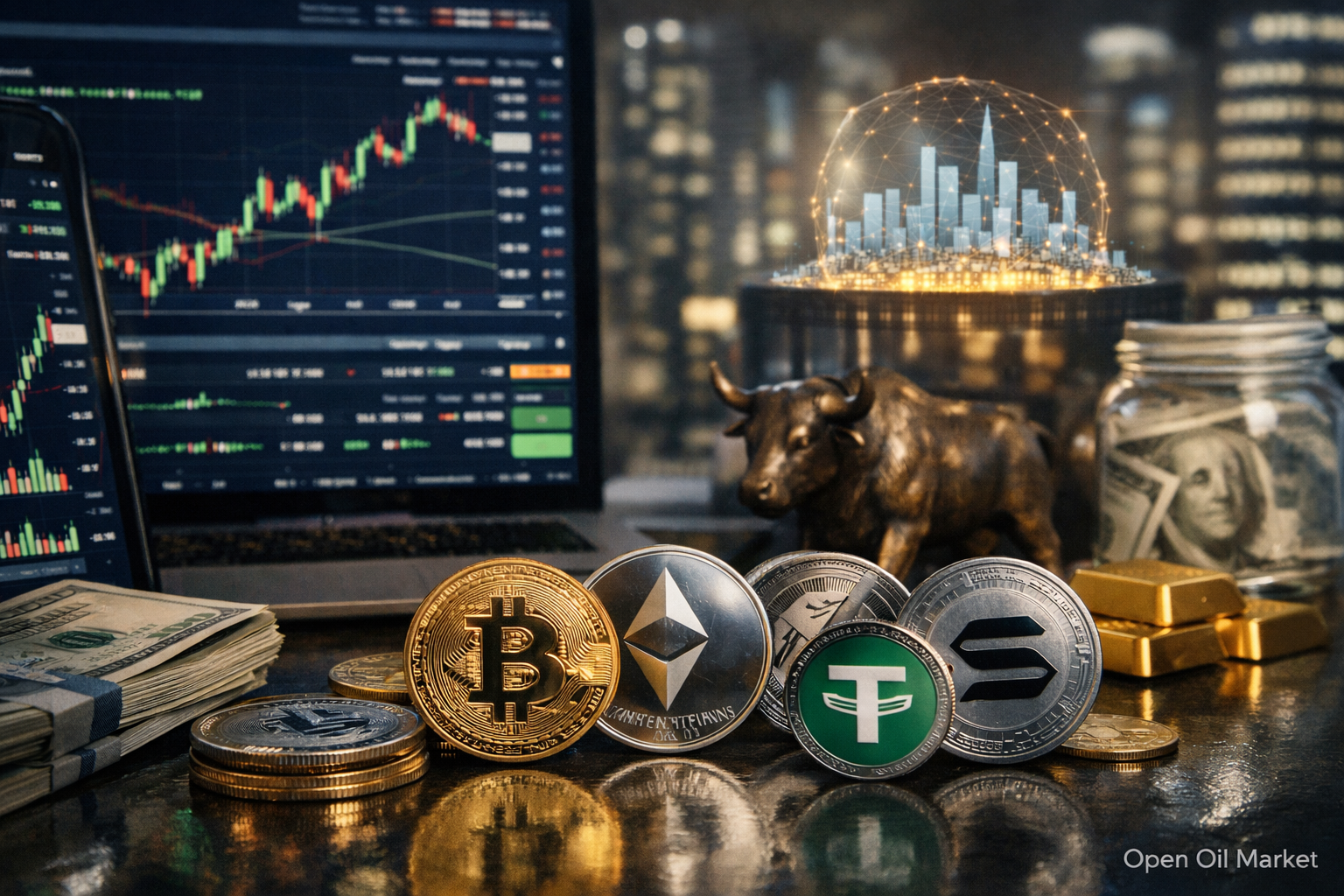
- Bitcoin (BTC) — the key macro asset of the crypto market and the primary benchmark for institutional capital;
- Ethereum (ETH) — the foundational infrastructure for smart contracts, DeFi and tokenisation;
- Tether (USDT) — the largest stablecoin, critically important for market liquidity;
- XRP — an asset closely watched in the context of international payments and regulation;
- BNB — an important element of one of the largest global crypto ecosystems;
- USDC — a stablecoin with growing institutional significance;
- Solana (SOL) — a key representative of high-performance blockchain platforms;
- TRON (TRX) — a notable player in the stablecoin turnover and payment infrastructure;
- Dogecoin (DOGE) — an asset that retains mass recognition and high retail engagement;
- Cardano (ADA) — a project that continues to capture investor attention as a major alternative blockchain ecosystem.
For investors, not only the list itself is significant, but also the fact that various investment narratives are currently forming within it: Bitcoin as a macro asset, Ethereum as infrastructure, stablecoins as a payment layer, and Solana and XRP as bets on alternative growth scenarios for ecosystems and international calculations.
What This Means for Investors on Tuesday, 17 March
The key takeaway for global investors is that the cryptocurrency market is once again becoming multi-layered. The growth or stabilisation of Bitcoin is important, but it is no longer sufficient for a comprehensive analysis. Today, it is necessary to monitor four levels concurrently:
- The dynamics of BTC as the primary market indicator;
- The state of Ethereum and infrastructural ecosystems;
- The evolution of stablecoins and the payment layer;
- Regulatory signals and institutional products.
If a constructive backdrop is maintained in the coming sessions, the market may shift from a defensive phase towards a more comprehensive recovery, where not only Bitcoin and Ethereum but also the largest liquid altcoins will benefit. However, investors must remain mindful of the high sensitivity of cryptocurrencies to macroeconomic conditions, monetary policy, and geopolitical events.
What to Pay Attention to in the Coming Day
Cryptocurrency news on Tuesday, 17 March 2026, sets several key benchmarks for the market. Firstly, institutional demand remains the main factor ensuring the sector's resilience. Secondly, Ethereum and stablecoins are increasingly enhancing their investment significance. Thirdly, regulation and tokenisation are gradually restructuring the very architecture of the digital market.
In the coming day, investors should pay particular attention to whether momentum in Bitcoin persists, whether interest in the major top-10 altcoins expands, and whether the focus continues to shift towards infrastructure themes — ETFs, staking, stablecoins, and tokenisation. These directions are currently defining what the next phase of the global cryptocurrency market will look like.