Global Oil, Gas, and Energy Market News - 17 March 2026: Hormuz, Risk Premiums, and the Restructuring of Global Energy Balances
As of 17 March 2026, the global fuel and energy complex is entering a phase of heightened turbulence. The main topic for investors, oil companies, gas traders, refineries, and participants in the commodities market is the consequences of disruptions through the Strait of Hormuz and their impact on oil, gas, petroleum products, coal, LNG, and electricity. The oil market remains extremely sensitive to any signals regarding physical deliveries, while energy sectors in various regions of the world are increasingly responding not only to commodity prices but also to logistics, fuel availability, and the resilience of energy systems.
For the global energy market, this signifies a shift from discussions about a soft balance of supply and demand to a more rigid agenda: where barrels will be lost, how quickly supplies can be adjusted, which refineries will face shortages of raw materials, what will happen to diesel and jet fuel, and who stands to benefit from increasing volatility in oil, gas, and energy. For investors and fuel companies, not only the price level of oil and gas matters, but also the market structure: spreads, premiums on petroleum products, refinery capacity utilisation, generation profitability, and the redistribution of LNG flows between Europe and Asia.
Oil: The Market Operates on a Logic of Supply Shortage and High Geopolitical Premiums
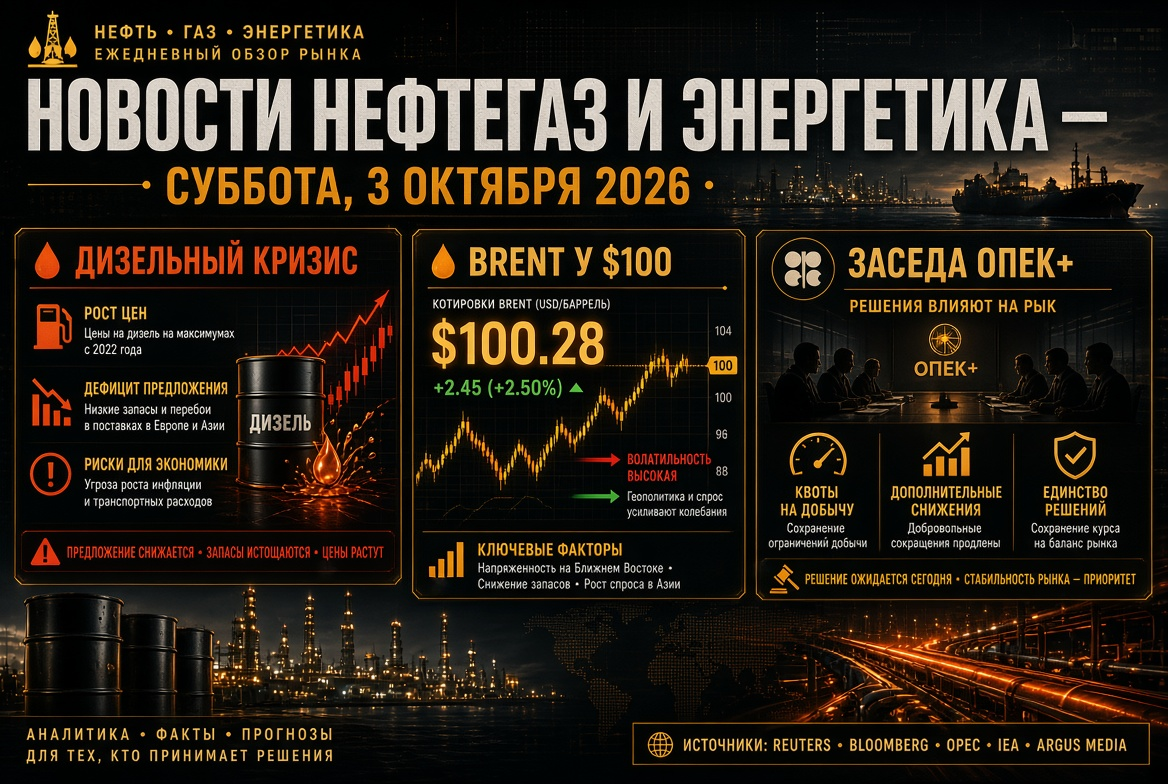
In the oil sector, the key factor for tomorrow is not the rate of demand growth, but the actual availability of crude oil in the global market. Brent crude is experiencing high volatility as traders assess the magnitude of supply losses in the Middle East, the potential duration of disruptions, and the ability of alternative routes to partially offset the lost volumes.
Three circumstances are currently critical for the oil market:
- A portion of Middle Eastern production and exports remains under pressure due to logistical constraints and security risks;
- Investment banks and commodity analysts are revising their forecasts for Brent upwards, bolstering expectations for higher oil prices in the second quarter;
- Even with a partial recovery in shipping, the market has already factored in a persistent risk premium for oil, gas, and petroleum products.
For oil companies, this means an improvement in the short-term price environment for the upstream segment, while simultaneously increasing pressure on refining, trading flows, and downstream margins. For the global oil and gas sector, this marks a crucial turning point: the market is once again trading not only on fundamental balances but also on the stability of the entire supply system.
OPEC+, Strategic Reserves, and the New Balance of Supply
The next question for the energy market is how quickly the lost volumes can be compensated. Formally, some producers retain spare capacity; however, the physical implementation of these capabilities depends on export logistics, the availability of free routes, and the condition of terminals. This is particularly critical for countries whose oil and petroleum products traditionally rely on narrow transport corridors.
In this context, the importance of coordination between exporters and consumers is growing. International mechanisms have already shifted towards mitigating shocks through strategic reserves, which temporarily reduces the risk of panic in the oil and petroleum markets. Yet, investors need to understand: strategic reserves can alleviate the peak tension but cannot replace stable exports over an extended period.
- If disruptions are short-lived, the oil market may have an opportunity for a partial correction downward.
- If restrictions persist, the risk premium on oil will remain longer, and prices will stay structurally higher than previous expectations.
- If additional export nodes are affected, the market will transition from a state of tension to one of pronounced physical scarcity.
For participants in the oil and gas market, this means that on 17 March, attention will be fixed not only on OPEC+ statements but also on any signs of recovery in maritime logistics, terminal utilisation rates, and inventory dynamics.
Gas and LNG: Asia Intensifies Competition for Molecules, Europe Loses Comfortable Balance
The gas and LNG markets have emerged as the second major topic after oil. The redistribution of liquefied natural gas flows is already intensifying competition between Europe and Asia. While the European market historically relied on relatively stable LNG imports, Asian buyers are now proactively securing cargoes, with certain shipments changing destination en route.
This creates several implications for global gas:
- Asian LNG prices are receiving additional support;
- Europe faces the risk of increased prices for new gas supplies ahead of the next injection cycle;
- Importing countries are forced to compete more aggressively for spot LNG, which exacerbates price volatility throughout the system.
In the medium to long term, this enhances the strategic value of new LNG projects, including export capacities outside Middle Eastern routes. For oil and gas investors, this is an important signal: natural gas and LNG are once again perceived not only as transitional fuels but also as elements of energy security.
Refineries and Petroleum Products: Diesel, Jet Fuel, and Export Restrictions Come to the Fore
The most painful aspect of the current shock is not so much crude oil, but rather petroleum products. The refining and fuel supply segment now appears to be the most vulnerable. For refineries, the rising costs of raw materials are compounded by supply instability, while for end consumers, this translates into risks of price spikes for diesel, jet fuel, and certain industrial fuels.
The situation in the global petroleum products market is evolving as follows:
- Some refining capacities in the Persian Gulf are already operating under restrictions or at reduced utilisation;
- Asian refining margins have surged, particularly for diesel and aviation fuel;
- Some countries have begun restricting fuel exports to protect the domestic market;
- Major Asian refiners are reducing throughput due to more challenging access to Middle Eastern crude.
For energy market participants, this means that oil price indicators alone are insufficient for assessing the situation. Key indicators now include diesel spreads, refinery capacity utilisation, the existence of export quotas, the state of maritime logistics, and the availability of middle distillates. It is the petroleum products that currently pose the greatest risk to inflation, transportation, agriculture, industry, and energy generation sectors.
Electricity, Renewables, Coal, and Nuclear: Energy Systems Return to Reliability Focus
The electricity sector is reacting to events more swiftly than might be apparent. As gas and petroleum products rise in price, countries with high import dependence begin to strengthen their reliance on coal, nuclear generation, and domestic energy sources. In practice, this means that even with ongoing growth in renewables, the priority in the coming weeks becomes energy supply reliability.
Several trends are already visible in the energy sector:
- Some Asian countries are prepared to temporarily increase output from coal and nuclear plants;
- The discussion regarding the role of renewables is shifting from deployment rates to the quality of integration into the grid, predictability of generation, and balancing costs;
- There is greater focus on network infrastructure and system flexibility as demand for electricity continues to grow globally.
Renewables remain a crucial structural trend in global energy; however, the current market conditions indicate that solar and wind generation is only effective when combined with strong grids, storage technologies, gas flexibility, nuclear capacity, or backup thermal generation. For investors, this means that not only pure renewable energy producers will succeed but also companies involved in networks, storage, systems integration, and reliable baseload generation.
Regional Landscape: Asia, Europe, and the USA Enter Different Phases of the Same Energy Shock
Asia currently appears most sensitive to the LNG, petroleum product, and coal markets. For China, India, South Korea, Japan, and Southeast Asian countries, the level of prices is crucial, but so is the physical availability of fuel. Europe is more focused on whether it can maintain a stable gas balance and avoid a repeat spike in prices for diesel and electricity. The USA appears comparatively stable due to its own oil and gas production, but the influence of the global price premium on the domestic fuel and energy markets is becoming increasingly evident.
Globally, the energy market is entering a phase where regional differences are set to intensify. Some economies will benefit from energy resource exports and high prices for oil, gas, coal, and petroleum products, while others will face rising import costs, a reassessment of fuel balances, and additional inflationary pressures.
Implications for Investors, Oil Companies, and Energy Market Participants
As of 17 March 2026, the fundamental takeaway for the oil and gas and energy market appears as follows: the sector remains investment strong, yet a rapid divergence is emerging between the winning and losing segments within it.
- Upstream companies, LNG suppliers, coal exporters, selected trading houses, and refineries with access to alternative raw materials may find themselves in a favourable position.
- Import-dependent economies, the aviation sector, logistics, some petrochemicals, and refiners lacking a flexible raw material basket remain under pressure.
- In electricity generation, there is a growing interest in networks, storage, nuclear generation, and projects that enhance system reliability.
For fuel companies, oil companies, refineries, and investors, the main priority now is not an abstract forecast for Brent prices but the monitoring of logistics, raw material availability, petroleum product premiums, gas balances, and the state of electricity systems in key regions worldwide.
Conclusion
News from the oil, gas, and energy sectors on Tuesday, 17 March 2026, centres around one central idea: the global energy sector is transitioning into a more stringent risk management regime. Oil, gas, LNG, coal, electricity, renewables, petroleum products, and refineries are now more closely interconnected through logistics, inventories, and political decisions. For the global audience of investors and market participants, this signifies that the energy sector is once again becoming not just a cyclical narrative but a key indicator of global economic resilience and international trade.