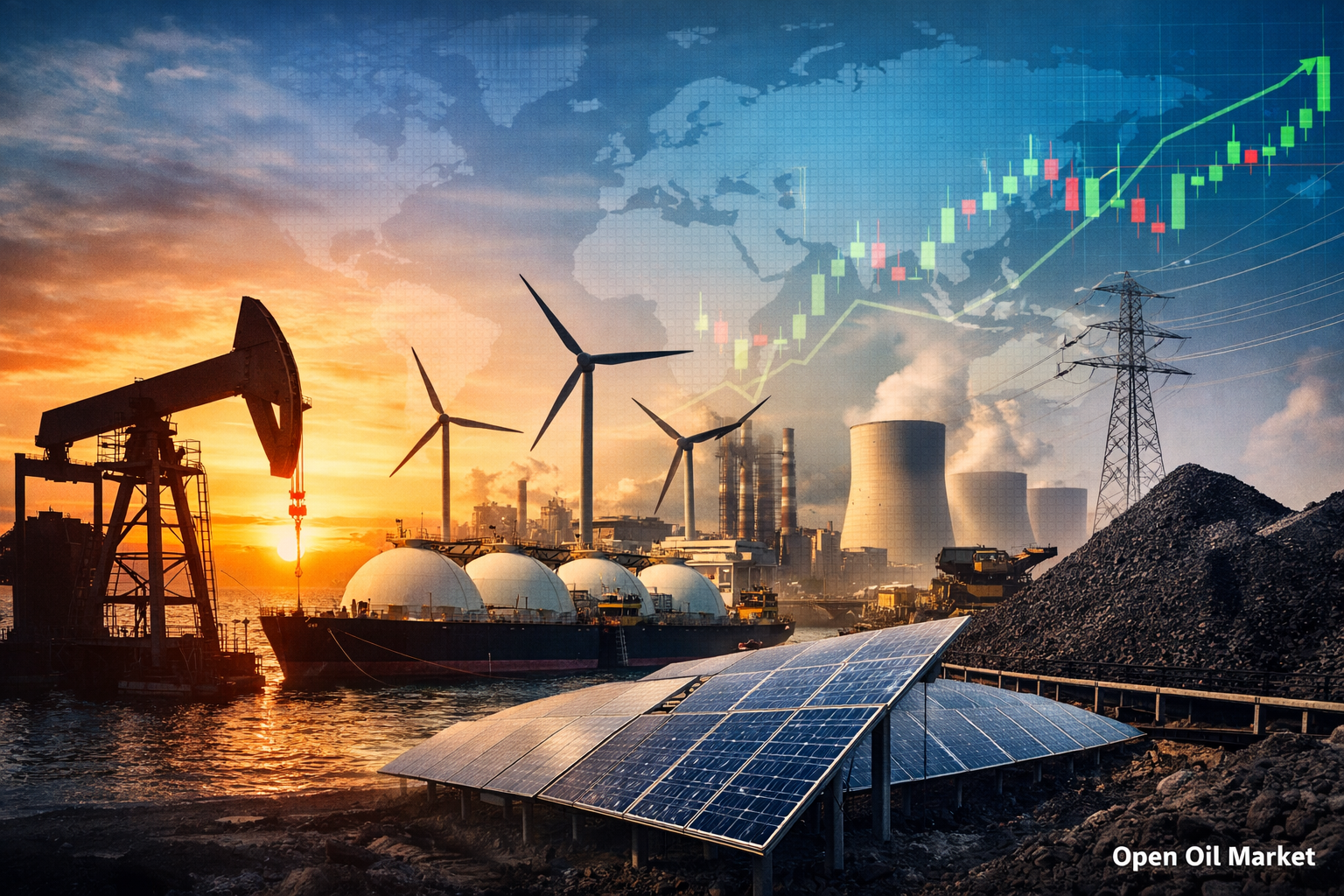
Current Global News from the Oil, Gas, and Energy Sector as of 24 December 2025: Oil, Gas, Electricity, Renewables, Coal, Refining, and Key Trends in the Global Energy Market.
On the diplomatic front, negotiations to resolve the protracted conflict in Eastern Europe continue without specific results. The stringent sanctions regime in the energy sector remains unchanged.
The global oil market continues to face pressure from excessive supply and weakened demand. Prices for the benchmark Brent crude are hovering around $60 per barrel, reaching their lowest levels since approximately 2021. This indicates a surplus of raw materials in the market. The European gas market is demonstrating relative resilience: even during peak winter consumption, gas storage in the EU is approximately 67% full, virtually eliminating the risk of shortages. Stable liquefied natural gas (LNG) supplies and alternative pipeline fuels are keeping prices at moderate levels, significantly lower than the peaks of 2022, thus alleviating the burden on consumers.
Meanwhile, the global energy transition is gaining momentum. Many countries are setting new records for electricity generation from renewable sources (RES), although traditional coal and gas-fired power plants still play a crucial role in ensuring the reliability of energy systems. Below is a detailed overview of the key news and trends in the oil, gas, electricity, and raw material sectors as of this date.
Oil Prices and OPEC+ Strategy
The oil market is experiencing downward pressure on prices: Brent crude is trading around $60 per barrel, while WTI is approximately $55. These are the lowest levels in almost four years. The main reasons for this price decline include:
- Increased Supply. OPEC+ countries have ramped up production by millions of barrels per day, creating a surplus of raw materials and additional pressure on prices.
- Hope for Peace. Progress in negotiating the resolution of the conflict has created expectations for the easing of sanctions and the return of Russian oil to the market, further applying downward pressure on prices.
- OPEC+ Policy. After months of increasing production, members of the agreement have decided to halt any further increases in supply in Q1 2026 to prevent oversupply. At their December meeting, the alliance agreed only on a symbolic increase in quotas (+137 thousand barrels/day). Major exporters are prepared to cut back on their production again if prices fall below acceptable levels.
These factors contribute to a moderate surplus in the global oil market. Even geopolitical incidents and new restrictions are only causing short-term price fluctuations without changing the overall downward trend. Market participants are awaiting fresh signals—both from diplomatic efforts and from OPEC+ actions—that could alter the risk balance for oil prices.
Natural Gas and LNG Market
Europe has entered the winter season with relative confidence: gas storages in the EU are more than two-thirds full at maximum, significantly reducing the likelihood of shortages even during peak demand periods. Moreover, record LNG supplies have compensated for the loss of Russian pipeline gas. As a result, gas prices have stabilised at levels significantly lower than the crisis peaks of 2022, which considerably eases expenses for consumers.
- Record LNG Imports. In 2025, Europe imported approximately 284 billion cubic meters of liquefied gas—a historic high. The key supplier has been the USA (accounting for nearly 60% of the volume).
- Withdrawal from Russian Gas. The EU aims to completely halt the purchase of Russian gas by 2027. Starting from early 2026, a ban on purchasing Russian LNG on the spot market will come into effect, forcing EU countries to shift entirely to alternative supply sources.
Globally, the demand for natural gas remains stable, primarily owing to Asian countries. At the same time, competition among exporters is intensifying: countries in the Middle East and North Africa are actively investing in new LNG projects, hoping to capture a share of the growing market. Concurrently, the increased gas exports from the USA and Australia create a supply surplus, keeping global prices within moderate bounds.
Renewable Energy: Record Growth
The year 2025 has seen unprecedented growth in "green" energy. According to industry reports, the capacities of solar and wind power plants installed in the first half of 2025 increased by more than 60% compared to the same period the previous year, and for the first time, electricity generation from RES exceeded generation from coal-fired plants (based on a half-year calculation). However, even this record growth is insufficient to meet long-term climate goals—further investments and upgrades to electrical grids are necessary.
Coal Sector: Peak Demand
Global coal consumption in 2025 reached a record volume (growth of approximately 0.5%). A prolonged plateau in consumption is forecast, followed by a gradual decline toward 2030. Coal remains the largest source of electricity, but its share is beginning to decrease due to competition from alternative sources.
The regional dynamics of coal demand varies. In China, the largest consumer (over 50% of global volume), coal usage in 2025 has stabilised; a gradual decline is expected by the end of the decade as RES capacities are installed. In India, thanks to a record hydropower output, a reduction in coal burning has been noted for the first time in many years, while in the USA, a slight increase in coal usage is observed amid expensive gas and extended operations of coal-fired power plants.
Oil Products and Refining: High Margins
By the end of 2025, the oil products market is demonstrating high profitability for refineries (refining margins). Global oil refining margins (the so-called crack spreads) have soared to multi-year highs. Reasons for this include sanctions that have reduced oil product exports from Russia; the shutdown of several major refineries in Europe and the USA for maintenance; and delays in bringing new refining capacities online in the Middle East and Africa. Particularly high profitability is noted in the European diesel market: diesel refining margins in Europe have risen to levels unseen since 2023.
In response, refiners are striving to capitalise on the favourable market conditions. Major oil companies report a sharp increase in refining profitability due to expensive gasoline and diesel. Estimates indicate that European refineries increased oil refining by several hundred thousand barrels per day in the second half of 2025. Analysts warn that without the introduction of new capacities, fuel shortages may persist, and high margins may continue into 2026.
Geopolitics and Sanctions: Market Impact
Geopolitical factors continue to significantly influence global commodity markets. Sanction restrictions in the oil and gas sector remain stringent and strictly enforced. In December, the USA intercepted a tanker carrying oil off the coast of Venezuela and intensified pressure on the "shadow fleet" transporting Iranian oil. Despite the prohibitions, Iran's exports in 2025 reached a multi-year high, primarily due to supplies to Asia. Russian oil and oil products have been entirely reoriented towards alternative markets (China, India, the Middle East); however, price caps and the EU embargo continue to reduce industry revenues. Furthermore, starting from early 2026, the EU is implementing a ban on the import of Russian LNG, effectively completing Europe’s energy separation from Russia.
Against this backdrop, market participants are factoring in heightened political risks and price premiums. Any signals of easing sanctions or diplomatic progress significantly impact the market. Meanwhile, companies are adapting to the new conditions—diversifying logistics and sales channels.
Investment and Projects: A Forward Perspective
Despite volatility, significant investments continue to flow into the energy sector, both in traditional oil and gas operations and in "green" energy. Middle Eastern countries are expanding oil and gas production (for instance, ADNOC has raised approximately $11 billion to boost gas output), while leading exporters such as Qatar and the USA are increasing LNG export capacities. At the same time, global corporations are investing in building new solar and wind power plants, as well as in promising technologies, including hydrogen energy and energy storage systems. A wave of new mergers and acquisitions and the launch of large projects are expected in 2026 in both traditional segments and the RES sector.