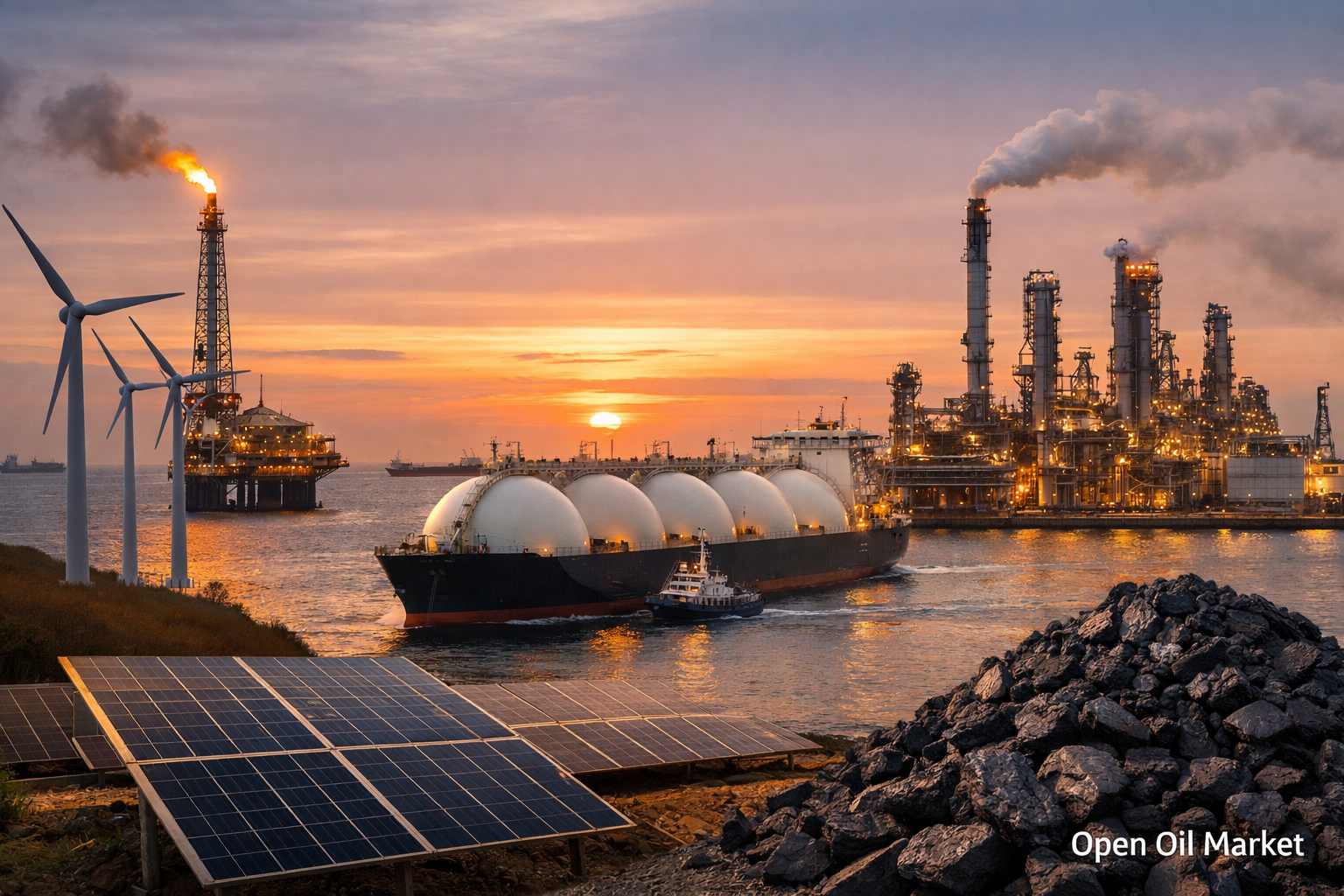
Global Oil and Gas News and Energy Update - 8 March 2026: Market Analysis for Oil, Gas, LNG, Refineries, Electricity, and Renewables for Investors and Stakeholders in the Global Energy Sector
Oil Market: Brent Receives Strong Geopolitical Support
The oil market faces a heightened level of nervousness as it approaches Sunday. At present, the global oil market is influenced less by traditional cyclical factors of supply and demand, and more by the risk of actual supply disruptions from a region that accounts for a significant proportion of worldwide crude and refined product exports.
The rise in oil prices at the beginning of March indicates that traders are prepared to factor in a scenario of prolonged logistical constraints. Even a moderate deterioration in transport accessibility on Middle Eastern routes can quickly amplify the risk premium, given that excess capacity within the global system is unevenly distributed and rapidly replacing large export volumes proves challenging.
- the oil market is increasingly less responsive to formal signals from OPEC+ and more reactive to the safety of physical exports;
- suppliers and buyers are factoring in rises in insurance, freight, and operating costs;
- for oil companies and traders, the importance of flexible routes, inventories, and a diversified contract base is growing.
For investors in the energy sector, this suggests that oil is receiving short-term support, with volatility likely to remain high even in the absence of new formal sanctions. For refined product manufacturers and refinery owners, this also signifies a need to reassess pricing expectations for crude and finished products.
OPEC+ and Production: Formal Supply Increases Fail to Resolve Market Issues
The additional production volume agreed upon by OPEC+ is being perceived by the market more as a symbolic stabiliser than as a credible balancing tool under current circumstances. The reason is clear: if geopolitical risks impact transport routes, export terminals, refining, and shipping, even an increase in quotas on paper does not guarantee physical market saturation.
Hence, participants in the raw materials sector are now evaluating not just the level of production, but also three practical questions:
- can the produced crude be quickly brought to external markets;
- how resilient is the export infrastructure;
- are importers able to swiftly adjust their procurement routes.
In this context, oil and gas, as well as energy, are reverting to the classical logic of a crisis cycle: the real value lies not only in the volume of production but in the reliability of supply. This enhances the significance of large integrated companies with their own logistics, terminals, refining operations, and export channels.
Gas and LNG: Global Market Shifts to Cautious Scarcity
At the beginning of March, the gas and LNG markets appear even more sensitive than oil. While oil remains a relatively interchangeable commodity, infrastructural constraints for gas, particularly LNG, are much tighter. Disruptions in supply from Qatar and increased risks in key transportation routes immediately impact Europe and Asia, where importers are forced to compete for limited quantities.
For Europe, the situation is particularly precarious as the injection season for storage facilities has only just begun, and initial stock levels are weaker than usual. This heightens the likelihood that gas prices will remain elevated for longer than the market anticipated at the year’s outset.
- European buyers are facing more expensive restocking of strategic gas reserves;
- Asian countries are compelled to actively seek alternative LNG sources;
- the freight rates for gas carriers and logistics significantly intensify pressure on final fuel prices.
For oil and gas companies and investors, this indicates that gas and LNG are becoming the primary channels for transmitting Middle Eastern crisis impacts into the electricity sector, industry, and public utilities. The longer the tension persists, the greater the likelihood of demand reassessment, a transition of part of generation to coal and refined products, as well as additional inflationary pressure.
Refineries and Refined Products: Diesel, Jet Fuel, and Refining Margins Back in Focus
A separate focus for the global energy sector is refining. The market for refined products is responding to the crisis more rapidly than many upstream segments. It is already evident that the refining margin for middle distillates is rising faster than oil prices. This is especially important for diesel, gas oil, and jet kerosene, as these products are more sensitive to logistical disruptions and regional shortages than others.
For refineries, the current situation could present both an opportunity and a risk. The opportunity lies in the increase in refining margins. The risk involves rising raw material costs, supply instability, and potential export restrictions on finished products.
- Asian and Middle Eastern refineries are under maximum pressure from logistics;
- the European refined products market remains vulnerable regarding diesel;
- the aviation segment is receiving an additional inflationary impulse due to rising kerosene prices.
For market participants in refined products and traders, this means that the coming weeks could be characterised by enhanced profitability among efficient refineries, whilst simultaneously experiencing high price volatility across the fuel supply chain.
Electricity: Expensive Gas Enhances Importance of Flexible Generation and Networks
The rise in gas prices is quickly transferring its impact to the electricity sector. For power plants in Europe and parts of Asia, this signifies increased production costs and new questions regarding the resilience of energy systems. In such an environment, countries and companies with a diversified energy balance—comprising a mix of gas, coal, nuclear generation, hydropower, and renewables—will come out on top.
At the same time, the role of electrical network infrastructure is becoming more critical. Even with the rapid incorporation of solar and wind capacities, reliable power supply cannot be ensured without modernising networks and storage systems. Thus, the current crisis paradoxically supports not only the traditional energy sector but also accelerates investments in new types of electricity generation infrastructure.
- gas generation remains critically important for balancing;
- investments in networks are becoming a key area for capital expenditures;
- energy security is again prioritised alongside decarbonisation efforts.
Renewables: The Energy Transition Continues, Shifting Its Rationale
The renewables sector in 2026 is developing not only under the banner of climate policy but also as a component of energy security. Solar and wind generation continue to expand in Europe, the UK, and China, while significant infrastructural developments in networks affirm that the world is not steering away from a long-term energy transition, even as oil and gas regain media prominence.
It is crucial for energy investors to note that the structure of arguments has shifted. Whereas renewables were previously viewed primarily as investments in ESG and emissions reduction, they now also represent a means to decrease dependence on imported gas, expensive fuels, and external shocks. In this context, integrated models encompassing generation, networks, storage, and digital demand management are favoured over individual projects.
Coal: A Backup Resource Regains Its Significance
Despite the long-term trend towards decarbonisation, coal retains its role as a hedge fuel during periods of gas shortages. For some Asian markets, coal remains the most accessible alternative to expensive LNG. However, the global coal market no longer experiences an unqualified growth sentiment: demand has become more volatile, and maritime trade is gradually approaching a plateau.
Nevertheless, in a stress scenario, coal will continue to serve as a buffer for energy systems, especially where gas generation or LNG imports cannot be rapidly increased. This indicates that investors should not entirely exclude the coal sector from their assessments of the short-term resilience of electricity supply.
What This Means for Investors and Energy Companies
As of 8 March 2026, the global energy sector is navigating two trajectories simultaneously. The first is crisis-driven: oil, gas, LNG, refineries, and refined products are all receiving a significant impetus from geopolitical considerations, logistics, and impending shortages. The second is strategic: electricity, renewables, and network projects are gaining equal importance as they contribute to the long-term resilience of energy systems.
For the global market, the following conclusions are particularly pertinent:
- oil and gas remain the primary indicators of geopolitical risk;
- LNG has become the most vulnerable segment in the global energy landscape for the short term;
- refineries and the refined products market are entering a new wave of volatility and margin growth;
- electricity and network assets are increasing in strategic value;
- renewables are strengthening their positions not in opposition to the crisis, but largely because of it.
Hence, the oil and gas news and energy developments on 8 March 2026 should be interpreted not as a collection of isolated incidents, but as a signal of a new cycle in the global realignment of energy balances. For companies, investors, and stakeholders in the raw materials sector, this is a period where supply chain resilience, infrastructure quality, and the ability to adapt rapidly take precedence over merely betting on price direction.