The Global Startup and Venture Capital Market as of 9 March 2026 Demonstrates Record Capital Concentration in AI, Mega-Rounds, Infrastructure Technologies, and Major Deals for Funds and Investors
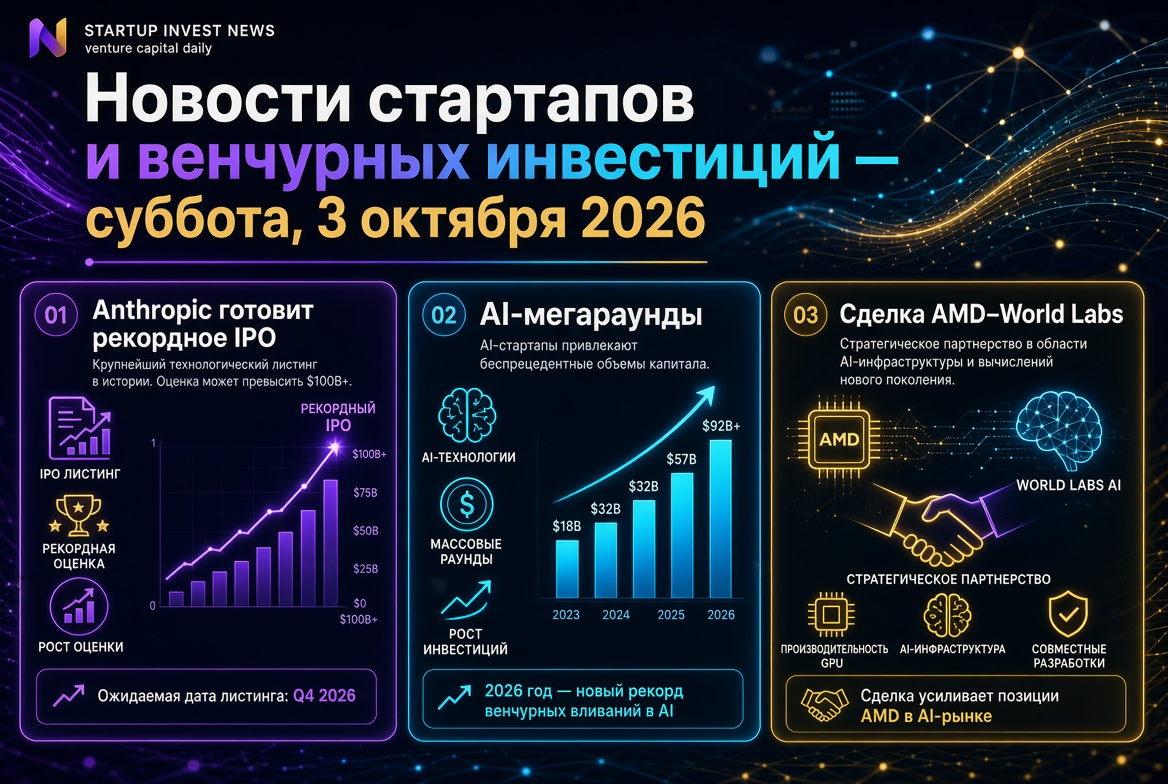
As the new week begins, the global startup and venture capital market enters a phase of sharp capital concentration. Following a few subdued years, the venture market is once again demonstrating the ability to close the largest deals in history; however, this growth is unevenly distributed. The primary flow of funds is directed towards artificial intelligence, AI infrastructure, defence technologies, autonomous transport, semiconductors, and platform companies capable of scaling globally at speed.
For venture capitalists and funds, this signifies a crucial shift. The market no longer resembles a broad upward cycle across all segments simultaneously. Instead, capital is concentrating in a narrow set of themes where technological leadership, strategic significance, and infrastructure scarcity converge. This is why there is a keen focus on mega-rounds, new mega-funds, AI chips, agentic AI, defence tech, and deep-tech projects that can claim dominance within their verticals.
Today's Key Trend: AI has Become the Centre of the Global Venture Market
The central theme at the beginning of March is the unprecedented role of AI in the distribution of global venture capital. Artificial intelligence has ceased to be merely a rapidly growing sector and has evolved into the primary mechanism for reallocating funds across the entire market. For funds, this is no longer a separate bet on technology, but a new foundational logic for portfolio construction.
Against this backdrop, several processes are particularly noteworthy:
- Significant growth in interest towards AI infrastructure and computing platforms;
- A shift from investments in models to investments in applied and agentic systems;
- Increased demand for hardware startups creating alternatives to dominant AI chip suppliers;
- Acceleration of deals in adjacent segments — robotics, autonomy, enterprise software, defence tech.
For the startup market, this creates a new hierarchy: the best companies gain access to a record volume of capital, while the rest of the ecosystem is forced to compete for investor attention under much harsher conditions.
Record February Altered the Landscape of the Venture Market
February 2026 was a pivotal month for the global startup and venture capital market. The volume of financing hit a record high, yet the main storyline was not merely the total amount but the extreme concentration of capital in a few large deals. This serves as an important signal for funds: the market is growing, but it is doing so through a very limited number of winners.
The most significant takeaways for investors are:
- The largest AI companies continue to attract an inconceivably larger volume of funds than all other segments;
- The US reinforces its dominance in venture capital, claiming the major share of global rounds;
- Early-stage companies remain resilient but lose attention to later and strategic deals;
- The IPO window remains unstable, hence private capital continues to play a decisive role.
Therefore, the article for 9 March should be read not as a list of individual news stories but as a map of the new architecture of the venture market: AI occupies the centre, infrastructure becomes the new premium, and access to major rounds increasingly depends on a startup's ability to demonstrate strategic indispensability.
Mega-Funds are Making a Comeback and Pushing the Market Upwards
The return of large funds is once again newsworthy for the entire market. After a period of caution, investors are re-forming large pools of capital to compete in the race for AI, defence tech, and deep tech. This increases the likelihood of new mega-rounds and intensifies competition among the largest funds for access to a limited number of quality assets.
The activity of Andreessen Horowitz remains particularly significant for the market. The scale of new funds confirms that the largest players are not waiting for market stabilisation, but are already positioning themselves for the next investment cycle. For startups, this is a positive signal, but only for teams working in substantial technological themes and capable of justifying a global market.
Major Deals at the Start of March: From Defence Tech to AI Software
The agenda of recent days demonstrates that funds are being allocated not just to foundational models, but also to more applied segments. Defence tech, orchestration software, autonomous transport, and AI semiconductors continue to secure large checks.
The most notable directions of the week include:
- Defence Tech. Interest in Anduril affirms that defence technologies have become one of the most capital-intensive and rapidly growing themes in the market.
- Agentic AI and Enterprise Orchestration. The round for Temporal indicates that investors are willing to pay high valuations for the infrastructure that will support AI agents and corporate automation processes.
- Vertical AI. The case of Basis reflects sustained demand for applied AI companies embedded in specific business functions, including finance and accounting.
- Autonomy. The Oxa deal suggests that autonomous systems are increasingly being commercialised not only in robotaxi but also in logistics, airports, warehouses, and industrial zones.
For venture funds, this indicates that the market is once again rewarding not abstract AI narratives, but teams with clear implementation economics, contractual growth logic, and understandable infrastructural advantages.
AI Infrastructure and Semiconductors are Becoming a Distinct Investment Class
Another fundamental trend is the transformation of AI infrastructure into a distinct hub for venture and strategic capital. Demand for inference, data centre capacity, photonics, networking, and computing platforms is expanding the pool of winners. While previously the lion's share of attention was directed at model developers, capital is now increasingly flowing into companies that are constructing the "bricks" of the new AI cycle.
On the market, several key bets are already evident:
- AI chips and alternative architectures;
- Platforms for inference and orchestration;
- Hardware-software combinations for enterprise implementation;
- European and Asian deep-tech players capable of occupying a niche in the global supply chain.
Against this backdrop, deals surrounding SambaNova and Axelera AI appear particularly indicative. Investors are increasingly seeking projects that can become not just startups but strategic components of the AI infrastructure for the next decade.
The Geography of Capital is Changing, but the US Maintains Overwhelming Leadership
Although the global startup and venture capital market remains international, the distribution of capital in 2026 is becoming even more asymmetric. The US is solidifying its status as the main centre for mega-rounds, AI companies, and stock preparation. Europe retains strong positions in AI chips, cybersecurity, and autonomy, while Asia is bolstering state-supported technological initiatives, especially in China.
For the global investor, it is currently essential to consider three levels of competition:
- Competition among startups for capital;
- Competition among funds for access to the best assets;
- Competition among governments for technological platforms, supply chains, and talent pools.
This is precisely why news from China regarding its new technological direction, priorities in AI, robotics, and industrial deployment holds significance not only for the local market but also for global venture strategies. Capital is increasingly following industrial policy rather than merely revenue growth.
The IPO Window Remains Selective, but Public Offerings are Back on the Agenda
Despite the high activity in the private market, investors remain vigilant regarding the liquidity window. The situation regarding IPOs is still uneven: some companies are postponing listings due to volatility, while others are testing demand, especially in biotech and technological niches, where the market is prepared to pay for quality assets and a coherent growth narrative.
This is a crucial moment for the venture market. Even if the classic IPO window has not fully opened, the mere fact that discussions about public offerings are re-emerging is boosting investor sentiment and increasing funds' willingness to participate in late-stage rounds.
What This Means for Venture Funds and Investors as of 9 March 2026
At present, the startup and venture capital market appears robust but uneven. This is not a classic recovery where all segments grow simultaneously. This is a market of high concentration, where companies operating at the intersection of AI, infrastructure, industrial application, defence technologies, and enterprise automation fare best.
Investors should pay attention to the following insights:
- AI remains the primary beneficiary of capital and dictates the logic of startup valuation worldwide;
- Mega-rounds sustain the overall market volume but disguise a harsh selectivity at other stages;
- Hardware, semiconductors, robotics, and autonomy receive a structural premium;
- Mega-funds are once again setting the pace and raising expectations for new large deals;
- Startups that possess not only technology but also a position in critical future infrastructure will triumph.
Consequently, as of Monday, 9 March 2026, the global venture market can be encapsulated in one formula: capital has returned, but access to it is becoming increasingly elite. For funds, this is a market of great opportunities, while for startups, it is a market where mere growth is no longer sufficient. Scale, strategic significance, and a compelling path to leadership are essential.