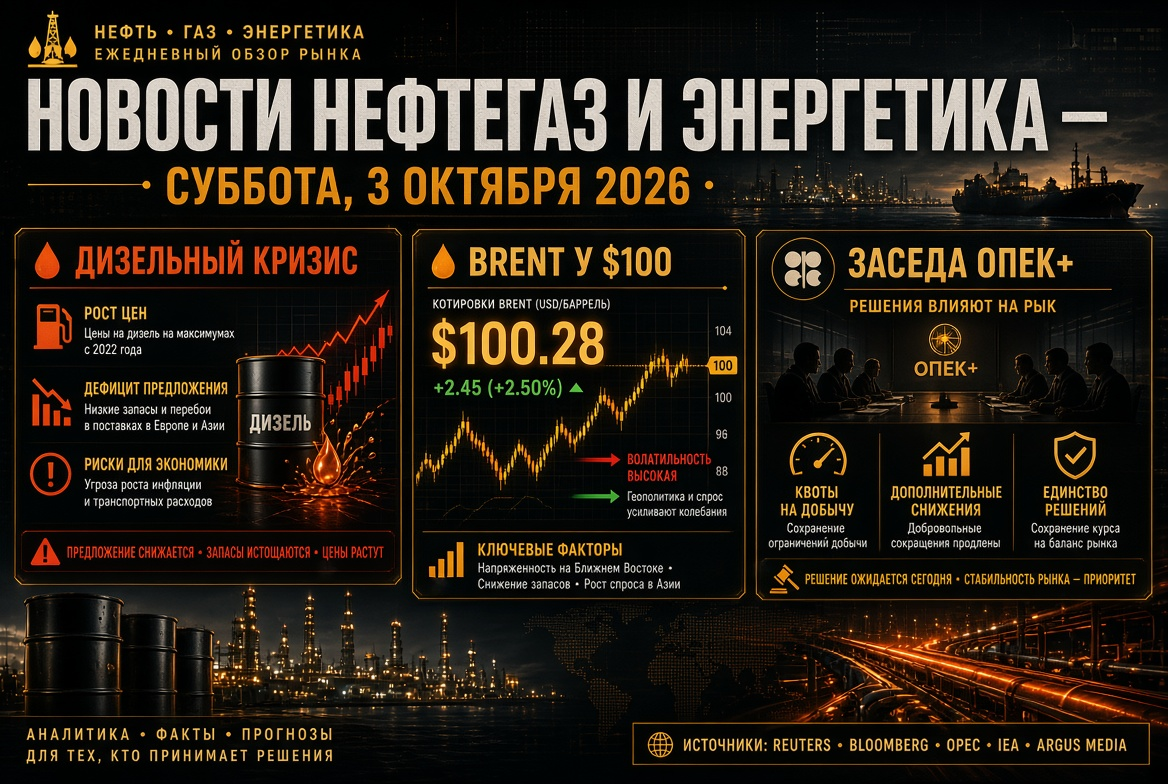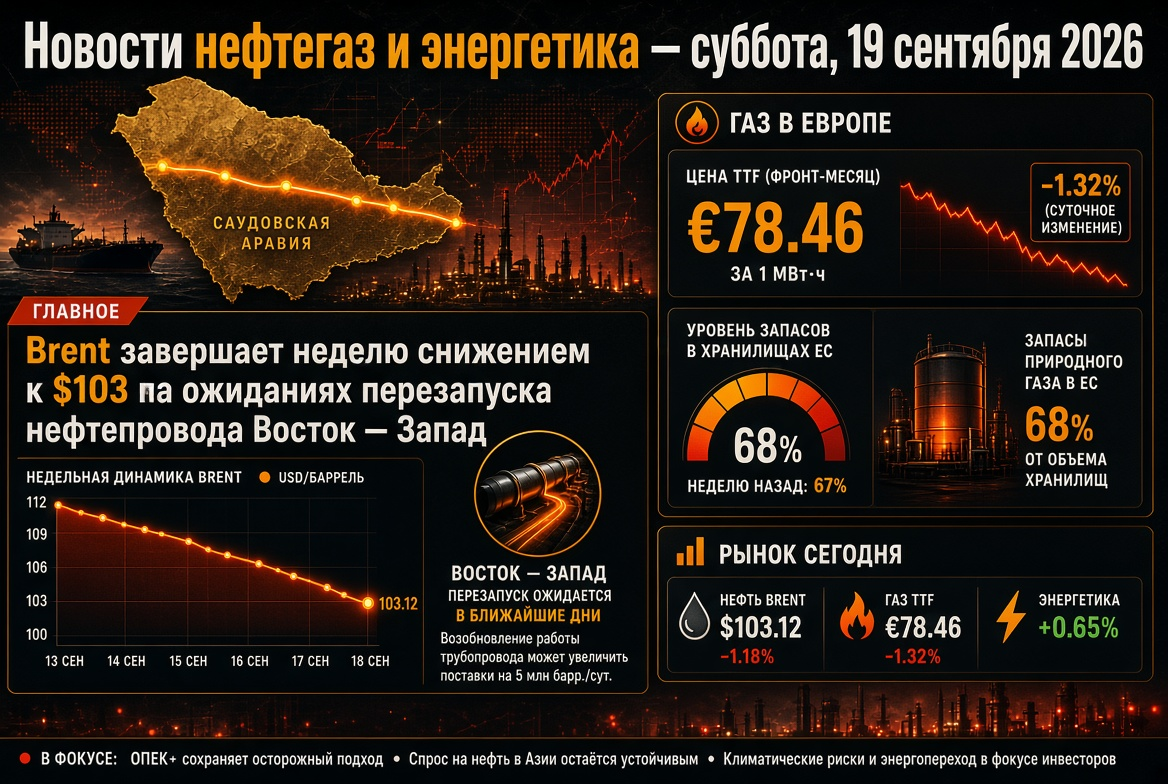
Global Oil, Gas and Energy News as of March 15, 2026: Brent Oil Prices Surpass $100, Global Gas Market Tensions, LNG Market Developments, Oil Products and Electricity Situations, and Key Trends Analysis for Investors and Energy Companies.
The global fuel and energy complex enters mid-March amidst heightened volatility. For investors, oil companies, gas traders, electricity market participants, refineries, and oil product manufacturers, the key theme remains the sharp rise in geopolitical risk premiums in oil and gas. The oil market has settled above the psychologically significant level of $100 per barrel, the European gas market is facing low stock levels ahead of the injection season, and refining and electricity sectors are urgently adapting to a new risk structure. Against this backdrop, the energy sector is increasingly divided into two contours: traditional hydrocarbons are once again becoming the cornerstone of short-term stability, while renewable energy sources (RES), grids, and storage retain strategic investment appeal.
For the global market, this signifies a shift in focus. While earlier in the year the main questions revolved around demand growth and the OPEC+ strategy, attention has now shifted to the physical availability of raw materials, logistics resilience, the state of export corridors, refinery profitability, and the capability of energy systems to cover peak loads without price shocks for consumers.
Oil Market: Risk Premiums Define Barrel Prices Once Again
The primary development in the global oil and gas sector is the significant resurgence of geopolitics in price formation. The oil market in March is influenced more by issues of physical raw material and oil product availability than by demand expectations. For sector participants, this indicates a return to a mode where even modest supply disruptions quickly lead to price spikes.
- Brent oil remains above $100 per barrel, sharply increasing inflation risks for the global economy.
- Export flows through the Middle East and maritime logistics resilience are centre-stage.
- For oil companies, rising prices bolster cash flow, but also intensify political pressure on producers.
The oil market remains extremely sensitive to news flow. Even a potential supply expansion from certain countries does not alleviate tensions, as market participants factor not only current shortages into prices but also the risk of prolonged supply disruptions. For investors in oil, oil products, and companies within the oil and gas sector, this represents an environment marked by high returns, but also significant price turbulence.
OPEC+, IEA and Strategic Reserves: Market Transitioning from Forecasting to Crisis Management
An important turning point in March is that market stabilisation mechanisms are now engaged. Coordinated oil releases from strategic reserves indicate that major energy consumers recognise that tensions in the energy sector have transcended ordinary market corrections. While this mitigates some panic, it does not eliminate the underlying problem—risks to physical supply remain greater than the volume of immediate compensation.
- OPEC+ continues to play a vital role in supply management, but its influence is temporarily overshadowed by logistical and geopolitical constraints.
- Strategic reserves help to cushion price shocks but do not replace steady exports from key producing regions.
- For the global energy sector, this signals that in 2026, the oil balance will be determined not only by production levels but also by transport infrastructure.
In this configuration, the oil market remains challenging for consumers and favourable for raw material producers. However, for governments and central banks, this worsens the macroeconomic backdrop as expensive oil increases transportation, industrial, electricity, and petrochemical costs.
European Gas Market: Low Stocks Become Primary Risk in Q2
The European gas market enters a new cycle with a noticeably weakened position. After winter fuel withdrawals, gas storage in the EU is significantly below average levels of previous years. This implies that the injection season starts from a more strained point, where any instability in the LNG market immediately reflects on pricing.
For Europe, this is particularly critical for several reasons:
- The low stock base increases sensitivity to the cost of summer supplies;
- Competition with Asia for LNG may intensify as early as the second quarter;
- Gas once again becomes not only a resource for heating but also a pricing factor in electricity and industry.
The gas market is currently forming a new pricing corridor for the entire European economy. For electricity producers, energy-intensive industries, and gas traders, this translates into heightened hedging activity and a more cautious approach to long-term sales. For investors in the energy sector, gas remains one of the most sensitive segments of the global energy market.
LNG: Global Logistics Become a Key Variable
The LNG segment in March has once again proven to be the central channel for reallocating gas risks between Europe and Asia. When pipeline flexibility is limited, the market swiftly pivots to compete for LNG cargoes. In this situation, suppliers with reliable logistics, available volumes, and flexible contracts stand to gain.
Three major trends are currently developing in the global LNG market:
- Europe is striving to secure summer stock replenishment at any cost, while regulators are attempting to prevent "any price" purchases.
- The US is solidifying its role as a systemic supplier, with its export infrastructure gaining strategic significance for the Western energy balance.
- Any disruptions among major exporters immediately translate into rising premiums on gas, electricity, and coal.
This elevates the value of LNG projects, tanker fleets, regasification terminals, and gas infrastructure within the global energy sector. For funds and strategic investors, interest is shifting from purely raw material stories to infrastructure assets with long cash flows.
Refineries and Oil Products: Refining Margins Improve, but Operational Risks Grow
In the oil product market, March marked a month of significant strengthening of refining activities. Refineries worldwide are benefiting from rising crack spreads, particularly in diesel and aviation fuel. For refiners, this is a positive signal: even with expensive oil, margins can remain robust if the market is experiencing a shortage of finished products.
However, the refining sector still faces constraints:
- Supply instability complicates plant loading planning;
- High logistics costs increase the production costs of oil products;
- The diesel market remains particularly sensitive for Europe, where a structural deficit of distillates persists.
For fuel companies and traders, this indicates a favourable environment in oil products, but with heightened demands for inventory management. For investors, shares of refiners and companies with a strong marketing and distribution component appear more resilient in the current market phase than businesses fully reliant on upstream operations.
Electricity: Demand Growth Enhances the Value of Gas, Nuclear, and Backup Generation
The global electricity sector is concurrently experiencing two trends: long-term demand growth and short-term fuel cost increases. This is particularly evident in the US and Asia, where the expansion of data centres, industrial loads, and digital infrastructure is driving consumption upwards. For generation, this signifies that reliability is once again becoming a key asset evaluation factor.
The following trends are currently emerging in the electricity sector:
- Gas remains the basic stabiliser of energy systems, despite price volatility;
- Coal temporarily strengthens its position in several countries as a hedge against gas shortages;
- Nuclear generation re-emerges as a source of predictable and non-carbon power;
- Grids, storage, and demand flexibility are becoming as crucial as generation itself.
For the electricity market, this signifies an increase in the value of capacity assets, grid projects, and companies capable of providing stable power supply during price stress periods.
Coal and RES: Temporary Increase in Coal's Role Does Not Undermine Long-term Energy Transition
Rising gas prices and disruptions in the LNG market have already supported certain segments of the coal market. For some Asian countries and parts of emerging markets, coal remains the quickest means to prevent explosive growth in electricity prices. However, this does not signify a reversal of the global energy transition. Rather, global energy is entering a phase where short-term supply security temporarily takes precedence over climate optimisation.
Renewable energy sources continue to maintain strategic appeal:
- Solar and wind generation reduce dependence on imported fuels;
- Storage and grid modernisation projects gain additional justification;
- Energy security is increasingly viewed as diversification, not solely as oil and gas production growth.
This is why, over the next few years, balanced energy portfolios that combine traditional energy sectors, electricity, infrastructure, and low-carbon power are likely to outperform extreme bets of "only oil" or "only RES."
What This Means for Investors and Participants in the Global Energy Sector
As of March 15, 2026, several fundamental conclusions can be drawn regarding the global energy market. Firstly, oil, gas, and oil products have once again become the primary transmission mechanism for geopolitics into inflation. Secondly, the European gas market enters the injection season with a vulnerable starting position. Thirdly, refineries, LNG infrastructure, electricity sectors, and flexible generating capacities are gaining a new investment premium.
Key benchmarks for investors, oil companies, refineries, gas traders, and electricity market participants in the coming weeks include:
- Dynamics of Brent oil prices and resilience above $100 per barrel;
- Speed of recovery in global oil, LNG, and oil products flows;
- Rate of gas injection in the EU and TTF's reaction to LNG competition;
- Refining margins in diesel, petrol, and aviation fuel;
- Political measures by governments to contain tariffs and fuel prices;
- New signals regarding demand for electricity, coal, gas, and RES.
The conclusion for the global energy sector is straightforward: the market has entered a phase where not only reserves of oil and gas hold value, but also the capacity to swiftly deliver energy, process raw materials, balance energy systems, and protect consumers from price shocks. This logic will dictate the behaviour of oil, gas, energy sectors, oil product markets, coal, and RES in the coming weeks.