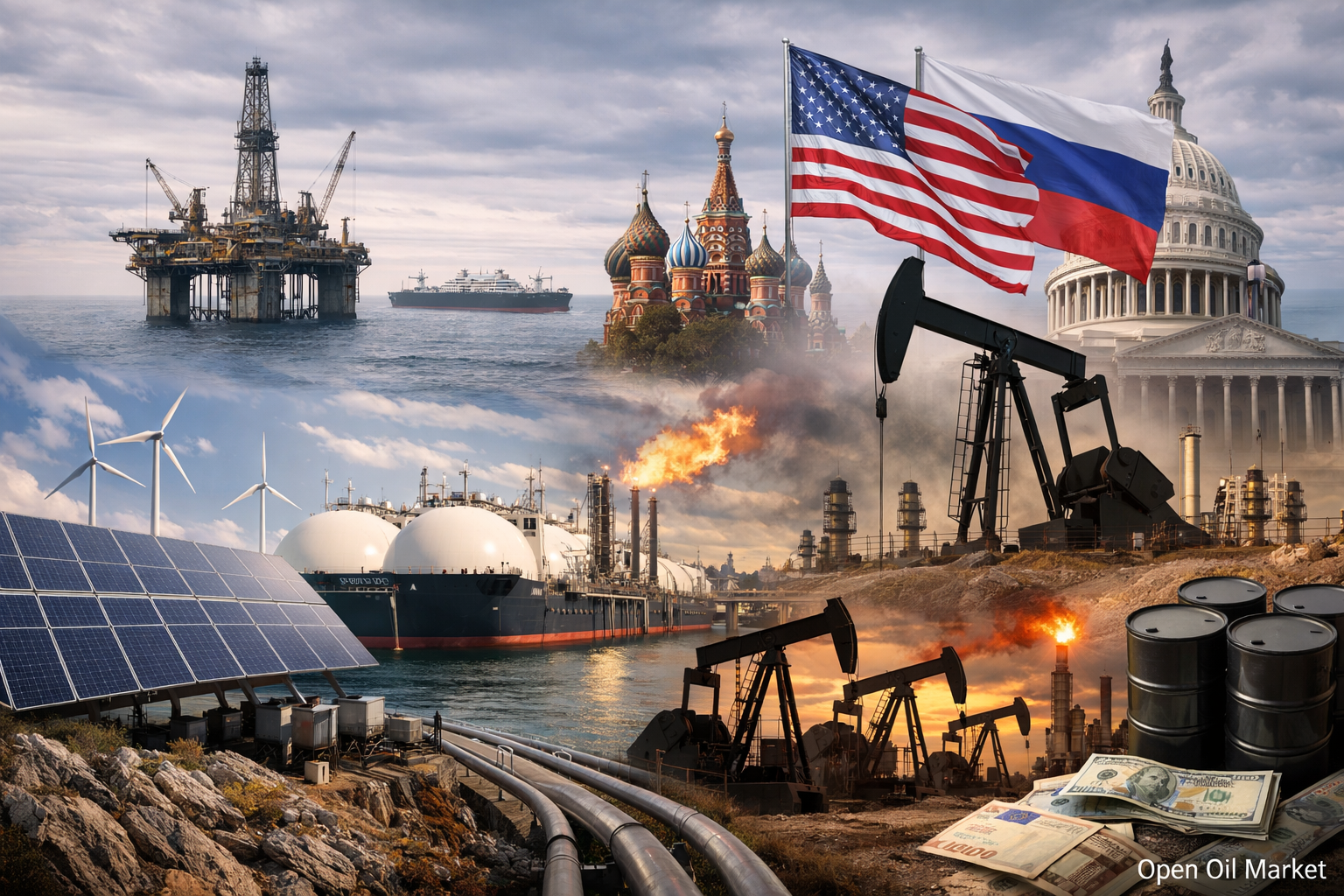
Current News in the Oil, Gas and Energy Sector as of January 14, 2026: Oil and Gas Prices, Sanctions Policy, Demand-Supply Balance, Refinery Market, Renewable Energy, and Key Trends in the Global Fuel and Energy Sector.
The current events in the global fuel and energy sector as of January 14, 2026, are characterised by increasing geopolitical tensions and ongoing price pressures due to an oversupply. Diplomatic efforts for resolution continue; however, the conflict surrounding Ukraine remains far from resolved, and the United States is preparing to tighten its sanctions on Russian energy exports. However, the oil market remains oversaturated: Brent crude prices hover around $62–63 per barrel—almost 20% lower than a year ago—reflecting excess supply and moderate demand. The European gas market is displaying relative stability: gas storage in the EU, while decreasing in the midst of winter, still exceeds 55% of capacity, maintaining prices at a moderate level (~€30/MWh). Concurrently, the global energy transition is gaining momentum—2025 saw record levels of solar and wind capacity installations, yet to ensure the reliability of energy systems, countries have not yet renounced traditional oil, gas, and coal. Below is a detailed overview of the key news and trends in the oil, gas, electricity, and raw materials sectors as of this date.
Oil Market: Oversupply and Weak Demand Keep Prices Low
Global oil prices remain under downward pressure due to an oversupply and insufficiently high demand. North Sea Brent trades at around $63 per barrel, and American WTI is in the vicinity of $59. Such levels are approximately 15–20% lower than last year, indicating a continued market correction following the price surge of previous years. A combination of several factors supports the current situation in the oil market:
- Growth in non-OPEC production: Oil supply is increasing globally due to active production in non-OPEC+ countries. In 2025, there was a noticeable rise in supplies from Brazil, Guyana, and other nations. For instance, production in Brazil reached a record 3.8 million barrels per day, while Guyana ramped up to 0.9 million barrels per day, also exporting oil to new markets. Additionally, Iran and Venezuela have somewhat increased exports due to a partial easing of restrictions, adding oil to the global market.
- OPEC+ cautious stance: OPEC+ countries are not in a hurry to reduce production again. Despite the decline in prices, official production quotas remain unchanged following previous restrictions. As a result, additional OPEC+ oil remains in the market, and the organisation aims to preserve its market share by allowing lower prices in the short term.
- Slowing demand: Global oil demand is growing at more modest rates. Analysts estimate that consumption growth in 2025 reached less than 1 million barrels per day, compared to 2–3 million barrels per day the previous year. Economic growth in China and several developed countries has slowed to approximately 4% per year, limiting fuel consumption growth. High prices in previous years have also encouraged energy-saving measures and a shift to alternative energy sources, cooling demand for hydrocarbons.
- Geopolitical uncertainty: The ongoing conflict and sanctions create contradictory factors for the oil market. On one hand, the risks of supply disruptions due to sanctions or escalation of the conflict support some premium in prices. On the other hand, the absence of clear supply disruptions and reports of ongoing negotiations among major powers slightly alleviate market participants' fears. Consequently, prices fluctuate within a relatively narrow range, lacking momentum for either growth or collapse.
Overall, supply currently exceeds demand, creating a near-oversupply situation in the oil market. Global commercial oil and petroleum product stocks continue to rise. Brent and WTI prices remain firmly below the peaks of 2022–2023. Many investors and oil companies are planning for a "low" price scenario: several forecasts indicate that in the first quarter of 2026, the average Brent price could drop to $55–60 per barrel if the current oversupply persists. Under these conditions, oil companies are focusing on cost control and selective investments, preferring short-term projects and those in natural gas.
Natural Gas Market: Europe Navigates Winter Without Crisis
The gas market's focus is on Europe, where a relatively calm situation persists amidst the winter. EU countries entered the heating season with high levels of reserves: by early January, the average fill level of European underground gas storage surpassed 60% (compared to a record 70% a year ago). Even after several weeks of active withdrawals, storages remain over half full, providing a buffer for the energy system. Favorable factors sustaining the stability of the European gas market include:
- Record LNG imports: The European Union has maximally utilised global liquefied natural gas (LNG) capacity. By the end of 2025, total LNG imports into Europe rose by approximately 25%, reaching around 130 billion cubic metres per year, compensating for the cessation of most pipeline gas supplies from Russia. In December, LNG vessels continued to arrive actively at EU terminals, meeting the increased winter demand.
- Moderate demand and mild weather: Winter in Europe has thus far been relatively mild, and the energy system is coping without extreme loads. Industrial gas consumption has remained restrained due to last year's high prices and energy-saving measures. Wind and solar generation at the start of the 2025/26 winter demonstrated strong performance, further reducing gas consumption for electricity generation.
- Diversification of supply: The EU has recently established new energy import routes. In addition to LNG, pipelines from Norway and North Africa are operating at full capacity. The capacity of terminals and interconnectors within Europe has been expanded, allowing prompt gas transfers to regions in need. This smooths local imbalances and prevents price spikes.
Thanks to these factors, exchange prices for gas in Europe remain at relatively low levels. Futures at the TTF hub trade around €30/MWh (approximately $370 per thousand cubic metres)—significantly lower than the peak levels during the 2022 crisis. Although prices recently rose slightly (by 7–8%) due to a temporary cold snap and maintenance work at some fields, the overall market remains balanced. Moderate gas prices positively impact European industry and electricity generation, reducing enterprise costs and tariff pressure on consumers. Europe still has to navigate the remaining winter months: even if the cold intensifies, the accumulated stocks are likely sufficient to avoid shortages. Analysts estimate that by the end of winter, approximately 35–40% of gas could remain in storage, significantly above critical levels of past years. However, some risk arises from the potential revival of Asian demand—competition between Europe and Asia for new LNG shipments could intensify in the second quarter of 2026 if economic recovery in Asian countries continues.
Geopolitics and Sanctions: Stricter Measures from the US and No Breakthrough in Negotiations
The geopolitical situation continues to have a considerable impact on energy markets. In recent months, diplomatic efforts to resolve the conflict in Eastern Europe have taken place: since November 2025, a series of consultations have occurred among representatives from the US, EU, Ukraine, and Russia. However, as of now, these negotiations have not yielded any tangible progress. Moscow is not demonstrating readiness to make concessions, while Kyiv and its allies insist on acceptable security guarantees. Against the backdrop of prolonged confrontation, Washington signals its willingness to intensify sanctions pressure.
New US Sanctions Bill. In early January, the US administration publicly supported a bipartisan bill proposing stringent measures against countries aiding in circumventing sanctions or actively trading with Russia. Specifically, secondary sanctions are proposed against purchasers of Russian oil and gas. Major importers of Russian energy resources, such as China, India, Turkey, and several other Asian countries, could be affected. Washington signals that if these nations do not reduce their purchases from Moscow, they could face restrictions on access to American markets or 100% tariffs on their exports to the US. The bill has already received the "green light" from the White House and may be put to a vote in Congress soon. Such a step would be unprecedented for the global oil and gas market: effectively, some buyers could find themselves under sanctions, which would redistribute oil trade flows and complicate the price situation.
Reactions and Market Risks. Major consumers, primarily China and India, are under close scrutiny. India has long benefitted from significant discounts on Russian Urals oil (up to $5 below Brent prices) in exchange for maintaining purchase volumes—this "privileged" arrangement has allowed New Delhi to increase its imports of Russian crude and petroleum products. China, for its part, has also increased imports from Russia, becoming the main market for Russian oil following the EU embargo. The US plans to introduce secondary sanctions have met with sharp disapproval from Beijing and New Delhi, as these countries declare their intent to uphold their energy security. It is likely that should the law be passed, they will seek ways to circumvent the new restrictions—such as through transactions in national currencies, shadow tankers, or refining Russian oil in third countries for re-export. Markets are watching developments closely: threats of sanctions add uncertainty and could heighten price volatility, especially for Urals oil and tanker shipping. Meanwhile, existing sanctions remain unchanged, and no significant interruptions in Russian oil supplies to the global market are observed—the volumes have been redirected to Asia, albeit at a discount.
US-Russia Negotiations. Despite the harsh rhetoric, the dialogue channel between Washington and Moscow remains open. Following a leaders' meeting in August 2025 (where it was decided to continue consultations), special representatives from both sides have discussed the parameters of a potential agreement several times. In December, the American side proposed a framework plan for security guarantees in Ukraine in exchange for the gradual easing of some energy sanctions, but Moscow demanded that its conditions be considered, including the lifting of certain export restrictions and guarantees against the expansion of NATO military infrastructure. So far, these disagreements have not been resolved. Meanwhile, US allies in Europe have declared their readiness to continue to pressure Russia until the situation improves—new EU restrictions on maritime transportation of Russian oil products above the price cap have come into effect. Thus, the political front remains tense: prospects for a quick lifting of sanctions are slim. For investors in the fuel and energy sector, this means that sanctions risks will continue to be considered in their trading operations and investment planning, particularly regarding projects involving Russia.
Venezuela: Shift in Direction and Potential for Oil Production Growth
Another significant development that could affect the long-term balance of power in the oil market is the changes in Venezuela. At the end of 2025, the situation surrounding this South American country changed dramatically: the government of Nicolas Maduro effectively lost control after he was detained during a special operation with foreign assistance. The United States has expressed support for the formation of a transitional administration in Caracas and intends to engage American oil companies in the restoration of Venezuela's oil industry. For many years, the country, which possesses the largest proven oil reserves in the world, has produced less than 1 million barrels per day due to sanctions, a lack of investment, and destroyed infrastructure.
The new political conditions open the prospect for the gradual increase of Venezuelan oil production. Analysts estimate that with relative stability in the country and an influx of investments from the US and other nations, production in Venezuela could increase by 200–300 thousand barrels per day in the next one or two years. JPMorgan's optimistic scenario anticipates reaching levels of 1.3–1.4 million barrels per day in two years (up from approximately 1.1 million in 2025) and, over a decade, reaching 2.5 million barrels per day if large-scale modernisation projects are implemented. In the early days following the change in administration, reports emerged regarding plans to audit the condition of PDVSA's fields and infrastructure and attract international partners to restart idle wells.
However, experts warn that swift results should not be expected. Venezuela's oil industry requires extensive updates—from repairing refineries to investing in port facilities. The necessary investments are estimated at tens, if not hundreds, of billions of dollars. Furthermore, questions regarding the legitimacy of the regime change and long-term political risks persist. Some countries allied with the former authorities condemned the external intervention; Russia, for example, stated that control over Venezuelan oil should not pass to the US. This implies that diplomatic friction may arise around Venezuelan issues.
For the global market, the increase in exports from Venezuela in the near months will be small but symbolically significant. There are already signs of a resumption of shipments of heavy Venezuelan oil to American refiners in the Gulf of Mexico under licenses issued by the new administration. In the mid-term, additional Venezuelan volumes may intensify competition in the heavy oil segment, where OPEC currently dominates. According to Goldman Sachs, if production in Venezuela were to rise to 2 million barrels per day in the future, it could reduce the equilibrium price of Brent by $3–4 by 2030. Although it is still far from such levels, investors are factoring in the emergence of a "new-old" player in the market. Overall, the situation in Venezuela adds yet another factor to the global oversupply, reinforcing expectations that the period of relatively low oil prices might extend.
Energy Transition: Record Green Generation and the Role of Coal
The global energy sector continues to shift towards low-carbon sources, although fossil fuels maintain a significant share in the energy mix. The year 2025 was record-breaking for renewable sources: according to the International Energy Agency, around 580 GW of new renewable energy capacity was commissioned worldwide. Over 90% of all new power plants launched last year operate on solar, wind, or hydro energy. As a result, the share of renewable generation in electricity production has reached historical highs in several countries.
Europe and the US. In the European Union, the contribution of electricity generated from renewable sources exceeded 50% for the first time in 2025. Offshore wind farms in the North Sea, solar farms in Southern Europe, and bioenergy accounted for the main growth. This allowed the EU to reduce coal and gas combustion for generation by 5% and 3%, respectively, compared to the previous year. The share of coal in the EU energy mix is back on a downward trajectory following a temporary spike in 2022–2023. In the US, the renewable energy sector has also reached new heights: major solar stations have been commissioned in Texas and California, along with wind installations in the Midwest. As a result, nearly 25% of American electricity now comes from renewables—the highest in history. Government initiatives and tax incentives (for example, under the federal Inflation Reduction Act) stimulate further investment in clean energy.
Asia and Developing Markets. In China and India, there is also a significant growth in renewable energy, although absolute consumption of fossil fuels continues to rise. China set records with 130 GW of solar panels and 50 GW of wind energy installed in one year, increasing total renewable energy capacity to 1.2 TW. However, the rapidly growing economy requires increasing amounts of electricity: to avoid shortages, Beijing is concurrently ramping up coal production and constructing coal-fired plants. As a result, China continues to generate about 60–65% of its electricity from coal. India faces a similar situation: the country is expanding solar and wind capacities (over 20 GW added in 2025), but more than 70% of Indian electricity is still generated in coal plants. To satisfy growing demand, New Delhi has approved the construction of new high-efficiency coal blocks, even in the face of climate objectives. Many other developing economies in Asia and Africa (such as Indonesia, Vietnam, South Africa, etc.) are also balancing the development of renewables with the necessity of expanding traditional generation to ensure base load.
Challenges for Energy Systems. The rapid growth in the share of solar and wind power presents new challenges for energy providers. Intermittent spikes in renewable generation demand the development of energy storage systems and backup capacities. Already, in Europe and the US during peak load hours or adverse weather conditions, grid operators have to resort to gas and even coal plants to balance the system. In 2025, several countries experienced moments where the share of renewables dropped during windless nights, with traditional thermal plants temporarily shouldering the main load. To enhance flexibility in energy systems, energy storage projects are being scaled up—from industrial batteries to the production of "green" hydrogen for seasonal storage. Nevertheless, fossil source reserves remain critically important for stable energy supply. It is projected that global demand for coal in 2026 will remain close to record levels (around 8.8 billion tonnes per year) and will only start to decline significantly towards the end of the decade, as the deployment of clean technologies accelerates and countries fulfil their climate commitments.
Petroleum Products and Refining Market: Oversupply Reduces Fuel Prices
The global petroleum products market at the beginning of 2026 is in a comfortable state for consumers. Prices for key types of fuels—gasoline and diesel—remain significantly below last year's levels, largely due to the cheaper cost of crude oil and an expansion of supply from refineries. Throughout 2025, new refining capacities came online, boosting competition among petroleum product manufacturers and increasing the availability of gasoline, diesel, and jet fuel in the international market.
Capacity Growth in Asia and the Middle East. The largest investment projects in refining launched in recent years are beginning to yield effects. In China, several modern refineries ("petrochemical complexes") have ramped up to full capacity, raising the country's installed capacity to approximately 20 million barrels per day—the highest in the world. Beijing had planned to limit national capacity to 1 billion tonnes per year (around 20 million barrels per day), and this threshold is almost reached now. The oversupply of refining capacities domestically is already leading to some smaller, older plants in China operating at reduced loads or facing closure in the coming years. In the Middle East, the gigantic Kuwait Al-Zour refinery has been fully commissioned, and expansion projects in refining are underway in Saudi Arabia (including new complexes involving foreign partners). These new plants are aimed not only at domestic demand but also at exporting fuel—primarily to Asian countries and Africa, where the demand for petroleum products continues to grow.
Stabilisation of the Diesel Market in Europe. The European Union, which faced tension in the diesel market in 2022–2023 due to the cessation of Russian supply, has managed to reorient its logistics by 2025 and avoid shortages. Diesel and aviation kerosene imports into Europe from the Middle East, India, China, and the US have increased, compensating for the drop in Russian exports. The role of India is particularly notable: its refineries, benefiting from discounted Russian oil, produce surplus diesel, a significant portion of which is then directed to Europe and African countries. Such "reallocation" has helped maintain stable European diesel prices even during peak summer demand. Within the EU, refiners have also increased output: refineries in the Mediterranean and Eastern Europe operated at high load, partially compensating for the closure of some obsolete plants in Western Europe. As a result, wholesale diesel prices in Europe have decreased by approximately 15% by the end of 2025 compared to the beginning of the year, easing inflationary pressures.
Refining Margins and Prospects. For refiners themselves, the situation is dual-edged: on one hand, cheaper crude oil reduces the raw material component, while on the other, oversupply of fuel and competition erodes margins. Following record-high margins observed in 2022, refiners faced tightening conditions in 2025. The average global margin decreased, particularly in diesel and heavy fuel production. In Asia, due to gasoline oversupply, some refineries reduced output and shifted towards producing higher-value petrochemical products. In Europe, biodiesel content requirements and environmental regulations are also increasing refinery costs, pushing the sector toward consolidation and modernization. It is expected that in 2026, global refinery capacities will continue to grow—new projects are underway in East Africa and refining expansions in the US. This means that competition in the petroleum products market will remain high, and gasoline and diesel prices are likely to remain relatively low unless there is a sharp spike in crude oil prices.
Outlook and Expected Events
At the beginning of 2026, investors and participants in the fuel and energy sector are keenly evaluating how key factors affecting prices and the demand-supply balance will develop. In the coming months, the dynamics of global fuel and energy markets will be influenced by the following aspects:
- Sanction Decisions and Conflict Progress: Whether the new US sanctions bill against buyers of Russian oil will be approved and implemented. Its implications for the global market (potential supply reductions, redistribution of flows, and political reactions from China/India) will be among the main factors of uncertainty. Simultaneously, markets are attentive to any signals of progress or failure in peace negotiations regarding Ukraine—this directly impacts sanctions policy and investor sentiment.
- OPEC+ Strategy: Attention will be on the oil alliance's policy. If oil prices continue to decline, an extraordinary meeting or quota revision may occur. The usual OPEC+ meeting is scheduled for spring, and markets are awaiting whether measures will be taken to cut production to support prices, or if the cartel will allow prices to remain at relatively low levels to maintain market share.
- Economic Dynamics and Demand: The state of the global economy, particularly in China, the US, and the EU, will be decisive for energy carrier demand. If there is acceleration in GDP growth or, for example, industrial production in China in the second half of 2026 following stimulus measures, this could elevate oil and LNG consumption, somewhat reducing the oversupply. Conversely, risks of recession or financial upheavals may dampen fuel demand. Additionally, seasonal recovery in air travel (jet fuel) and vehicular traffic in spring-summer will also affect the petroleum products market.
- End of Winter and Preparation for the Next Season: The outcomes of the current winter for the gas market will determine strategies for 2026. If Europe avoids an energy shortfall, with substantial gas reserves remaining in storage, this will ease the task of filling storage for the next winter and could keep prices low. A key event will be the summer injection season of 2026: under expectedly increased global LNG supply (with new projects in the US and Qatar), Europe aims to reach 90% storage fill by autumn. The market will assess whether this can be achieved without price surges and without fierce competition with Asian importers.
- Energy Transition and Corporate Investments: Monitoring will continue regarding how energy corporations are reallocating capital between fossil and renewable sectors. In 2026, a decline in investments in oil production is forecasted amid low prices—particularly among independent companies in North America and international majors focusing on financial discipline. At the same time, an increase in investments is likely in LNG projects (increased exports from North America and Africa) and in "green" energy initiatives. Any new government initiatives for decarbonisation (such as tightening climate goals at forthcoming climate summits) or, conversely, steps to support fossil fuel production will directly impact long-term expectations for demand and prices.
Overall, industry experts provide a cautiously positive outlook for consumers in 2026: high market availability of oil and gas should prevent sharp price increases. However, for producers, this means the need to adapt to a new reality—a period of lower margins and heightened efficiency focus. Geopolitical factors remain a "wild card": unexpected events—be they breakthroughs in peace negotiations, major force majeure at producing facilities, or new trade wars—could instantly alter the balance. Participants in the fuel and energy sector approach the start of the year with caution, shaping strategies capable of withstanding various scenarios of development.




