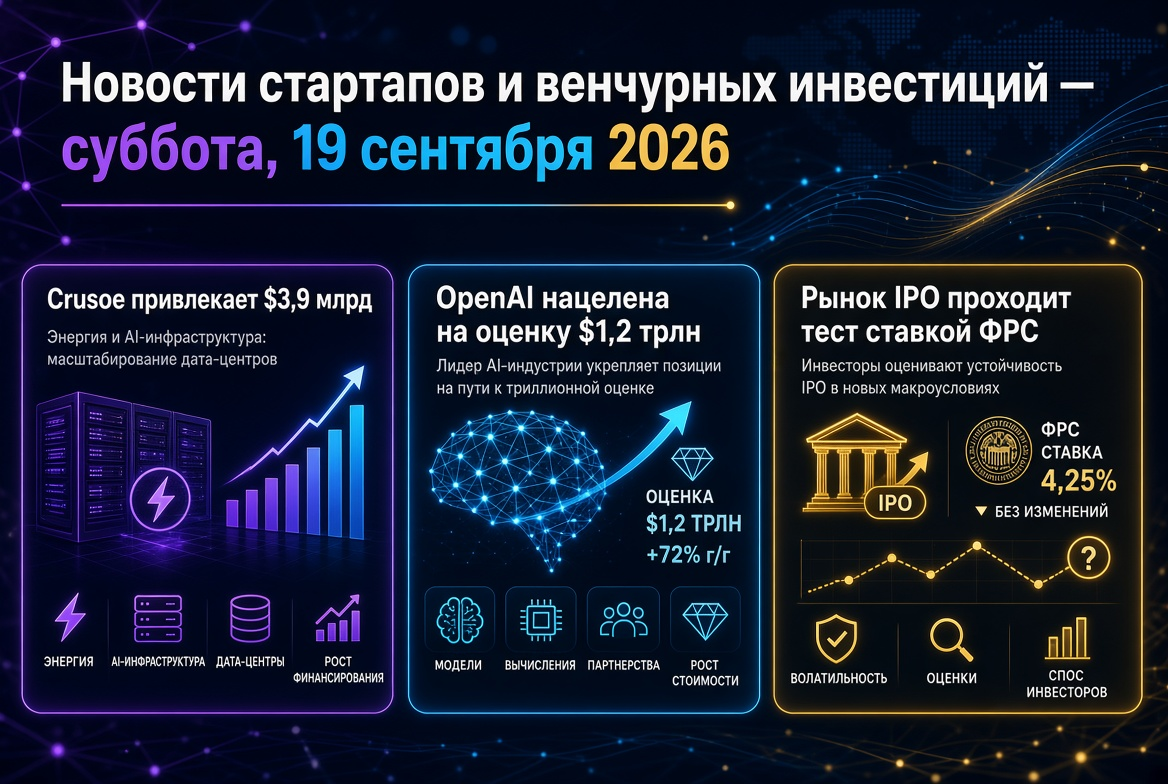
Startup and Venture Capital News for Thursday, 15 January 2026: Record AI Rounds, Return of Mega Funds, IPO Revival, and Key Trends in the Global Venture Market.
- Return of Mega Funds: Leading venture firms and investors are actively structuring record funds and increasing capital allocations to new projects.
- Record Investments in AI: Startups in artificial intelligence attracted approximately $150 billion in 2025, leading to a new wave of 'unicorns.'
- Revival of IPOs and M&A: The initial public offerings market is becoming active again, and the number of mergers and acquisitions is rising, opening additional exit routes for investors.
- Diversification of Sectors: Capital is increasingly being distributed across various sectors: besides AI, interest in fintech, green technologies, biotechnology, and defence startups has significantly grown.
- Global Boom: The United States continues to attract the lion's share of venture investments (~70% in 2025), yet new tech hubs are actively developing in Asia, the Middle East, and Africa.
- Russia and the CIS: The domestic venture market is undergoing transformation: investment in Russian startups decreased by approximately 10% in 2025, but new funds and technology support programmes are being launched.
Return of Mega Funds: Big Money Back in the Market
After a two-year downturn, the market is again attracting large inflows: leading venture firms worldwide are structuring record funds. For instance, the American firm Andreessen Horowitz raised over $15 billion in five new funds — the largest round in the firm's history. This accounts for nearly 18% of all venture investments in the US for 2025. Similar trends are observed globally: funds are accumulating hundreds of billions in 'dry powder,' ready for investment. Sovereign and private investment funds from the Middle East have also reactivated, investing billions in the development of the tech sector and creating regional tech hubs.
AI Breakthrough: Record Investments and New Unicorns
Startups in artificial intelligence remain a capital magnet. Analysts estimate that investments in AI companies reached an unprecedented $150 billion in 2025, significantly exceeding previous records. Mega-rounds have propelled the valuations of leading players to unseen heights. Major deals included rounds for OpenAI (~$40–41 billion) and Anthropic (~$13 billion), further confirming the hype surrounding AI. Projects like xAI and Scale AI also attracted tens of billions. A substantial portion of the funding is concentrated within a select few companies, raising analysts' concerns about the risk of a bubble in the AI sector. Nevertheless, the current investment boom is spawning many new 'unicorns' (startups with a valuation exceeding $1 billion) and stimulating the development of high-tech infrastructure — such as data centres and specialised chips for AI.
Revival of the IPO Market: A Window of Opportunity for Exits
Stock exchanges are regaining attention — several major tech companies have successfully completed IPOs, indicating a renewed interest from investors in public offerings. In Asia (primarily in Hong Kong), large-scale placements of major startups have occurred, while in the US, more IPOs of known 'unicorns' are on the horizon. The revival of the IPO market is crucial for the venture capital ecosystem: successful public offerings allow funds to lock in profits and reinvest in new projects. Concurrently, M&A activity is increasing: in 2025, the number of agreements for the acquisition of startups rose, providing startups with alternative paths for scaling and investors with exit opportunities. Notably, in the Middle East, the volume of M&A transactions increased by 41%, reflecting a general shift in the industry towards consolidation.
Diversification of Investments: Not Just AI
Venture capital is increasingly being distributed across sectors. Fintech remains one of the most active areas: for instance, in the Middle East and North Africa, fintech accounted for a record $1.15 billion in investments, marking the largest share of transactions in the region. Additionally, attention is growing towards green technologies — projects in renewable energy, energy efficiency, and sustainability — as well as biotechnology and pharmaceuticals, following a lengthy lull in these sectors. Defence and cybersecurity technologies are also receiving increased backing amid global instability. This diversification of investments makes the entire industry more balanced and reduces market dependence on a single trend.
Consolidation and M&A: The Market is Structuring
Corporate acquisitions and strategic investments are intensifying. Large tech and financial companies are acquiring promising startups to expand their innovation portfolios. In 2025, major M&A deals became more pronounced, offering early investors exit routes alongside IPOs. The rise in M&A activity is noticeable across all regions: as already mentioned, the number of such deals in the Middle East increased by more than 40%. Shares are being acquired to accelerate the development of startups and consolidate technologies under one management, expediting the creation of strong industry players.
Global Diffusion: New Regions and Leaders
Despite the leading role of the US, the venture boom is becoming increasingly global. According to CB Insights, American startups attracted around $327.8 billion in 2025 (approximately 70% of all capital worldwide); however, activity is also rising in other parts of the world. European companies secured about $68 billion (18% of the market), with Germany surpassing the UK in deal volume for the first time. In Asia, investments are shifting from China to India and Southeast Asia, where new tech ecosystems are forming. In the Middle East, the volume of investments reached a record $3.8 billion (a 74% increase), while Africa and Latin America saw the emergence of their first local 'unicorns,' indicating the truly global nature of the current startup boom. Investors are actively seeking innovations worldwide, from developed markets to emerging regions.
Russia and CIS: Local Initiatives amidst Changes
In Russia and neighbouring countries, the startup market continues to transform under the influence of internal and external factors. According to reports, the volume of deals in the Russian venture sector decreased by approximately 10% in 2025 (to 7.2 billion rubles), and the number of deals fell by a third, indicating a 'deep contraction' of the market. Nevertheless, the government and large corporations are not leaving innovative projects without support: new government and corporate funds are being launched, and accelerators, grant programmes, and partnership initiatives are being opened. All this is aimed at creating an 'autonomous' development model and integrating Russian startups into global technology trends, even amidst the constraints of the international environment.