Global Oil and Gas Industry News and Energy Updates Including Oil, Gas, Power, Renewables, Coal, Oil Products, and Key Events in the Global Energy Market
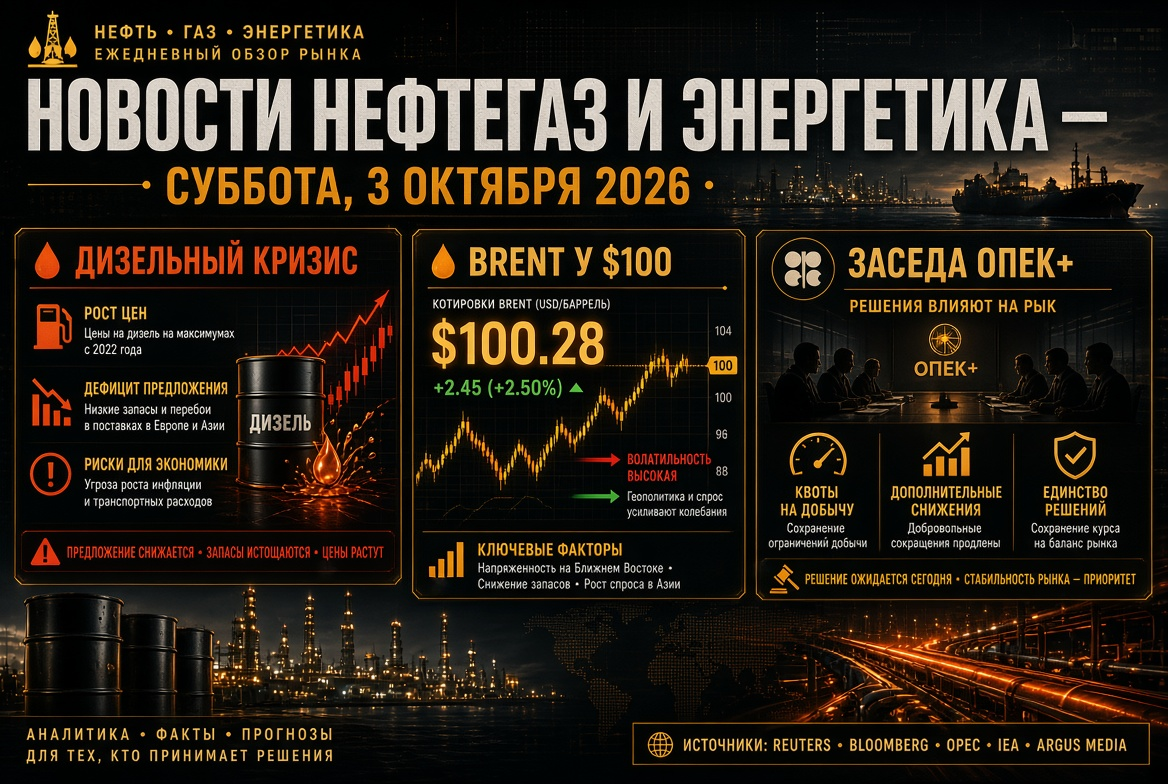
Oil: Brent and WTI Remain Above $100, the Market Pays for the "Immediate Barrel"
Evidence of strength persists not only in price levels but also in the structure of the futures market. Backwardation at tens of dollars represents a bet on the scarcity of current supplies: participants are willing to pay a premium for prompt delivery of crude as long as logistics and export corridors remain unstable. For oil companies and traders, this translates to an increase in price premiums for physical grades and an enhanced role for inventories.
The shock is exacerbated by reports of production and export cuts in the Middle East: output in southern Iraq is estimated to have decreased by about 70% (to 1.3 million barrels per day), while several producers have declared force majeure. Against this backdrop, OPEC+'s decision to increase production by approximately 206,000 barrels per day from April appears insufficient in scale—the market reacts to actual barrels and their delivery possibilities, rather than to "paper quotas."
Gas and LNG: Qatar's Force Majeure and Price Shock in Europe and Asia
Qatar (about 20% of global LNG exports) has declared force majeure and halted liquefaction at the largest export hub, Ras Laffan. The recovery of supplies is not instantaneous: even after the decision to restart liquefaction lines, there is a required ramp-up period, and market participants estimate a return to normal volumes at a minimum in the "monthly horizon."
Europe reacted with a surge in prices: the TTF base contract rose to €65.79/MWh in the early days of the crisis (more than double the levels of the previous week). The risk for the region is not so much a "physical shortage today," but rather the speed of injection into underground gas storage (UGS): as spring arrives, the EU enters the replenishment season with about 30% full storage and must reach 90% by November. Asia, which received over 80% of Qatari cargoes, is activating emergency plans, reducing industrial supply, and searching for spot cargoes, intensifying the competition between Europe and Asia for available LNG cargoes and increasing the significance of redirecting flows from the US and other exporters.
Oil Products and Refineries: Diesel and Jet Fuel Accelerate Profit Redistribution in the Chain
The oil products market typically first "shows" shortages. In Asia, spot prices for jet fuel in Singapore peaked at a record $225.44/barrel on March 4, while gasoil reached $123.39/barrel—its highest since 2023. For end markets, this translates to increased costs in aviation, freight logistics, and industrial pricing.
For refineries, rising product prices enhance margins, but simultaneously increase risks related to raw material supply, logistics, and export policies. In Asia, the complex margin in Singapore was estimated at around $30/barrel; the crack spread for jet fuel exceeded $52/barrel, and for diesel (10ppm)—$48/barrel. In a high-price environment, governments and companies are intensifying measures to protect domestic markets—from restrictions on oil product exports to temporary price caps.
- Diesel: the main channel for transmitting shocks to transport, construction, and extraction.
- Jet Fuel: an indicator of real shortages and a leading signal for business activity.
- Petrol: a product with maximum political sensitivity.
Logistics: Freight for Tankers and LNG Carriers Rises, Delivery Times Become a Price Factor
The supply of energy resources hinges on transportation and insurance. The rate for VLCCs from the Middle East to China has been assessed at around $423,736 per day during peak moments. In the LNG market, freight has also surged: Atlantic rates reached $61,500 per day, while Pacific rates hit $41,000 per day. This makes spot transactions more expensive and accelerates the "flow" of cargoes to the most solvent buyers.
Coal: Fuel Switching Returns Premiums to Energy Coal
With natural gas prices soaring and an LNG shortage, the energy sector is turning back to coal as a "safety net." The Asian benchmark Newcastle saw an 8.6% increase at the onset of the shock, rising to $128.7 per tonne—the market is pricing in rising demand for coal-fired generation and the heightened value of fuel with more stable logistics. This increases volatility in coal and intensifies the ESG dilemma: the stability of energy supply may temporarily outweigh emission reduction goals.
Electricity, Renewables, and Nuclear: Increasing Volatility and Demand for Baseload Generation
Gas-fired power plants frequently set the marginal price in European wholesale electricity markets, thus the gas shock is quickly translating into MWh costs for industry. Market participants estimate that since February 28, gas prices have risen by about 50%, with the annual contract for baseload electricity in Germany increasing by approximately 9%.
The high share of renewables reduces the average price but increases intraday fluctuations and the need for reserve capacity. By 2026, this is fuelling interest in "baseload" low-carbon generation, including small modular reactors: in Helsinki, the city energy company is contemplating investments of €1–5 billion in SMR capacity (up to 300 MW) for heat and electricity in response to rising demand from electrification, data centres, and hydrogen projects.
Politics and Macro: Reserves, Pricing Measures, and the Risk of a New Wave of Inflation
The sector shock is quickly becoming a macroeconomic factor. Finance ministers from G7 countries are discussing coordinated releases of oil from strategic reserves in collaboration with the International Energy Agency. At the same time, individual countries are implementing pricing measures on fuel and temporary export restrictions on oil products in an attempt to mitigate the effect on domestic markets.
For central banks, the key risk is a "second round" of inflation: expensive energy drives up transport and production costs. Financial markets in Europe have already heightened expectations for a tighter trajectory on rates (including a scenario for the ECB), if high prices for oil, gas, and electricity persist not for days but for weeks and months.
What Investors and Market Participants Should Monitor on March 10:
- actual tanker traffic and insurance conditions in the Strait of Hormuz;
- the shape of the Brent/WTI curve and premiums for physical grades and futures;
- timelines for recovery of Qatari LNG and the redirection of cargoes from the US and other exporters;
- refining margins and the operational stability of refineries, particularly for diesel and jet fuel;
- trends in electricity prices and signs of fuel switching (gas/coal);
- the next steps from regulators: reserves, pricing measures, export restrictions, and gas storage norms in UGS.