Global Startup and Venture Investment News for 11 March 2026, Including AI Mega-Rounds, Defence Tech Developments, Deep Tech Growth, and Key Venture Market Trends
AI Once Again Takes Centre Stage in the Global Venture Market
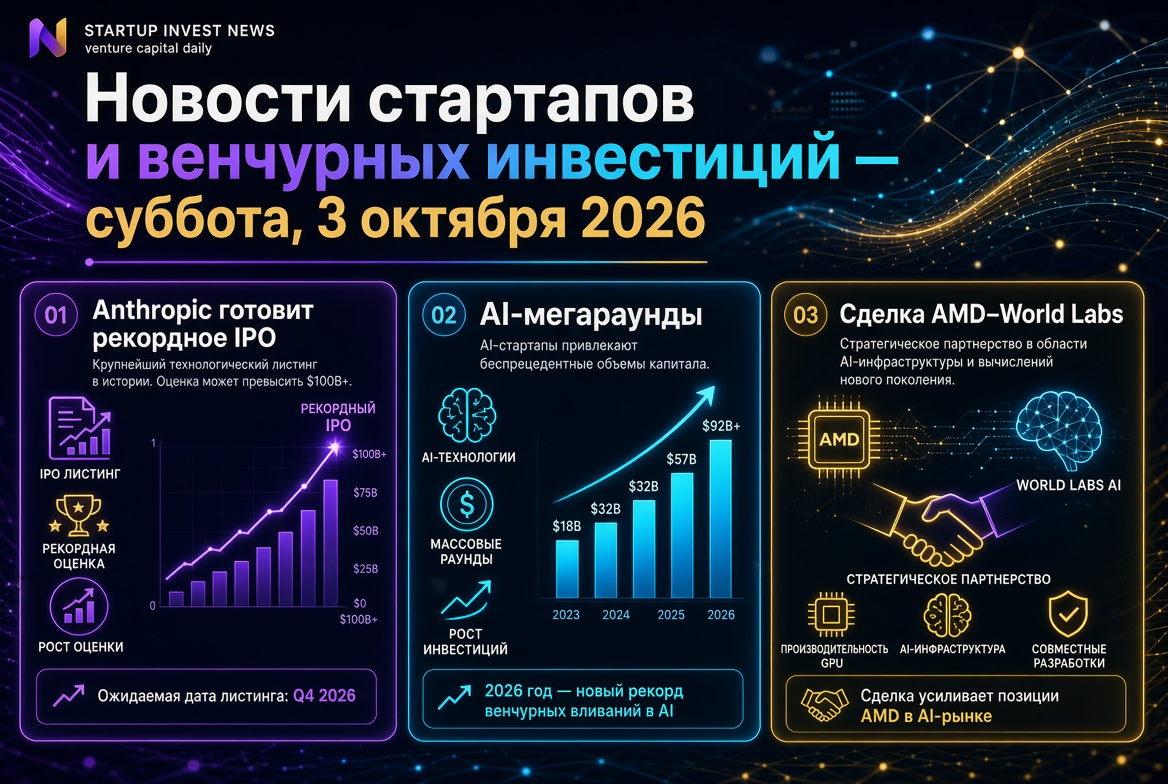
The main topic of the day is the sharp increase in capital concentration within the artificial intelligence segment. Investors are focusing on companies that are not only building interfaces over large language models but also creating foundational technological platforms: proprietary architectures, computing clusters, orchestration tools, corporate AI agents, and infrastructure for deploying models into industrial applications.
This creates a dual effect for the startup market. On one hand, the largest venture funds are ready to write record cheques, particularly for startups operating at the intersection of AI, infrastructure, and real industrial applications. On the other hand, the rest of the market is becoming more competitive: companies without a clear monetisation strategy, protected technology, and a strong team find it increasingly difficult to claim high valuations.
- AI infrastructure and compute-heavy projects are prioritised.
- Investors are increasingly viewing access to chips and data centres as part of the investment thesis.
- The venture investment market is increasingly dividing into elite mega-rounds and ordinary deals with stricter terms.
Thinking Machines Lab Strengthens Position in the AI Infrastructure Race
One of the most notable events has been the strengthening of positions by Thinking Machines Lab — a company founded by former OpenAI CTO Mira Murati. The startup has already been viewed as one of the most ambitious new players in AI, and its recent agreement with Nvidia effectively turns it into one of the key infrastructure projects of the new cycle. For the market, not only is the funding important, but also the company's access to large-scale next-generation computing resources.
This case confirms the new standard of the venture market in 2026: the valuation of a startup is increasingly constructed not only around the product and team but also around the ability to ensure long-term access to scarce resources. In AI, this primarily pertains to computing power, accelerators, energy supply, and partnerships with major infrastructure providers.
For funds, this is a signal that investments in AI are increasingly resembling investments in industrial platforms, rather than in traditional software.
Jan LeCun's AMI is Forming a New European Capital Attraction Centre
Another significant development for the global venture market has been the launch of Advanced Machine Intelligence (AMI), associated with Jan LeCun. The company raised over $1 billion and has become one of the most high-profile deals of the year, ranking among the largest seed deals in European history. This is an important signal for the international market: Europe is no longer restricted to supplying talent for American big tech companies and is beginning to form its own world-class AI platforms.
Interestingly, the emphasis is not on the traditional path of scaling large language models but on an alternative research paradigm — models capable of better understanding the physical world, causality, and long-term planning. For venture investors, this serves as a reminder of an important thesis: capital in 2026 is chasing not only growth speed but also scientific differentiation.
- The European startup market is gaining a strong reputational boost.
- Deep tech and fundamental AI are once again becoming attractive for investment.
- Funds are increasingly diversifying the geography of major deals beyond the US.
Defence Tech Emerges as One of the Major Winners of the New Cycle
The defence tech segment continues to strengthen its position. Interest in Anduril and other companies working with autonomous systems, sensors, security, and dual-use technologies indicates that venture investments are increasingly flowing into sectors previously considered niche for traditional VC. Geopolitical tensions, increases in defence budgets, and demand for software-hardware solutions make this segment one of the most capitalised.
For the startup market, this means that investors are once again willing to fund complex engineering companies if they have a clear customer base, entry barriers, and scalable prospects through government or corporate contracts. Defence tech is now being viewed not as an exotic niche but as a fully-fledged strategic asset class within the venture market.
Autonomous Transport and Industrial AI Maintain High Investor Interest
Against the backdrop of the AI boom, investors continue to support startups related to autonomous transport, industrial automation, and edge AI. Additional funding for Oxa and similar companies underscores that capital is not only seeking high-profile generative stories but also practical industry cases where AI generates measurable economic value.
Such projects often present a compromise between high growth and defensibility. They may not always attract the loudest headlines, but for institutional investors and large funds, they appear particularly attractive as they combine technological novelty, deep industry integration, and clearer revenue pathways.
Cybersecurity Remains One of the Most Resilient Areas
The rise in valuation of Aikido Security and the attention towards security startups confirm that cybersecurity remains one of the most resilient categories for venture investments. The reason is evident: the mass adoption of AI solutions, the increase in automated developers, and the expansion of digital supply chains create a new class of risks for businesses.
For venture funds, cybersecurity today is not a defensive bet but a growth sector. Companies that are directly embedded in development processes, DevOps, and corporate risk management are particularly valued. This enhances revenue quality, reduces churn, and makes startups more appealing for subsequent rounds or strategic M&A.
Fintech and Private Markets Are Gaining Traction
The topics of private markets and fintech deserve separate attention. The public offering of Robinhood, focused on providing retail investors access to private technology companies, indicates that the market is gradually searching for new liquidity formats. This is not a classic IPO boom but an important sign that interest in private assets remains high, while the infrastructure for interacting with them is becoming more widespread.
For the venture market, this is a positive signal. If new instruments for access to private equity and late-stage venture continue to expand, some of the liquidity pressure may ease. This is particularly important given that many large tech companies are remaining private longer than in previous cycles.
Exits and M&A: The Market Remains Selective, but the Window is Gradually Opening
The exit market cannot yet be described as fully recovered; however, signs of revitalisation are becoming more apparent. Biotech IPOs, large technology deals, and increasing interest in late-stage platforms show that the liquidity window is gradually expanding. Nevertheless, investors remain extremely selective: capital and the public market are ready to support primarily companies with strong technology, convincing unit economics, and a large addressable market.
This means that in 2026, startups must do more than simply be part of a trendy sector. For successful advancement to the next round, M&A, or IPO, a combination of factors is required:
- Stable revenue or a clear monetisation trajectory;
- Strong technological differentiation;
- The ability to operate in capital-intensive and regulated segments;
- Support from strategic or global institutional investors.
What This Means for Venture Investors and Funds
The picture as of 11 March 2026 is quite clear: the global startup and venture investment market remains vibrant and active, but capital is distributed extremely unevenly. The main competition is for companies capable of becoming the infrastructure of the new technological economy — in AI, defence, industrial automation, cybersecurity, and deep tech.
For venture investors, this presents several practical conclusions:
- The next stage of market growth will likely be determined not by the number of deals but by the quality and size of the largest rounds.
- The geography of global venture is expanding: alongside the US, Europe and select international deep tech centres are gaining strength.
- A competitive advantage for funds lies not only in capital but also in access to infrastructure, corporations, talent, and government contracts.
- Sector selection is becoming stricter: those who can combine technological depth with a clear commercial model will benefit.
For the global startup market, the environment on 11 March 2026 is marked by the concentration of capital and increasing stakes in technological sovereignty, computing infrastructure, and applied AI. This serves as a business signal for the entire industry: the venture market has not returned to its previous breadth but is once again ready to finance big ideas — provided they are backed by strong technologies, large markets, and substantial entry barriers.