The global energy market concludes the week in a state of high volatility. Brent crude oil remains above $100 per barrel. Natural gas prices in Europe are trading at their highest levels since the end of 2022. The diesel fuel market remains the most strained segment of the oil and gas industry. For investors, oil and fuel companies, traders, and refinery operators, three key factors persist:
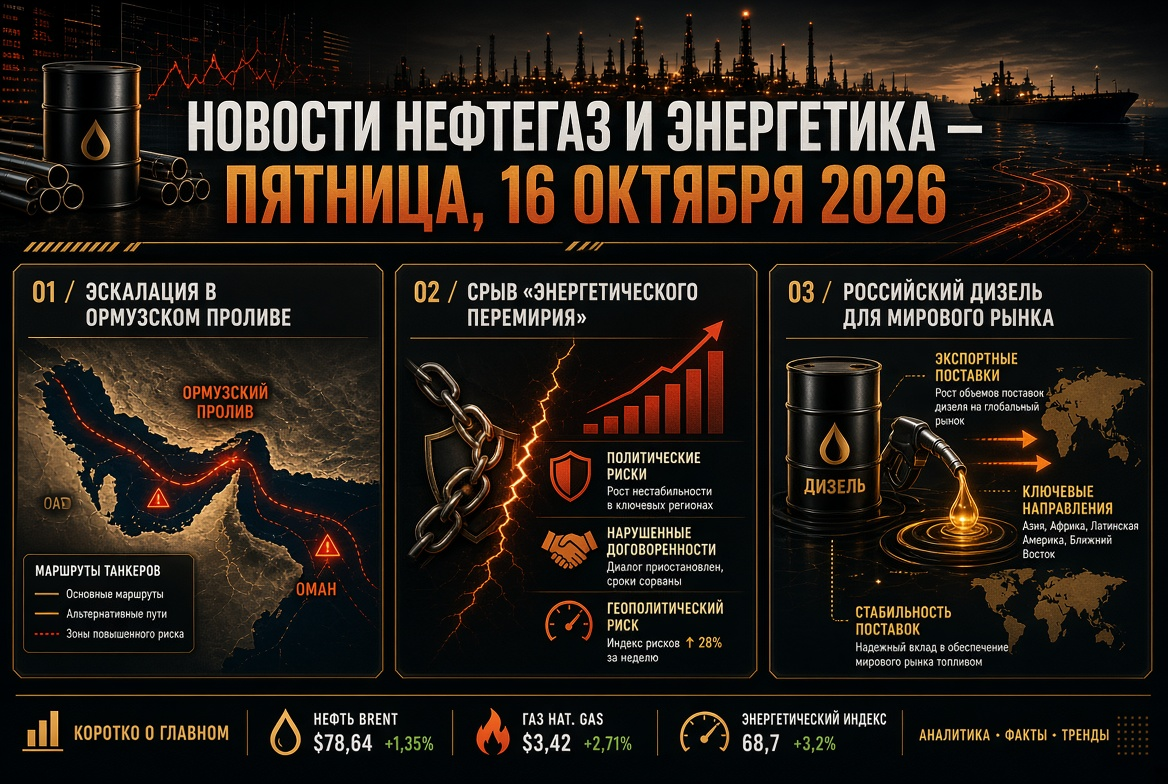
- attacks on tankers in the Strait of Hormuz;
- the Russia-US deal for diesel fuel supplies;
- the fate of strikes on refining infrastructure following the collapse of the “energy truce.”
Oil Market: Brent at $104 Amid Expectations of Easing Sanctions on the "Shadow Fleet"
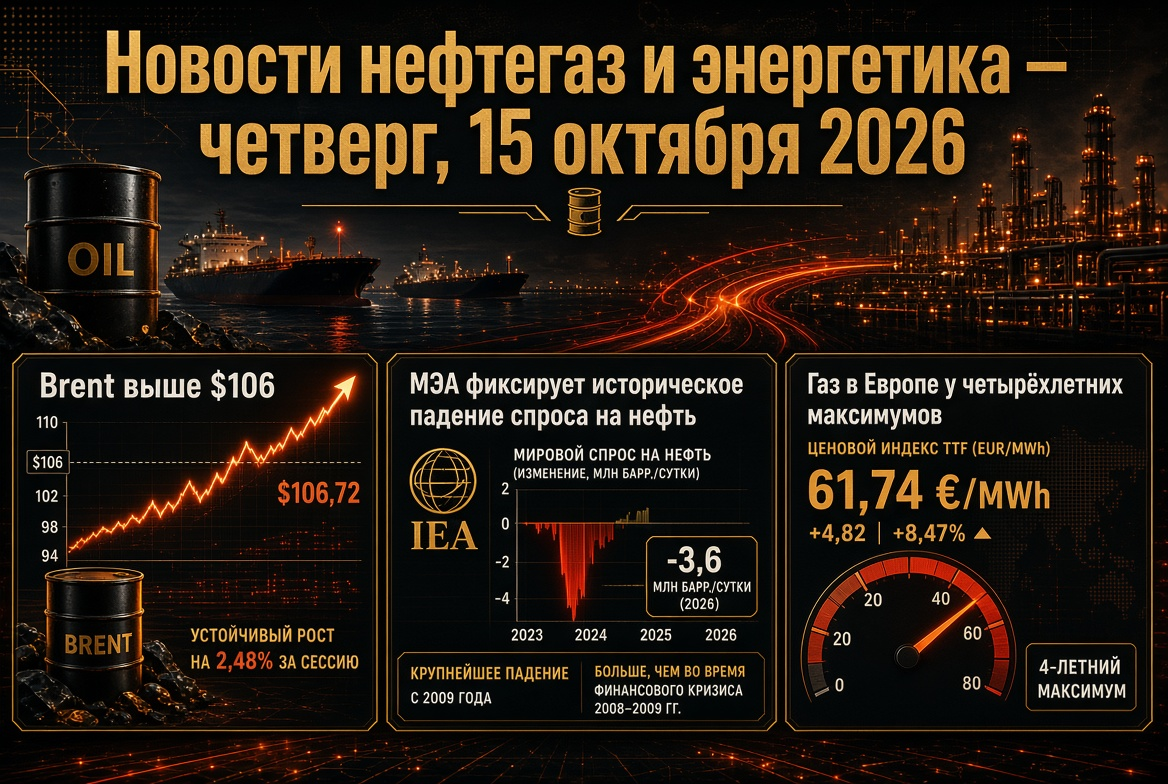
Oil prices fell by approximately 2% on Thursday. The December futures for Brent dipped to around $103.5–104 per barrel after closing at $106.06 on Wednesday. November WTI is trading at around $94–95. Price pressure came from reports that the US administration is considering easing sanctions on vessels from the "shadow fleet." Washington's aim is to reduce record freight rates and expedite oil exports from the Persian Gulf.
Fundamental support for the oil market remains intact:
- US inventories are declining. According to the American Petroleum Institute, commercial inventories fell by 11.1 million barrels in the week ending on 9 October.
- Prices remain high on a year-on-year basis. Brent is approximately 70% higher than a year ago. The yearly peak of $120.88 was recorded on 30 April.
- The Brent-WTI spread has widened. The difference exceeds $9 per barrel, reflecting a risk premium for maritime routes.
Strait of Hormuz: The Most Dangerous Phase for Shipping Since the Start of the War
October has become one of the most tense months for the tanker fleet since the conflict surrounding Iran began in late February. This week, two vessels sank, including the Singaporean container ship GFS Pride. Since the beginning of the week, at least nine attacks have been reported in the strait, targeting tankers carrying oil, LNG, and liquefied petroleum gas.
- In September, crude oil exports from the Middle East almost returned to pre-war levels, facilitated by nighttime passages of tankers under US Navy escort with transponders switched off.
- Iran is increasing pressure to regain control over flows. On certain days, passages through the strait are halved or more.
- For insurers and freight companies, this signifies the continuation of record rates and war-risk premiums.
OPEC+: Quotas Frozen, Actual Production Below Targets
At the meeting on 4 October, seven key OPEC+ participants maintained their quotas for November unchanged. The group includes Saudi Arabia, Russia, Iraq, Kuwait, Kazakhstan, Algeria, and Oman. The target levels are approximately 10.5 million barrels per day for Saudi Arabia, 9.9 million for Russia, and 4.4 million for Iraq.
- Actual production from the core of the alliance in August was about 25 million barrels per day, roughly 5 million barrels per day below the pre-war level.
- There are still around 2 million barrels per day of cuts in place.
- The secretariat is completing an audit of maximum capacities, which will be used to calculate baseline levels for 2027.
- The next meeting is scheduled for 1 November.
IEA Report: Oil and Diesel Shortage to Persist Until 2027
The October report from the International Energy Agency confirms that the balance of the global oil market remains in deficit.
- Global demand for oil is expected to decline by 2.6 million barrels per day to 102.4 million in 2026.
- Supply will drop by 5.8 million barrels per day over the year.
- The forecast for demand recovery in 2027 has been downgraded from 2.6 million to 2 million barrels per day.
- Refinery utilisation in October is expected to fall to a seasonal low of 81.3 million barrels per day, with a rise anticipated to 84.6 million by the end of the year.
The main risk for refining and fuel companies lies in mid-distillates. According to the agency, global diesel exports have dropped by approximately 700,000 barrels per day. Tensions in the gasoil market are expected to persist until 2027.
Russia-US Diesel Deal: New Flows of Oil Products
The key topic in the oil products market is the agreement between the presidents of the US and Russia on 9 October regarding the supply of Russian diesel fuel to the American and global markets. The US Treasury has issued a temporary licence for transactions involving Russian diesel up until 7 April 2027.
- Volumes: 300,000 tonnes in October, 500,000 tonnes in November, 1 million tonnes in December. Potentially up to 3 million tonnes per month thereafter.
- Regulation in Russia: Export restrictions on diesel are being lifted early. The export ban on gasoline remains in place until 31 January 2027. The government is also discussing restrictions on LPG exports.
- Supply Mechanism: According to Alexander Novak, the energy ministries of both countries are coordinating the contract and the supply mechanism, considering sanctions against major Russian oil companies.
- Market Reaction: Futures for diesel in the US have decreased by about 5%. The impact in Europe has been short-lived, as the volumes are not comparable to the shortage caused by the crisis in the Persian Gulf.
Refineries and the "Energy Truce": The Pause is Over
The "energy truce" declared on 11 October between Russia and Ukraine has effectively been disrupted. Kyiv paused strikes on Russian refineries for three days. Subsequently, Ukraine accused Moscow of a massive attack on its energy system and announced a resumption of strikes. In September alone, 12 major Russian refineries were hit. Capacities that are either halted or operating at reduced levels account for almost a quarter of Russian refining. This poses a significant risk for exporters of oil products: the volume of the diesel deal directly depends on the state of the refineries.
Gas and LNG: Europe Enters Winter with Low Stockpiles
The European gas market remains under pressure. TTF futures are trading around €85–87 per MWh, the highest level since December 2022 and nearly three times higher than a year ago.
- EU underground storage facilities are approximately 73–74% full, compared to a five-year norm of around 89%.
- Brussels has lowered the target for storage fill from 90% to 80%.
- Qatari LNG supplies to Europe are virtually non-existent. The Asian indicator JKM exceeds $25 per MMBtu, with Europe competing with Asia for every cargo.
- Some analysts still expect a correction. Citi's base forecast for Q4 is €56 per MWh.
Coal, Power Generation, and Renewables: Two Poles of Energy Security
The high price of LNG is bringing coal back into the energy mix in Asia. The price of Newcastle thermal coal stands at around $150 per tonne. In early October, it reached $152.20, the highest level since October 2024, and has increased by approximately 45% year-on-year.
At the same time, renewable energy growth is accelerating:
- In Australia, rooftop solar stations set a generation record of 17.5 GW on 11 October, with solar accounting for 72% of consumption;
- The capacity of Australian renewable energy projects with approved investment decisions by 2026 has already exceeded 5 GW, marking a yearly record;
- In Europe, energy companies are combining solar generation with storage solutions to reduce dependency on gas during peak hours;
- On 29 October, the IEA will present the Renewables 2026 report with updated capacity forecasts.
What Matters to Energy Sector Investors on 16 October
- Strait of Hormuz. New incidents could rapidly push Brent back to $107–110 per barrel.
- Sanctions on the "shadow fleet." An official US decision may reduce freight rates and exert downward pressure on oil prices.
- The first supplies of Russian diesel. These will serve as an indicator for crack spreads and refining margins.
- Corporate agenda. Gazprom Neft is issuing yuan-denominated bonds at a rate of 8.3% on 16 October. Shares of Sovcomflot respond to signals of easing sanctions.
- Political calendar. Ahead of the US midterm elections on 3 November, Washington will seek to reduce fuel prices.
In conclusion, the global market for oil, gas, and petroleum products remains a seller's market. The geopolitical premium, diesel shortages, and low gas stocks in Europe uphold prices. Easing sanctions and new logistical schemes partially alleviate tensions. For energy market participants, flexible risk management remains a key tool.