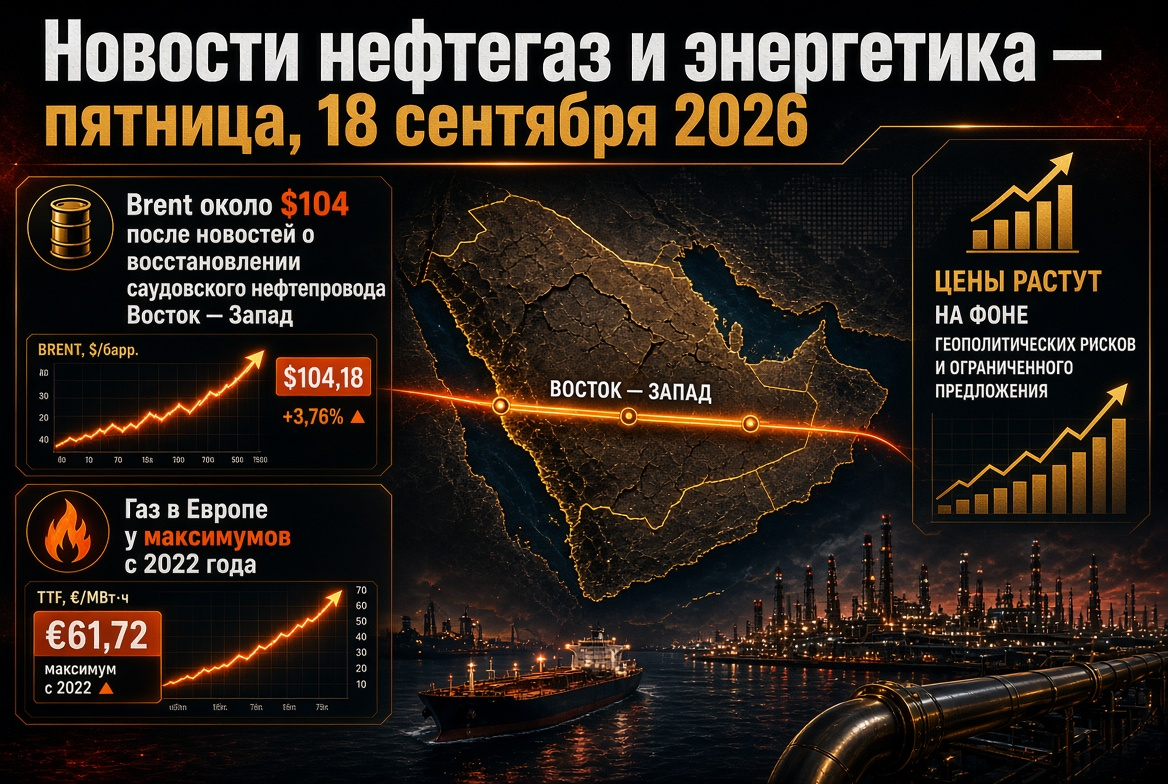
Current News in the Oil, Gas and Energy Sector as of 13 November 2025: Transactions, Geopolitics, Exports, Oil and Gas Production, Impact of Sanctions, and Global Market Balance. Analysis for Investors and Stakeholders in the Fuel and Energy Complex.
The latest developments in the fuel and energy complex (FEC) as of 13 November 2025 attract significant attention from investors and market participants due to their complexity. There is still no breakthrough in relations between Russia and the West; on the contrary, the United States has imposed new sanctions on major Russian oil companies, indicating an intensification of the sanctions standoff. The global oil market, which previously faced pressure from excess supply and slowing demand, remains in a fragile equilibrium: prices for Brent crude are hovering around the mid-$60 per barrel mark (approximately $64–66), reflecting a balance of opposing factors. The European gas market is entering winter with record supplies, as underground gas storage (UGS) facilities in the EU are over 95% full, ensuring a reliable reserve and keeping prices at a relatively moderate level. Meanwhile, the global energy transition is reaching new heights, with many countries recording record renewable generation; however, traditional resources remain necessary for the stability of energy systems. In Russia, following a spike in fuel prices, authorities have extended a ban on gasoline exports and restricted diesel exports until the end of the year, aiming to stabilise the domestic market. Below is a detailed overview of key news and trends in the oil, gas, electric power, and raw materials sectors as of this date.
Oil Market: The Threat of Excess Supply and Slow Demand
Global oil prices continue to show relative stability at low levels. The North Sea benchmark Brent is trading around $65 per barrel, while US WTI is close to $60. Current prices are roughly 10% lower than a year ago, reflecting the gradual normalisation of the market following the extreme peaks of the energy crisis of 2022–2023. The equilibrium is supported by a combination of several factors:
- Increase in OPEC+ Production. The oil alliance has been consistently increasing supply since the beginning of the year. By autumn 2025, the collective production quota of key participants in the deal had nearly returned to pre-pandemic levels: monthly easing of restrictions since spring led to an increase in daily production by several million barrels. This increase in supply is already reflected in the rise of global oil and petroleum product stocks, furthering pressure on prices.
- Slowdown in Demand. The pace of global oil consumption growth has significantly decreased. The International Energy Agency (IEA) forecasts an increase in demand in 2025 of only about +0.7 million barrels per day (compared to +2.5 million in 2023). OPEC estimates the increase in demand at approximately +1.3 million b/d. The slowdown in the economy, especially in China's industrial sector, and the effects of previously high prices have prompted energy conservation and restrained consumer appetite.
- Geopolitics and Sanctions. The protracted conflict over Ukraine and the lack of progress in negotiations suggest that sanctions pressure will remain, and in some cases intensify, on the Russian oil and gas sector. In late October, the US administration expanded sanctions for the first time in a long time, adding Russia's largest oil companies to the list. These measures are forcing trading flows to be reshuffled: for instance, Indian refineries are already signalling a readiness to cut back on purchases of Russian oil to avoid secondary sanctions. On one hand, such steps increase uncertainty and create risk premiums in oil prices. On the other hand, global supplies continue to be redirected via alternative routes, and no immediate shortages of raw materials have emerged in the market. As a result, oil prices fluctuate within a narrow range, not gaining momentum for either a new rally or crash.
The cumulative effect of these factors creates a moderate oversupply against demand. The market is balancing on the brink of surplus, and exchange prices confidently remain significantly below last year's highs. Many analysts warn that if current trends persist, the average annual price for Brent could drop to around $50 per barrel by 2026. For now, market participants are taking a wait-and-see approach, tracking both fundamental indicators (inventories, production levels) and political signals from OPEC+ and key powers.
Gas Market: Full European Storage Ensures Price Stability
The focus in the gas market remains on Europe, which successfully completed the fuel injection season. EU countries achieved a gas storage level exceeding 95% of total capacity - significantly above the 90% target set at the start of winter and a record for recent years. Such a high margin of safety before the heating season bolsters the region's energy security. By mid-November, gas volumes in storage in a number of Western European countries have roughly matched the levels seen last year at the height of winter, allowing for an optimistic outlook for the upcoming cold months.
High stocks and stable liquefied natural gas (LNG) supplies are maintaining a relatively calm price environment in the European gas market. Futures at the Dutch TTF hub are fluctuating around €31–33/MWh (approximately $380 per thousand cubic metres) – significantly lower than the crisis peaks of 2022. Demand and supply in Europe are currently close to balance: moderate consumption and a warm start to autumn have allowed reserves to increase without price spikes. EU importers continue to actively purchase LNG from around the world – regasification terminals are operating at high capacities, accepting tankers from the US, Qatar, Africa, Australia, and other regions. This compensates for the cessation of pipeline supplies from Russia: since January 2025, transit of Russian gas through Ukraine has been completely halted, and the Yamal-Europe pipeline is closed due to sanctions, meaning the only route for pipeline gas from the Russian Federation to the EU remains the TurkStream through the Balkans (approximately 50 million cubic metres per day, a mere fraction of previous volumes).
As a result of diversifying supplies, Europe has entered winter with virtually no dependence on Russian gas. Risks, of course, persist: abnormally cold weather could lead to increased fuel consumption, and competition with Asia for spot LNG cargoes may intensify if the economies of China and other countries in the region accelerate. However, for now, the balance in the European gas market appears stable, and prices are comparatively low. This situation is favourable for European industry and energy sectors ahead of peak loads, reducing the likelihood of a repeat of the price shocks observed in the recent past.
International Politics: Western Energy Partnerships and New Sanctions
Western countries are taking coordinated steps to restructure global energy ties amid geopolitical tensions. In early November, major agreements were made at an energy forum in Athens, aimed at reducing Russia’s influence on the European gas market. For example, American company ExxonMobil signed a contract for the exploration and extraction of natural gas in Greek waters in collaboration with local partners. Simultaneously, Greece has concluded its first long-term LNG import deal with the US: starting from 2030, the country will receive under the contract a minimum of 0.7 billion cubic metres of LNG per year, with the prospect of increasing it to 2 billion cubic metres. These deals fit into the broader strategy of the European Union to replace Russian energy resources: in July, the EU and the US concluded a trade agreement, under which Europe committed to purchasing around $250 billion a year in American energy resources (oil, gas, and nuclear fuel) over the next three years.
US officials openly state their intention to drive out "every last molecule" of Russian gas from the markets of Western Europe. This new energy partnership is already yielding results: the European market has rapidly reoriented towards LNG, with countries such as Greece transforming from end consumers of Russian gas into hubs for distributing American fuel throughout Europe. At the same time, the EU is tightening its own restrictions: a plan for a complete ban on Russian LNG imports by 2027 has been approved, while embargoes on oil and petroleum products from Russia have already been imposed. Thus, the energy map of Europe is changing rapidly, with the share of the US, the Middle East, and other alternative suppliers steadily increasing.
However, the intensified sanctions have side effects for market participants. **India**, which has become the largest buyer of discounted Russian oil, is now forced to reassess its strategy. In late October, the US added Russian oil companies "Rosneft" and "Lukoil" to the sanctions list, complicating transactions with them. Indian refiners, to avoid losing access to the US financial system and facing secondary sanctions, have stated a willingness to sharply reduce procurement of crude oil from these companies. According to traders, some Indian refineries have already suspended the execution of long-term contracts with "Rosneft." These steps may reduce the total import of Russian oil to India (which reached record levels of 1.5–1.7 million b/d in 2025) and shift Indian demand to Middle Eastern and African suppliers, albeit at higher prices. Therefore, the sanctions pressure from Washington is effectively forcing a redistribution of global oil flows: Russian companies are compelled to increase discounts and focus mainly on China, Turkey, and a number of other countries that have not joined the sanctions.
India and China: Adjusting Imports and Increasing Domestic Production
The largest Asian economies continue to balance between energy resource imports and developing domestic production. **India** has found itself faced with a choice due to sanctions pressure: to maintain profitable purchases of cheap Russian oil or avoid severing trade relations with the West. Until recently, India actively increased imports of Russian oil, taking advantage of significant discounts (on average $5–10 off the Brent price for Urals grade). This allowed Russian oil to account for about 34% of India's raw material imports. However, the new US sanctions against "Rosneft" and "Lukoil", as well as the threat of high tariffs on Indian goods in the US, are forcing New Delhi to reduce its dependence on Russian supplies. Major Indian oil companies are signalling readiness to virtually eliminate purchases from sanctioned Russian producers by the beginning of 2026. In the short term, India is replacing lost volumes with imports from the Middle East (Saudi Arabia, Iraq, UAE) and Africa, although this does lead to a slight increase in raw material costs. Simultaneously, the Indian government is accelerating its program to develop domestic fields: following the announcement in August of a national "deep-sea mission" to search for oil and gas, state corporation ONGC has already begun drilling ultra-deep wells in the Andaman Sea. Initial reports indicate promising results, raising hopes for increased domestic production and reduced reliance on imports in the future.
**China**, for its part, remains the largest buyer of Russian hydrocarbons but is simultaneously focusing on expanding its own energy base. Beijing has not joined Western sanctions but has seized the opportunity to increase imports at reduced prices. Although by the end of the third quarter of 2025, China reduced its imports of oil from Russia by approximately 8% compared to last year's record (down to around 74 million tonnes for 9 months), Russia still ranks as the top supplier of oil to China. At the same time, Chinese companies are actively sourcing crude from Saudi Arabia, Malaysia, Brazil, and other countries, diversifying sources. China's total crude oil imports from January to September increased by approximately 2.5% year-on-year, exceeding 420 million tonnes (around 11.3 million barrels per day). In addition to imports, China is increasing domestic production: for the first three quarters of 2025, national producers extracted around 150 million tonnes of oil (+1–2% y/y) and about 170 billion cubic metres of natural gas (+5–6% y/y). The development of fields, particularly offshore and hard-to-reach ones, remains a strategic priority to reduce reliance on external supplies. Nevertheless, the scale of China's economy is such that in the foreseeable future, the country will retain its status as the largest importer of energy resources: experts estimate that even with increased domestic production, China will need to cover at least 70% of its oil needs through imports and about 40% through gas. Thus, India and China – two key consumers in Asia – are adapting their energy strategies to the new global reality, combining the search for lucrative import opportunities with efforts to develop domestic production.
Energy Transition: New Records in Renewables and the Role of Traditional Generation
The global transition to clean energy in 2025 continues to gain momentum. Impressive milestones in renewable energy have been achieved in many regions. **In Europe**, for the year ended 2024, the combined electricity generation from solar and wind power plants for the first time surpassed that from coal and gas-fired plants, and this trend has continued into 2025. The share of green electricity in the EU’s energy mix is steadily increasing, displacing coal following a brief resurgence in 2022–2023. **In the US**, renewable sources now provide over 30% of electricity generation; total generation from wind and solar at the start of 2025 has for the first time exceeded generation from coal. **China** retains its global leadership in installed renewable energy capacity, with dozens of gigawatts of new solar panels and wind turbines being added annually, breaking previous records. According to the IEA, total investments in the global energy sector in 2025 will exceed $3 trillion, with more than half of this funding directed toward the development of green energy, modernizing power grids, and energy storage systems.
The rapid growth of solar and wind generation presents new challenges for energy infrastructure. Even achieving record levels of output, renewables remain variable sources – their production is dependent on weather and time of day. To ensure reliable power supply, countries must maintain adequate capacities of traditional generation. In periods of low renewable output – such as during calm weather or at night – gas and coal power plants are brought online to meet peak demand. During the last heating season, in certain European countries, the load on coal-fired power stations had to be temporarily increased during windless weather, despite the environmental cost. In response to these challenges, governments and companies are actively investing in energy storage systems (industrial batteries, pumped hydro storage plants) and smart grids capable of flexibly redistributing loads. Experts predict that by 2026–2027, renewable sources could become the leading source of generation globally, finally surpassing coal. However, in the meantime, the need for reserves from traditional power stations will remain, serving as insurance against power interruptions. Thus, the global energy transition is accompanied by new records and investments but requires a delicate balance between the implementation of green technologies and the maintenance of energy system stability.
Coal Sector: High Demand in Asia with Stable Prices
Despite the acceleration in the development of renewables, the global coal market remains a significant segment of the energy balance. Demand for coal in 2025 remains high, particularly in the Asia-Pacific region. **China**, the largest consumer and producer of coal, continues to burn massive volumes of fuel. Annual coal production in China exceeds 4 billion tonnes, covering a large portion of domestic needs. However, during peak demand periods (for example, in hot summers for air conditioning or cold winters for heating), even these colossal volumes are barely sufficient, and China periodically increases coal imports from countries such as Indonesia, Russia, and Australia to avoid shortages. **India** is also increasing coal consumption alongside economic growth and electrification: national coal production is breaking records, surpassing 900 million tonnes per year, although rapidly increasing energy demand necessitates greater imports. Other developing Asian countries (Indonesia, Vietnam, Pakistan, Bangladesh) are commissioning new coal-fired power plants in an effort to meet the energy demands of their populations and industries.
Prices for thermal coal in 2025 have stabilised relatively after sharp spikes observed during the global energy crisis. On the key Asian market (Australian Newcastle coal), prices remain in the range of $130–150 per tonne, significantly lower than the peaks of over $400 reached in 2022. This price correction is explained by the restoration of supply and demand balance: increased production in exporting countries (Australia, Indonesia, Russia, South Africa) and a slight decline in demand in Europe and North America (where the transition away from coal has accelerated) have compensated for the rise in consumption in Asia. As a result, the global coal market has entered a phase of relative stability. However, environmental restrictions and investments in clean energy gradually limit the prospects for long-term growth in coal demand. It is expected that global coal consumption will reach a plateau in the coming years and then begin to gradually decline as countries pursue decarbonisation goals. For now, coal continues to play a significant role, providing base load generation and industrial production, particularly in developing economies.
Russian Fuel Market: Extension of Export Restrictions to Stabilise Prices
In the Russian petroleum products market in the second half of 2025, a package of measures is being implemented to normalise the price situation. In September – October, there was a slight decrease in wholesale prices for gasoline and diesel fuel following a surge last summer. The Russian government, aiming to prevent shortages and a new spike in prices, has extended temporary export restrictions on fuel. Specifically, the previously imposed ban on the export of automotive gasoline for all production and trading companies was initially extended to September and then renewed until the end of the current year. Simultaneously, from autumn, restrictions were imposed on the export of diesel fuel for independent traders without their own production – this measure aims to close loopholes for the export of scarce fuel abroad. According to Deputy Prime Minister Alexander Novak, these steps should ensure priority supply of petroleum products to the domestic market.
Thanks to the implementation of this package of decisions, the situation at filling stations has stabilised significantly. Exchange prices for gasoline and diesel have retreated from peak levels, while retail prices are growing at moderate rates – around 5–6% since the beginning of the year, which is close to overall inflation. Filling stations across the country are adequately supplied with fuel, coinciding with the end of the harvesting campaign and the beginning of the winter season. The government has also increased volumes of subsidised fuel sales on the domestic market and tightened control over the sale of petroleum products to prevent a repeat of the sharp price spikes witnessed in spring and summer. Long-term measures are being discussed, such as increasing export duties and adjusting the damping mechanism, to create a more resilient supply system for the domestic market.
As a result of the efforts undertaken, the internal fuel market in the Russian Federation entered the winter period in a relatively balanced state. Authorities have succeeded in curbing price surges and creating reserves of fuel supplies. Market participants note that the further dynamics of prices will depend on the global market situation (the ruble exchange rate, oil prices) and the discipline in enforcing the imposed restrictions. Nevertheless, for now, the Russian fuel sector is demonstrating signs of stabilisation, which is especially crucial for the economy and the population during the season of heightened energy consumption.