Current News on Startups and Venture Investments as of 29 August 2026: Nvidia's Record Reporting as a Barometer for the AI Economy, the Race Between Anthropic and OpenAI for the Public Market, Mega Rounds in AI Infrastructure, Defence Technologies and Robotics, as well as Key Venture Market Trends for Investors and Funds.
By the end of August 2026, the global venture market is pulsating with a rhythm set by artificial intelligence. Nvidia's quarterly reporting, which became the week's main event, confirmed that the demand for AI infrastructure is unwavering, and capital expenditures among hyperscalers continue to rise. In this context, venture investments in startups are hitting record highs — in just one week of August, around 60 rounds in the AI segment were closed, totalling $11 billion, while the IPO market is gearing up for a listing that could become the largest in history.
Key events and trends shaping the venture market agenda leading into Saturday, 29 August 2026, include:
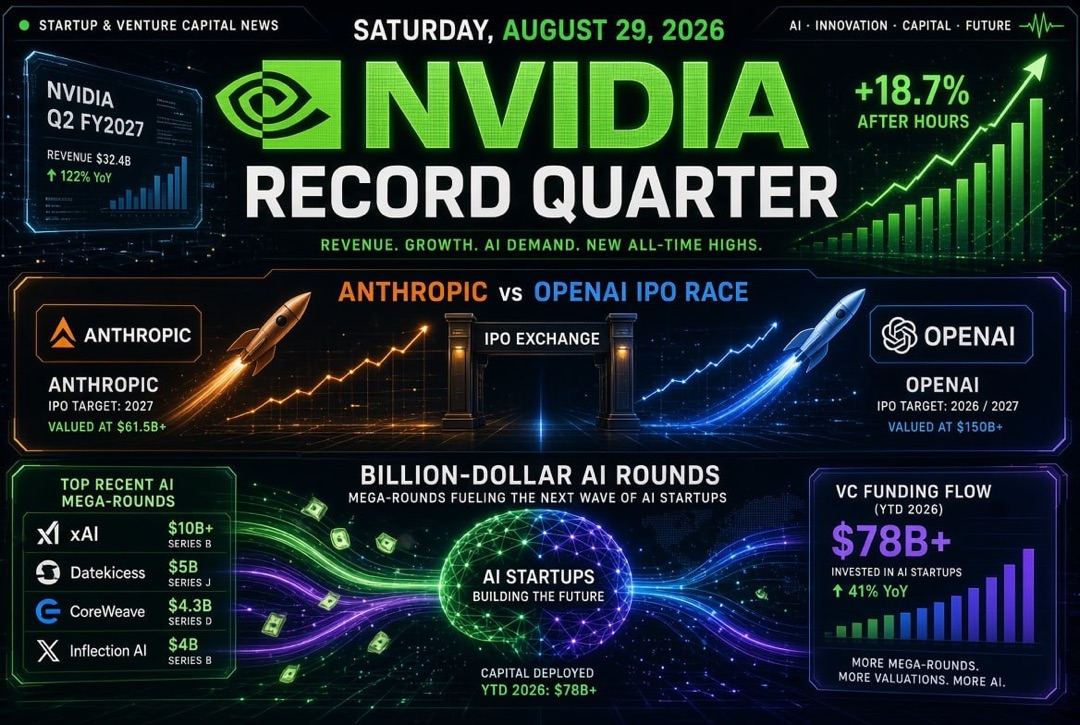
- Nvidia's Record Quarter. Revenues of $96.2 billion (+106% year-on-year) and a forecast of $108 billion for the next quarter dispelled concerns over an AI cycle slowdown.
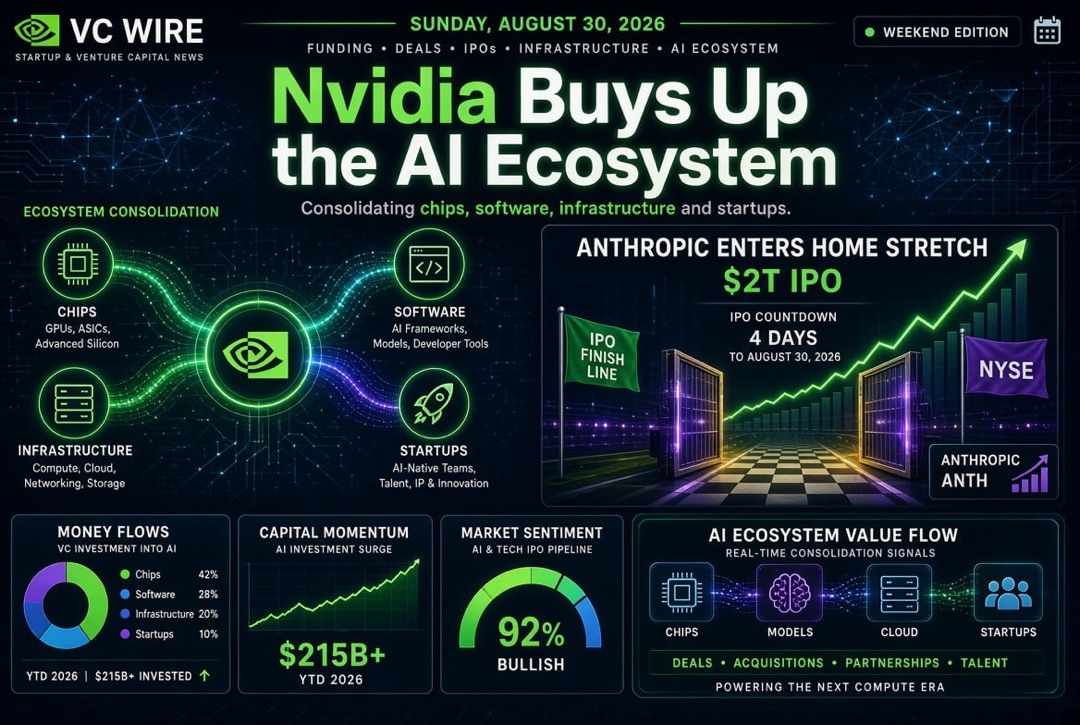
- The IPO Race of Anthropic and OpenAI. Anthropic is heading towards an October listing on Nasdaq with a valuation target of $1–2 trillion; OpenAI is leaning towards delaying its offering until 2027.
- Mega Rounds in AI Infrastructure. Nebius raised $4.5 billion, Castelion closed a $1 billion round, and Italian firm Domyn secured $1.1 billion.
- Capital Diversification. Record investments are flowing into defence technologies, humanoid robotics, energy, and fintech.
- Mega Funds Stockpiling "Dry Powder." Khosla Ventures is raising up to $5.5 billion, while the Abu Dhabi sovereign fund MGX closed a $49 billion fund.
Nvidia: $96 Billion for the Quarter and a Barometer for the Entire Venture Ecosystem
Nvidia’s report for the quarter ending in July has become a key macro signal for venture investors. The company's revenue reached $96.2 billion — a growth of 106% year-on-year, with $89 billion generated by the data centre business. Net profit soared to $59.7 billion compared to $26.4 billion a year ago, and the forecast for the current quarter at approximately $108 billion surpassed Wall Street's consensus. Shares reacted with a nearly 9% increase.
Two details are critical for the venture market. Firstly, the AI cloud segment for industrial and corporate clients grew by 138% year-on-year — demand is expanding beyond hyperscalers, precisely where venture portfolio companies operate. Secondly, Nvidia is increasingly financing AI infrastructure itself by participating in platforms expected to mobilise over $500 billion. The Vera Rubin platform has entered full production, and the race for computing power is transitioning into the inference phase — servicing already deployed models.
IPO Race: Anthropic on the Verge of Public S-1, OpenAI Takes a Pause
The main intrigue of the autumn is which of the two leading AI labs will go public first. Anthropic, which filed a confidential S-1 application on 1 June, is moving towards public document disclosure in September and a Nasdaq listing in October. The last private round valued the company at $965 billion, with a estimate of $65 billion, and investors are discussing a target valuation for the offering in the range of $1–2 trillion. The arguments are compelling: in the second quarter of 2026, Anthropic surpassed OpenAI for the first time in quarterly revenue — $11.5 billion compared to $6.7 billion.
OpenAI, conversely, is leaning towards postponing its IPO until 2027. Following the volatile debut of SpaceX in the summer, investors have become more cautious about oversized offerings, while internal forecasts indicate losses of around $14 billion for OpenAI in 2026. For venture funds, the outcome of this race is fundamental: the multiplier that the public market assigns to the first AI lab will serve as a benchmark for the revaluation of the entire private AI portfolio.
Mega Rounds of the Week: Infrastructure Leads Once More
Weekly statistics confirm the concentration of capital in the “picks and shovels” of the AI economy. The largest rounds of recent days include:
- Nebius — $4.5 billion for the expansion of cloud AI infrastructure, the largest deal of the week.
- Domyn — the Italian developer of AI models raised $1.1 billion in structured financing.
- Castelion — $1 billion in a Series C round for mass production of hypersonic systems.
- Instinct — $250 million in a Series B round from Index Ventures and Benchmark, valuing the company at $2.5 billion in the consumer AI agents segment.
- Starcloud — $250 million at a valuation of $2.3 billion for building orbital data centres.
- Velaura AI — $110 million in a Series A round: energy-efficient chips for AI have propelled the company into unicorn status.
Notably, capital is flowing to several levels below consumer applications — into optical interconnections, power electronics, and specialised silicon. Investors are financing the resolution of the physical limitations imposed by the AI boom: energy, cooling, and bandwidth.
Mega Funds and "Dry Powder": Capital Prepares for a New Cycle
Institutional capital continues to increase. Khosla Ventures is in talks to raise up to $5.5 billion for a new fund series. The Abu Dhabi sovereign fund MGX has closed its first fund at $49 billion, exceeding its target of $45 billion, and is building the largest AI campus in Europe near Paris with a capacity of 3 GW. The influx of “big money” intensifies competition for the best deals and maintains high valuations at later stages, while funds are becoming stricter in filtering projects lacking clear unit economics.
Diversification: Defence, Robotics, Energy, and Fintech
While artificial intelligence remains a magnet for capital, the sector focus of venture investments in 2026 is notably broader:
- Defence Technologies — a record year: alongside Castelion, billion-dollar rounds were closed by manufacturers of automated factories and containment systems.
- Humanoid Robotics — the volume of investments in the segment has already set a historical high for the first eight months of the year.
- Energy — nuclear startups like Valar Atomics and energy platforms such as Base Power are attracting rounds of $1 billion: the AI boom is hitting the electricity wall.
- Fintech — global investments reached $28.6 billion in the first half of the year, growing by 22.7% year-on-year.
Asia: India Gaining Momentum
The Indian ecosystem is demonstrating sustained activity. Fintech Navi, founded by Flipkart co-founder Sachin Bansal, raised $100 million in its first institutional round at a valuation of approximately $1.3 billion and is preparing for an IPO on local exchanges. Concurrently, deals are being closed in space technologies and logistics, new impact funds are being launched, and corporate family offices are allocating capital for deep-tech projects. India is increasingly asserting itself as the second centre of venture capital attraction in Asia amid restrained activity in China.
Russia and the CIS: Selectivity and Increasing Average Checks
The Russian venture market remains compact, yet is undergoing structural changes. In the first half of 2026, venture investments totalled 4.6 billion rubles across 54 deals, while the median check grew by 23% to 24.6 million rubles. Investors have become more selective: capital is shifting towards late-stage companies with revenue and profit, while the seed segment is suffering from a funding shortage. Niche initiatives are emerging — including funds focused on startups with AI agents at the core of their operational models, with checks ranging from 5 to 100 million rubles.
What This Means for Investors: Autumn Forecast
The market enters September with three defining factors. The first — Anthropic's public S-1, which will first disclose verified financial performance from a leader in the AI segment and set multipliers for the entire industry. The second — the resilience of capital expenditures on AI infrastructure, confirmed by Nvidia's forecasts. The third — the rising concentration of revenue and risks: three largest customers of Nvidia account for more than half of its revenue, while mutual financing within the AI ecosystem strengthens systemic links.
For venture funds, the baseline scenario for autumn predicts a continuation of the boom with increasing selectivity. The exit window is open, valuations are at historical highs, but discipline in deal selection is becoming the main competitive advantage. The seasonal question is not “will the growth continue,” but “what multiplier is the public market willing to pay for AI revenues.” The answer will emerge in October.