Oil Market: Brent at $88 — Week Ends with Over 5% Decline
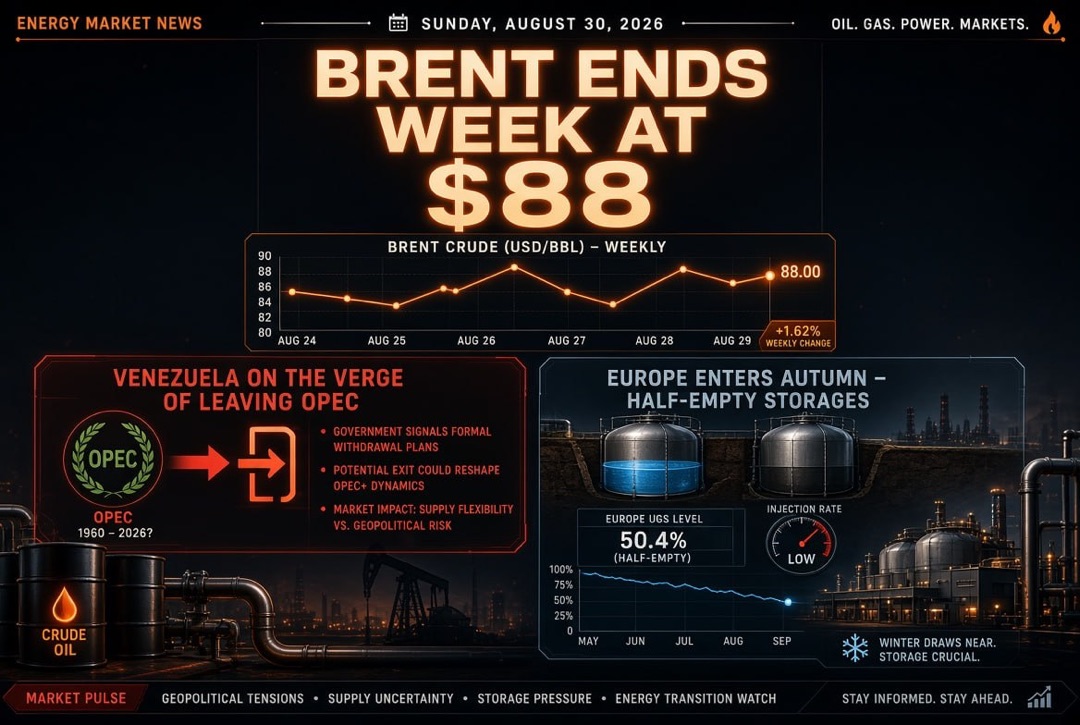
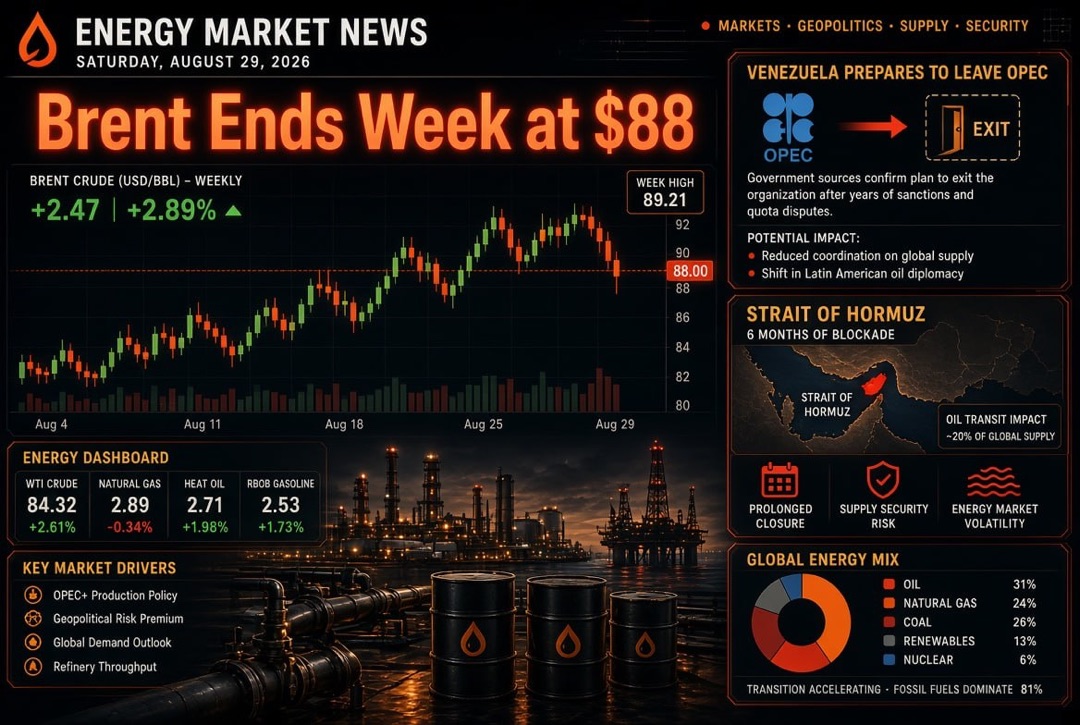
Oil prices are correcting after a two-week rally. On Friday, Brent traded near $88 per barrel, while WTI hovered around $82–83. The weekly decline for Brent exceeded 5%, and WTI fell by more than 4%; however, since the beginning of the year, the North Sea benchmark is still about 30% higher year-on-year, maintaining a premium for geopolitical risk since the closure of the Strait of Hormuz in February. Key price drivers as the weekend approaches include:
- Diplomacy over Hormuz: The Iran-Oman agreement on the division of control and revenues from transit through the Strait remains the main bearish factor of the week, although Tehran emphasizes that immediate reopening of shipping will not occur.
- Tight Washington Stance: On Friday, prices briefly turned upwards on reports that the U.S. is ruling out a return to the terms of the June peace memorandum with Iran — the market interprets this to mean that a final deal will be postponed.
- Russian Risk: Vladimir Putin's statements about the fruitlessness of negotiations with Ukraine and preparations for an escalation of hostilities, as well as ongoing strikes on Russian refineries and ports, are limiting Russia’s export potential and providing support for prices from below.
- Gulf Logistics: Saudi Arabia is ramping up shipments from its terminals within the Gulf, restructuring export routes due to threats to shipping from the Houthis in the Red Sea.
Venezuela and OPEC: Founding Member on the Brink of Historic Exit
The main corporate-political news of the week is reports that Caracas is seriously considering leaving OPEC. The matter is being discussed in negotiations with U.S. officials, but no final decision has been made. The context makes this story strategic for the entire global oil market:
- Venezuela is one of the five countries that founded OPEC in 1960 and holds the world’s largest proven oil reserves, with current production only around 1–1.2 million barrels per day.
- The U.S. is discussing long-term agreements for American companies to access Venezuelan fields; some officials view the Washington-Caracas alliance as a counterbalance to OPEC's influence.
- This is the second potential exit this year: the UAE left OPEC and OPEC+ as of 1 May 2026, and Iraq publicly expressed dissatisfaction with the quotas over the summer.
- Boosting Venezuelan production through U.S. investments could provide a new source of supply over the next few years — a factor that could pressure long-term prices.
For investors, the "Vexit" scenario primarily raises questions about the manageability of the cartel: further fragmentation of OPEC+ increases the risk of a market share battle reminiscent of 2020. The intermediate benchmark is the alliance's meeting on 6 September, where the baseline scenario remains a pause in increasing quotas until the end of the year.
Strait of Hormuz: Six Months of Crisis and a Fragile Diplomatic Window
Friday, 28 August, marked a symbolic date — six months since the onset of the U.S. and Israeli military operation against Iran and the subsequent closure of the Strait of Hormuz, through which approximately 20% of global oil trade and nearly a fifth of LNG transited before the war. The current status of this key artery of global energy:
- Iran and Oman have agreed on the coordinates of the routes: incoming traffic will use the northern corridor in Iranian waters, while outgoing will take the southern route in Omani waters, as well as an agreement on revenue sharing from transit and joint de-mining of the waters.
- Tehran insists: the agreement with Muscat does not automatically imply the opening of the Strait until the U.S. fulfills its commitments; traffic remains significantly below the pre-war average of ~130 vessels per day.
- Shipping security has not been restored: an attack on a tanker off the coast of Oman on 25 August keeps insurance premiums at prohibitive levels.
- U.S. Treasury Secretary Scott Bessent is preparing to demand from G20 partners a reduction of ties with Iran, under threat of restricting access to the dollar system — sanction pressure is shifting into the financial realm.
Gas and LNG: Europe Enters Autumn with Minimum Stocks Since 2009
The gas market remains the most vulnerable segment of the global energy landscape. TTF futures rose above €68/MWh at the beginning of the week — a peak since early 2023 — and by Friday retreated to the €65–67 range on news of diplomatic progress. The fundamental picture is concerning:
- Storages: EU gas storage facilities are only ~63% full — the lowest end-August level since 2009 — with a target level of 80% by 1 November, downgraded from the previous target of 90%.
- Qatar: Over six months of blockade, the world’s second-largest LNG exporter has lost about $24 billion in revenue, with shipments dropping by 96% during certain periods — an unprecedented supply shock.
- Price Forecasts: If Middle Eastern exports normalise slowly, the December TTF could soar past €100/MWh — double the baseline estimates made at the start of the year.
- Regulatory Factor: The EU's ban on Russian pipeline gas and LNG has been in place since March 2026, with transition periods that restrict manoeuvrability amidst shortages.
- Market Divergence: The Asian JKM remains at $21–22/MMBtu, while the U.S. Henry Hub is below $3/MMBtu with record production levels: this spread fuels interest in new U.S. LNG export projects.
Refined Products: Record Low Diesel in the U.S. and Peak Refinery Utilisation
The latest EIA report recorded U.S. refinery utilisation at 97.4% of capacity — processing reached 17.4 million barrels per day, while commercial oil stocks remained virtually unchanged (428.9 million barrels). The key signal for the refined products market: diesel stocks in the U.S. have fallen to their lowest seasonal level on record. Europe, facing a shortage of middle distillates due to the loss of Russian and Middle Eastern volumes, has, for the first time in seven years, sourced diesel from Mexico. For fuel companies and traders, this means record crack spreads for diesel will likely persist at least until the end of autumn — and heightened sensitivity in the market to any news about refinery status on both sides of the Atlantic.
Russia: Diesel Export Fate to Be Decided This Weekend
Russia’s domestic fuel market remains under manual control, and the coming days will be decisive. The current ban on diesel fuel exports for producers expires on 1 September; according to industry sources, the government is leaning towards an extension at least until the end of September, with discussions also considering a potential extension until the end of 2026. A full ban on gasoline exports is in place until 31 January 2027, with restrictions also affecting jet fuel. Deputy Prime Minister Alexander Novak indicated that there is no diesel shortage and that some refineries are returning from maintenance; however, drone strikes on refining infrastructure continue to limit output: processing levels were at a two-decade low during the summer, and July production — around 8.9 million barrels per day — marked a six-year low. For the global market, this indicates a shortfall of Russian diesel volumes at a time of peak European middle distillate shortages.
Electricity, Renewables, and Coal: Energy Crisis Prolongs Coal Era, But Energy Transition Accelerates
Expensive LNG has reshaped the balance of global electricity generation: coal has received an unexpected stay of execution and remains the largest single source of generation, accounting for about a third of global output. At the same time, the total of renewable sources — solar, wind, hydro, and bioenergy — is forecasted by the IEA to surpass coal for the first time in 2026. The regional picture is contrasting:
- In the U.S., solar generation increased by 21% in the first half of the year, with wind and solar together providing about 20% of output, while coal generation decreased by around 11% due to cheap gas.
- Texas has suspended approval for new data centres, prompting the EIA to lower projections for the state's energy consumption growth in 2027 from 14% to 6% — the first notable sign of cooling from AI-related load on the grid.
- In Europe and Asia, expensive LNG is making coal more competitive against gas in electricity generation, supporting demand for thermal coal from exporters — Indonesia, Australia, and South Africa.
Macro Views: Jackson Hole and Interest Rates as a Demand Factor for Energy Commodities
An additional reference point for commodity markets will be the speech by Federal Reserve Chairman Kevin Warsh at the Jackson Hole symposium on Friday. Signals regarding the trajectory of interest rates directly impact the dollar's value, the costs of financing energy projects, and forecasts for oil and gas demand. A softer tone would support commodity prices, while a hard line could increase pressure on oil, already declining on the diplomatic news.
What to Watch This Weekend and Next Week: Energy Market Participants' Calendar
- Official reaction from Caracas and OPEC regarding reports of Venezuela's potential exit from the cartel.
- Russia’s government decision on diesel fuel exports before the ban expires on 1 September.
- Data on actual transit through the Strait of Hormuz and the fate of the Iran-Oman corridor.
- Gas injection rates in European storage and TTF dynamics after retreating from three-year highs.
- OPEC+ meeting on 6 September: a pause in quota increases and discussion on parameters for 2027.
- Escalation risks along the Russia-Ukraine line and the state of Russian oil refining.
- Consequences of the Fed Chairman’s speech in Jackson Hole for the dollar and the commodity markets.
Summary of the week: the oil market drifts towards a de-escalation scenario in the Middle East, but remains hostage to physical flows through the Strait of Hormuz and growing uncertainty within OPEC itself, where, following the exit of the UAE, Venezuela is now contemplating its exit. Gas and diesel are the key points of deficit in the global energy landscape going into autumn 2026: Europe enters the heating season with the lowest stocks in 17 years, while coal receives an extension of its era despite the accelerating energy transition. Daily analysis on oil, gas, renewables, and the energy market can be followed in the Open Oil Market Telegram channel.