Key Topics of the Day: Venture Investments Are Fragmenting, Neo-Clouds Are Being Revalued Based on Jane Street Contracts, and Anthropic's IPO Is Being Pushed Towards the November Elections
Highlights of the Day: Summary for Investors
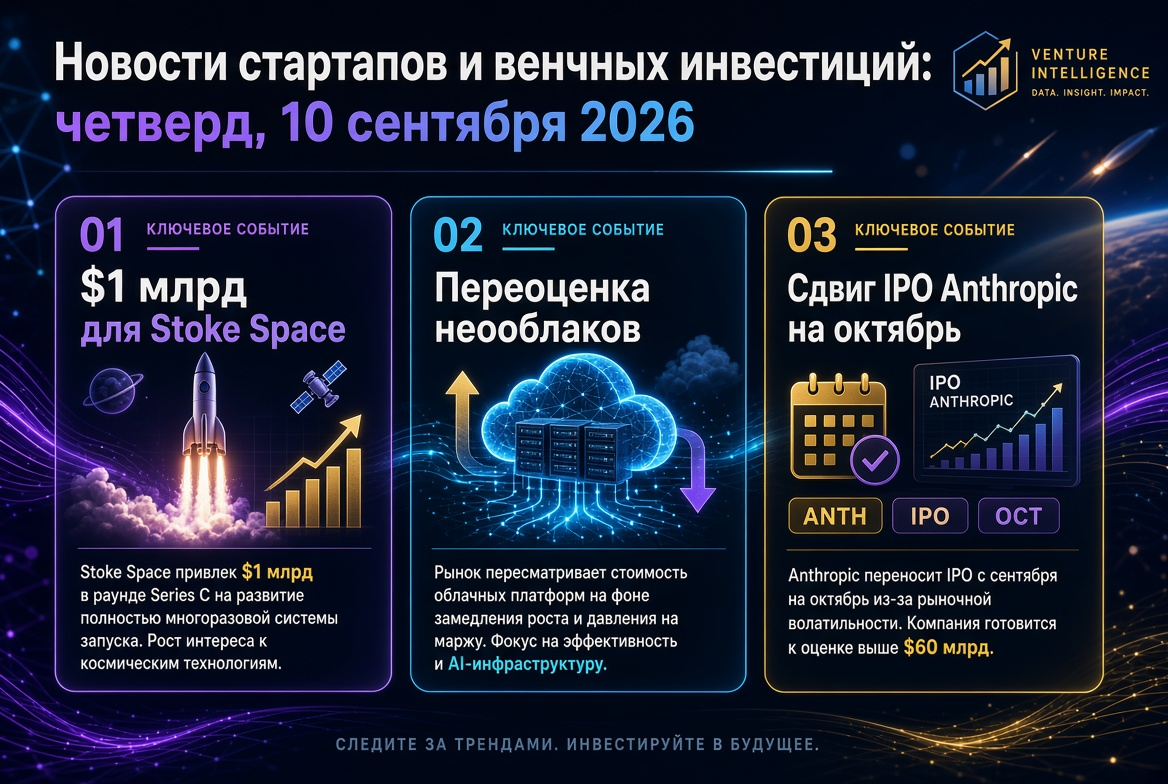
- Space. Stoke Space has closed the first part of its Series E round at $1 billion; The Exploration Company raised $450 million in Series C with participation from Scaleup Europe Fund.
- AI Infrastructure. Crusoe garnered over $3 billion at a valuation of around $30 billion, while Fluidstack raised $1.5 billion at $18 billion; Nscale is raising $3.5 billion ahead of its IPO.
- Applied AI. Forus tripled its valuation to $3 billion within four months; Split Pay disclosed $125 million across two rounds; Blee raised $20 million.
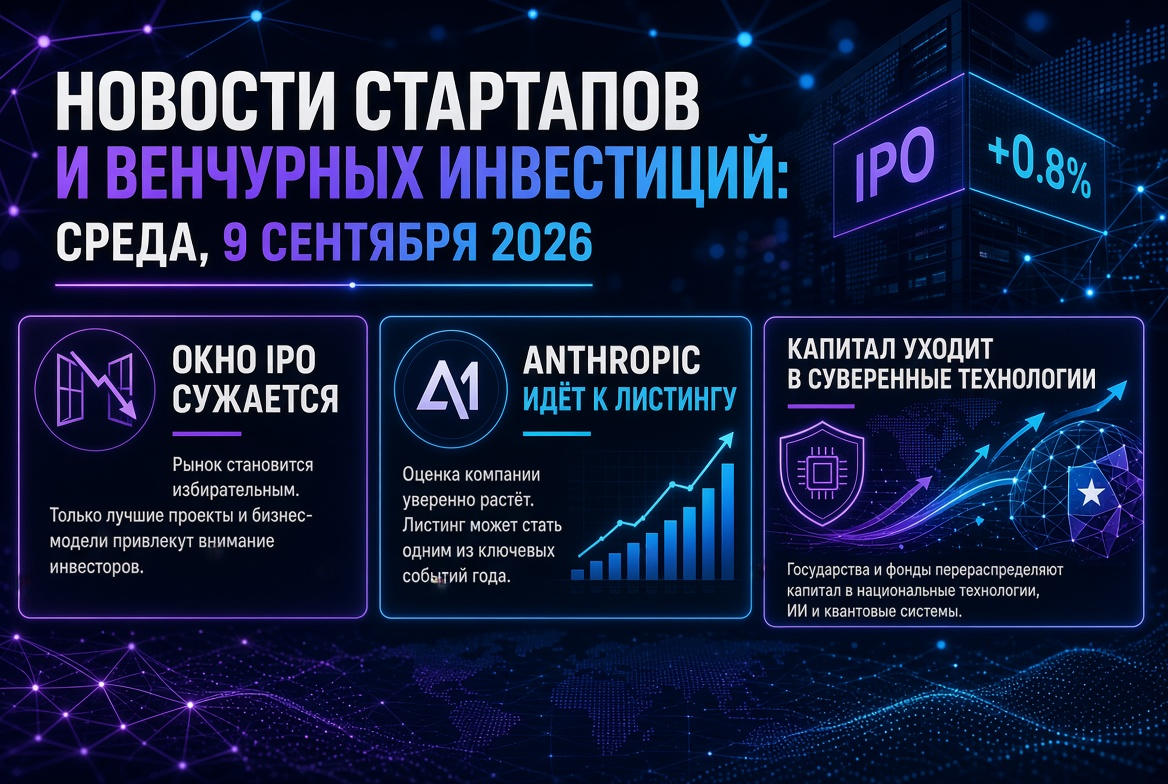
- IPO Calendar. Anthropic: public prospectus—end of September, roadshow—no earlier than mid-October, listing—just days before the US midterm elections.
- Macro. Debt financing for AI projects has approached $500 billion; lenders are tightening their requirements regarding lease agreements and energy supply permits.
Space Startups: $1.5 Billion in One Day and a New Logic of Sovereign Capital
Washington-based Stoke Space has closed the first part of its Series E round at $1 billion, co-led by Point72 Ventures and Spark Capital, bringing its total funding to $2.3 billion. The company is developing the Nova rocket, which features fully reusable first and second stages—with the first orbital flight of Nova Pathfinder scheduled for early 2027, and the Block 2 version designed to deliver around 15 tonnes to low Earth orbit. The billion-dollar round for a company yet to reach orbit is easily explained: access to launches has become critical infrastructure, and the market relies on a single dominant supplier.
Munich-based The Exploration Company raised $450 million in Series C from Bessemer Venture Partners, Atomico, and Scaleup Europe Fund, with participation from Balderton, Plural, Cherry, and Red River West. Its total funding reached approximately $680 million, with a portfolio of contracts and commitments exceeding $2 billion. The funds will go towards the reusable Nyx spacecraft and the Storm propulsion programme. The involvement of the European scaling fund partly positions the deal as an instrument of industrial policy: Europe regards orbital logistics as a strategic competency rather than a typical technological category.
Completing the space round is Poseidon Aerospace, which has re-signed its Series A at $60 million led by TQ Ventures for the Egret unmanned cargo aircraft, with its first flight expected by the end of 2026. The company consciously uses a classic design and conventional engines, concentrating the technological risks solely on autonomy and certification.
Neo-Clouds: Jane Street Sets the Price for AI Infrastructure
The most notable revaluation of the week occurs in the specialised AI data centre segment. Crusoe has closed its Series F with over $3 billion at a post-valuation of around $30 billion, co-led by Atreides Management and Valor Equity Partners, with participation from Mubadala Capital—almost three times the $10 billion mark recorded in October 2025. A five-year contract worth $13 billion with Jane Street for the provision of GPU resources was a major catalyst. Fluidstack, Anthropic's anchor infrastructure partner on a $50 billion programme, raised $1.5 billion under the same Jane Street leadership at a valuation of $18 billion—up from $7.5 billion confirmed in July. Meanwhile, Nscale is concurrently raising $3.5 billion with a target valuation of $30 billion ahead of its listing.
What the Convergence of Valuations Means for Funds
- Neo-cloud valuations are determined not by public comparables but by the volume of contracted revenue—essentially forming credit books.
- Quantitative trading firms have become the largest buyers of compute resources: Jane Street has committed around $19 billion in total to CoreWeave and Crusoe and is now also acting as an investor.
- The risk lies in the assumption that the multi-year demand for AI compute will remain at current levels; the largest neo-cloud clients are simultaneously potential competitors.
Applied AI: Premium for Owning the Workflow
The software transactions of the day share a common trait: artificial intelligence is embedded in a regulated or costly operational process, rather than being sold as a standalone model. Forus, previously known as Tandem, raised $150 million in Series C at a valuation of $3 billion, led by Bain Capital Ventures with participation from Thrive Capital, General Catalyst, and Accel—its valuation tripled in approximately four months. The company automates the journey from prescription issuance to treatment acquisition, working with nine of the fifteen largest biopharmaceutical corporations.
Split Pay disclosed $125 million over rounds A and B led by Khosla Ventures with participation from Thrive Capital and Max Levchin: its product allows users to defer up to half of their rent or mortgage payment for 30 days, with investor focus placed on AI underwriting for consumers under 40 years old. Blee from New York raised $20 million in Series A from Fin Capital and SMBC for its compliance control platform for marketing materials, including AI-generated content. Notably, the Israeli-Dutch company Wonderful raised $550 million at a valuation of $5 billion with the involvement of Salesforce—doubling its valuation in less than six months.
Biotech: Capital Follows Specific Clinical Assets
- BrainChild Bio - $116 million in Series A for CAR-T therapy BCB-276 for diffuse glioma of the brainstem in children, with the programme in the registration phase.
- Moonwalk Biosciences - $70 million in Series B for RNA interference targeting adipose tissue; leading candidate MW101 is set to enter the clinic by the end of 2027 as an alternative to GLP-1.
- Bluecore Energy - $50 million in seed capital led by Silverton Partners for small nuclear reactors on barges near ports, prioritising Long Beach port.
- ARC Ride (Nairobi) - $33.3 million in equity and debt from Norrsken22, Novastar, IFC, BII, and Proparco for a battery swapping network for electric motorcycles.
The common denominator is that investors are financing execution rather than platform narratives: trials, licensing, and production lines. ARC Ride's structure, involving development institutions, demonstrates that for physical infrastructure, capital architecture is as important as the product itself.
Anthropic IPO: The Calendar is Constrained by the November Elections
The publication of Anthropic's prospectus, initially expected this week, has been postponed until the end of September; marketing of the offering will not commence before mid-October, and the listing may occur just days before the US midterm elections. The organisers include Morgan Stanley, Goldman Sachs, JPMorgan, and Citi; prior to meetings with analysts, the company is securing a $15 billion revolving credit facility. Its valuation is being discussed at up to $2 trillion, with a fundraising goal of at least $130 billion. The experience of SpaceX, whose shares soared from $135 at the June debut to $226 and then fell to $105, prompts the issuer to contemplate extended lock-ups and staggered sales. The credit facility itself is a key indicator: it determines whether the company can weather a weak market rather than being forced to launch its offering.
Other Signals from the IPO Market
- SoftBank's infrastructure unit has submitted an updated application for a Nasdaq listing; Nvidia has committed to buy shares worth $1.5 billion at the offering price.
- Chinese service robot manufacturer Excelland Robotics is starting trading in Hong Kong with a net raising of approximately $87 million.
- Crusoe has held meetings with leading banks regarding its own listing.
Macro Context: Expensive Money and Oversubscribed Growth Funds
The Federal Reserve's rate remains in the 3.5–3.75% range, and the market is discussing a potential increase at the September meeting. At the same time, growth funds continue to gather capital: Menlo Ventures raised $3 billion in 2026, with $2.25 billion designated for late-stage investments, and CVC closed its sixth secondary deal fund at $10 billion. Debt financing for AI projects has approached $500 billion, but lenders are increasingly demanding verified lease agreements and connection permits. The combination of expensive money, abundant growth capital, and a robust public market is creating a classic "barbell" scenario: premiums are being awarded to companies controlling scarce resources—and to almost no one else.
Russia and the CIS: The Market is in the Phase of Selecting Sustainable Businesses
The Russian venture market is undergoing a profound transformation, the likes of which have not been seen since 2009-2011: the volume of deals has decreased by about 40%, and high deposit rates have rendered long-term illiquid investments irrational for most private investors. The largest local deals of the year are measured in tens of millions of dollars—a $15 million round is roughly equivalent to one-tenth of the total volume of venture investments in the country for 2025. The focus has shifted from “promising ideas” to companies with confirmed revenues, while regional fairs and the Russian Venture Forum remain the primary meeting points for funds and founders.
Conclusions for Venture Investors and Funds
- Scarcity has become the main investment thesis. Orbital launches, reliable generation, clinical solutions, and regulatory expertise are assets that cannot be reproduced through access to basic models.
- Capital efficiency requires a new metric. A rocket company cannot be evaluated by the burn rate of a SaaS startup; the question is what technical or regulatory risk is mitigated by each successive dollar.
- Neo-cloud valuations are tied to contracts, not multiples. Funds should analyse the structure of cornerstone clients and debt burdens, rather than revenue growth rates.
- October remains a calibration point. The success of Anthropic will unlock distributions for LPs in the fourth quarter; a second postponement into the pre-election volatility zone will signal a re-evaluation of the entire pool of private AI assets.