Global Startup and Venture Investment News as of 11 November 2025: Record Investments in Artificial Intelligence, IPO Market Revival, Mega Rounds, Consolidation, and Renewed Interest in Crypto Startups
As of early November 2025, the global venture capital market is confidently on the rise after several years of decline. Investors around the world are once again actively financing technology startups: record deals are being closed, companies are planning IPO exits, and major venture funds are returning to the stage with substantial investments. Governments in various countries are increasing their support for innovation, seeking to keep pace in the global technological race. Consequently, private capital is once again flowing into startup ecosystems, providing young companies with the resources needed for accelerated growth.
The latest statistics confirm this revival: in the third quarter of 2025, global venture investment reached approximately $97 billion, which is about 38% higher than last year and slightly above the previous quarter's figures. This marks the best quarterly performance since 2021 and the fourth consecutive quarter in which investment volume exceeded $90 billion. Following the "venture winter" of 2022–2023, startup funding has been steadily increasing for four reporting periods in a row, reflecting a return of investor confidence. Mega rounds in the artificial intelligence sector have significantly contributed to this growth, although an increase in investments is observed across all stages—from seed to late-stage funding. Approximately two-thirds of all venture investments in the past quarter were allocated to companies in the United States, but activity is also noticeable in Europe, Asia, the Middle East, and Latin America, underscoring the global nature of this upturn.
Key Trends for Venture Investors and Funds
- The Return of Mega Funds and Large Investors. Record funds are saturating the market with capital and enhancing the appetite for risk.
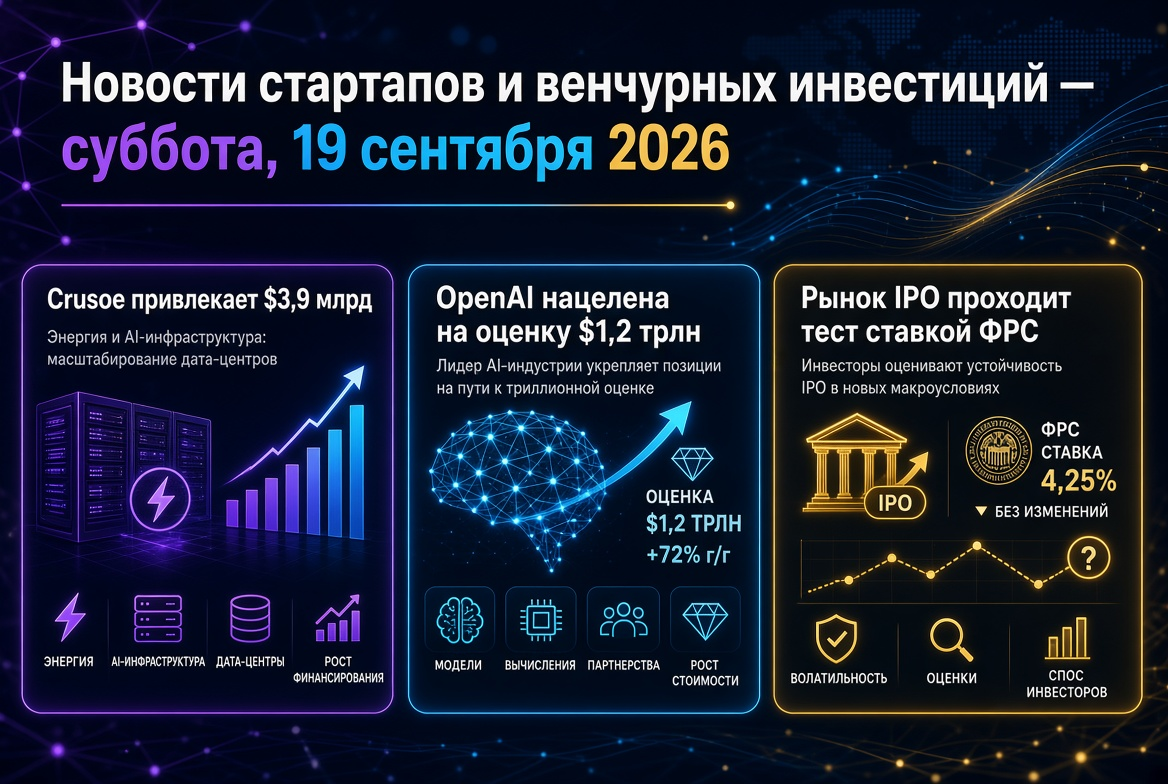
- Record Investments in AI and a New Wave of Unicorns. Large rounds are boosting valuations and accelerating scaling for industry leaders.
- The Revival of the IPO Market. The window for exits is once again open—both the quantity and quality of listing applications are on the rise.
- Industry Diversification. Venture capital is flowing into fintech, climate tech, biotech, space, defence, and SaaS.
- Consolidation and M&A. Strategic deals are creating new growth and liquidity trajectories.
- Renewed Interest in Crypto Startups. Funding for infrastructure and consumer Web3 applications is on the rise.
- Local Focus: Russia and the CIS. New funds and ecosystem development programmes are being established amidst limited access to external capital.
The Return of Mega Funds: Big Money Back in the Market
Major institutional players and venture firms are resuming fundraising and launching new mega funds focused on cutting-edge technologies. The return of "big checks" is increasing competition for the best deals, shortening the closing times for funding rounds, and creating a liquidity cushion for late-stage startups. For entrepreneurs, this translates into a broader choice of partners and funding strategies, while for LPs, it provides access to diversified portfolios in a growing market.
Record Investments in AI and a New Wave of Unicorns
Since the beginning of 2025, AI startups have become a magnet for capital, attracting a significant share of global investment in technology. Cumulative valuations of leading generative AI companies have approached the trillion-dollar mark, with the number of unicorns on the rise. The concentration of deals in top projects is elevating quality standards and scalability requirements, making early-stage selection increasingly stringent.
Examples of Notable Rounds in Recent Weeks
- Harvey (USA) — $150 million for the development of legal AI, valuation ~ $8 billion.
- Synthesia (UK) — $200 million for scaling a video generation platform.
- Fireworks AI (USA) — $250 million (Series C) for an AI platform in genomics and healthcare.
- Legora (Sweden) — $150 million, valuation ~$1.8 billion, legal software with AI elements.
- Armis (USA) — $435 million pre-IPO with a valuation of $6.1 billion (IoT cybersecurity).
The Revival of the IPO Market and Exit Prospects
After a two-year hiatus, technology companies are returning to public markets. Successful listings in fintech and digital assets have confirmed the demand for quality issuers, while a decrease in regulatory uncertainty in certain segments increases the likelihood of new listings in 2026. For venture funds, this opens a window for liquidity and improves DPI metrics, while for founders, it presents an alternative to costly private rounds.
Beyond AI: Healthcare, Climate, and Space
Biotech and healthcare are attracting double-digit capital volumes due to the fusion of data, AI, and clinical practices. Climate tech is advancing due to demand for sustainable materials and electric mobility, while space and defence startups are benefiting from the growing demand for satellite services and security. This diversification reduces the risks of overheating in any one niche and contributes to the resilience of the global startup market.
Consolidation and M&A: Mega Deals Reshape the Landscape
Strategic acquisitions in cybersecurity, fintech, AI, and software infrastructure are forming new centres of competence. For corporate buyers, M&A represents a way to accelerate product roadmaps, while for startups, it provides a pathway to scaling through access to distribution channels and infrastructure. For investors, these deals mean faster exits and a redistribution of capital into new investment opportunities.
Renewed Interest in Crypto Startups
The crypto industry is showing signs of a thaw: funding for infrastructure solutions (stablecoins, custody, compliance) is rising, and consumer Web3 applications are receiving support from top funds. Institutional interest is growing against the backdrop of a movement towards clearer regulations and the proliferation of exchange-traded products for digital assets. This expands the investor base and enhances the sector's resilience.
Local Perspective: Russia and the CIS
New funds and corporate initiatives are being launched in the region, with accelerators and grant programmes gaining momentum. Amidst limited access to international capital, the focus is shifting towards product-market fit in local markets, exports to friendly jurisdictions, and import-independent technologies. Key barriers—cost of capital and access to global technologies—are driving the search for niche strategies and partnerships.
What Investors Should Do: Practical Guidelines
- Focus on Quality Deal Flow. Enhance scoring based on profitability metrics, unit economics, and capital intensity.
- Portfolio Balance. Combine AI leaders with biotech, climate tech, and software infrastructure to reduce correlations.
- Readiness for Exits. Update strategies for secondary deals and monitor IPO windows for 2026.
- M&A Stream. Establish early connections with strategic buyers for potential synergies.
- Geographical Diversification. Consider the resurgence of interest in the Middle East, India, Southeast Asia, and Latin America.
Careful Optimism
The startup market has noticeably revived: new records in funding volumes are being set, high-profile IPOs are on the horizon, and venture funds are forming large pools of capital. Investors' approaches remain selective: capital is directed towards the most promising companies and sectors, while the discipline in selection is increasing. The main intrigue lies in whether the high expectations surrounding AI will be met and whether other sectors can narrow the funding gap. As of 11 November 2025, the baseline scenario is moderately positive, focusing on asset quality, thoughtful diversification, and readiness for exit windows in 2026.