Latest Startup and Venture Capital News as of 14 March 2026: Mega AI Rounds, New Unicorns, Venture Fund Deals, and Key Trends in the Global Startup Market
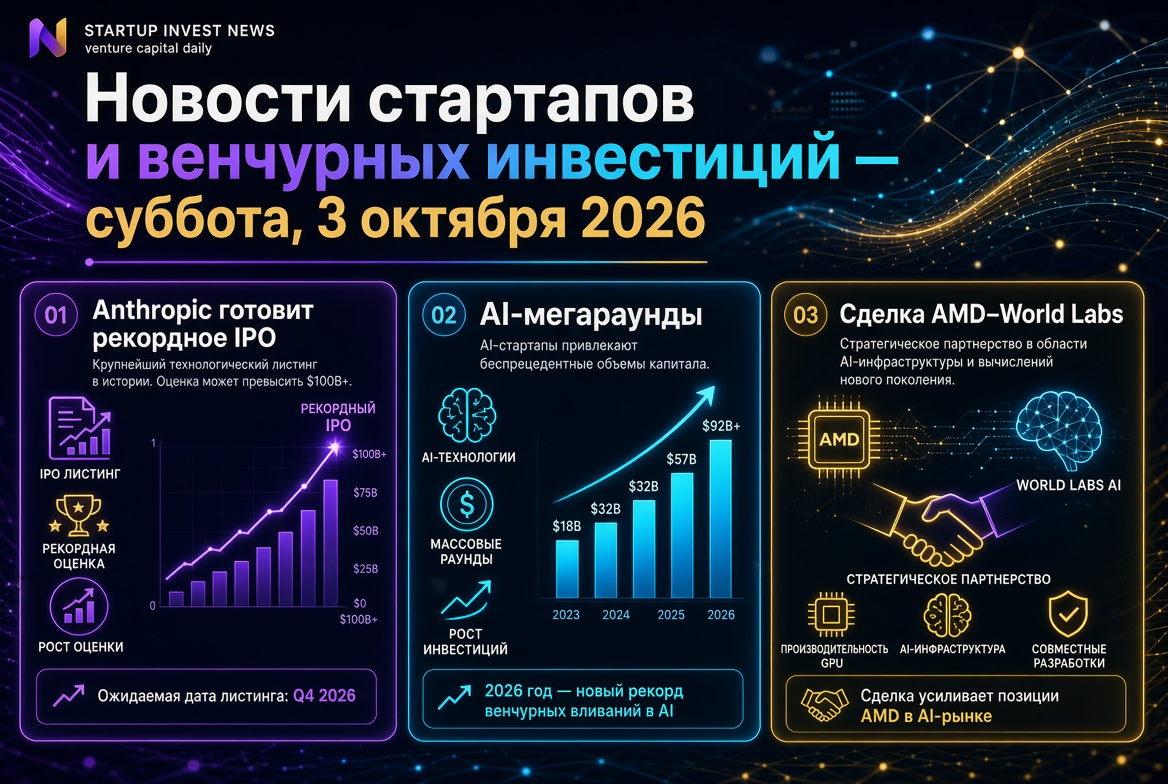
The global startup and venture capital market remains highly selective yet exceptionally aggressive in segments related to artificial intelligence, computing infrastructure, legal tech, fintech, and enterprise software as we reach mid-March 2026. If 2024 and 2025 were years of cautious recalibration of valuations, 2026 is increasingly transforming into a phase of renewed capital concentration: large funds, strategic investors, and technology corporations are once again willing to issue cheques worth hundreds of millions and even billions of dollars, primarily to those teams that can demonstrate technological leadership, access to computing resources, and the potential for global scalability.
For venture investors and funds, this signifies a transition of the market into a new configuration. Capital is available, but it is distributed unevenly. The bulk of liquidity is flowing into AI startups, infrastructure platforms, software companies with high levels of automation, and teams capable of integrating into large corporate ecosystems. The rest of the market continues to operate under a more stringent evaluation of business models, unit economics, and growth rates.
The Key Trend of the Day: Venture Capital is Becoming More Concentrated Around AI
The primary topic of recent days has been the unprecedented scale of AI-related deals. The startup market is increasingly dividing into two tiers:
- the upper echelon of companies, which are securing extraordinarily large rounds due to strong teams, access to computing, and unique technological propositions;
- the majority of startups, for whom fundraising remains a challenging, lengthy, and significantly more selective process.
This division is why news regarding startups and venture investments often revolves not merely around new deals but rather about who exactly gains entry into the select group of companies shaping the next technological platform. For the global market, this reflects not just a surge of interest in AI but an architectural restructuring of the entire logic of venture capital.
AMI and the Bet on an Alternative Development Path for Artificial Intelligence
One of the most discussed stories has been the deal surrounding AMI — a project associated with Yann LeCun. The fact that over a billion dollars has been raised at such an early stage demonstrates that investors are ready to fund not only classic language models but also alternative approaches to artificial intelligence, including world models, reasoning systems, and more intricate decision-making architectures.
From an investment perspective, this serves as an important signal for several reasons:
- venture funds are prepared to support not only application-layer AI but also fundamental research-driven companies;
- the market is once again allowing for large rounds based on long-term technological horizons rather than just rapid commercialisation;
- Europe is presented with an opportunity to strengthen its position in the race for global AI assets.
For funds, this indicates that deep technological expertise is becoming a competitive advantage once again. A mere interest in a trending theme is no longer sufficient. The winning investors will be those who understand product architecture, the need for infrastructure, and likely scenarios for commercial exit.
Thinking Machines and the New Reality: Capital is Now Inseparable from Computing Power
Another defining narrative is the partnership of Thinking Machines Lab with Nvidia. By 2026, for many AI startups, capital alone is no longer the main scarcity. What is far more crucial is access to chips, data centres, energy capacities, and strategic infrastructure providers. In other words, the startup market is entering a phase where an investment round increasingly represents a combination of funds, computing resources, and industrial alliances.
This changes the very nature of venture investments. Previously, a fund assisted a company with capital, networking, and hiring; now, in the upper segment of AI, the most vital resource becomes access to the supply chain of computing. This adjustment has also led to a new role for strategic players:
- chip manufacturers;
- cloud providers;
- large platform corporations;
- investors capable of providing not just funds but also infrastructural support.
For startups, this indicates that competitive advantage is increasingly determined not just by code and development speed but also by the quality of their partnership ecosystem.
Legal Tech and Vertical AI Emerging as Favourites
The sharp rise of Legora indicates that the venture capital market is betting not only on universal AI models but also on vertical solutions with clear business logic. Legal tech, accounting AI, enterprise copilots, and industry-specific platforms are particularly appealing due to their quicker transition from technology demonstration to viable demand.
For venture funds, this represents one of the most pragmatic segments of 2026. Unlike fundamental laboratories, vertical AI companies generally find it easier to scale revenue, more swiftly demonstrate product-market fit, and tend to attract strategic interest from corporations more frequently.
New Unicorns and the Expansion of the Winners’ Funnel
Despite the concentration of capital around the largest deals, the market is not limited to just a few superstars. The number of new unicorns in 2026 shows that the window of opportunity remains open. However, it is noteworthy that a significant portion of the new leaders is somehow linked to AI, automation, enterprise software, healthcare, or data infrastructure.
This suggests that the venture market is neither dead nor closed, but has become much more thematic. Startups find it increasingly difficult to raise capital for abstract ideas. On the other hand, companies that are addressing expensive problems, reducing client costs, or enhancing team productivity can still expect high investor interest.
The Return of Mega Funds is Altering Market Behaviour
Concurrently, another trend is strengthening: the resurgence of mega funds. New large fundraises by leading venture platforms imply that long-term aggressive capital is returning to the market. This signals an important shift for the industry. After a period of caution, investors are once again inclined to create large pools of funds to support a technological cycle that could span many years.
The implications for the startup and venture capital market will be noticeable in the forthcoming quarters:
- competition for top AI teams will intensify;
- late-stage rounds may accelerate again;
- valuations in the strongest segments will remain stubbornly high;
- the gap between top assets and the "middle market" will further widen.
For funds, this presents a simultaneous opportunity and risk. On one hand, there is a chance to participate in the formation of new global leaders. On the other, there is an increased danger of overpaying for assets, particularly where the pace of commercialisation lags behind the scale of expectations.
M&A Returns as a Tool for Accelerating the AI Race
In the context of new rounds, there is also an uptick in strategic activity among large tech companies. The acquisition of niche teams, platforms, and research assets is once again becoming part of the race for speed. Corporations are keen not to wait for promising players to mature, finding it easier to acquire the necessary capabilities, talents, and products at an early stage.
For startup founders, this offers an additional exit scenario. Not every project will reach IPO stage, but many companies could become vital building blocks for larger ecosystems. This renders the strategy of “building to sell” once again no longer marginal and re-enters the realm of rational venture scenarios as of 2026.
What This Means for Venture Investors and Funds
The current market demands greater discipline from investors than during previous hype cycles. To maintain competitiveness, funds should focus on several areas:
- seek startups with strong technological differentiation rather than merely AI-driven marketing;
- assess a company’s access to infrastructure and partnerships as a distinct asset;
- differentiate between fundamental research teams and applied vertical AI businesses using different evaluation criteria;
- model M&A scenarios, secondary funding, and late follow-ons in advance;
- not ignore non-AI segments if they exhibit transparent revenue, sustained demand, and weak competition for assets.
Saturday, 14 March 2026, greets the global startup and venture capital market at a juncture where optimism has returned but has become significantly more rigorous and professional. Capital is once again actively at work, mega rounds are returning, mega funds are gaining influence, and technology corporations are intensifying their competition for talents, models, and computing power. However, not all are emerging victorious. The winners will be the teams capable of combining fundamental technology, clear commercial direction, and the ability to integrate into the new AI infrastructure of the world.
For venture investors and funds, the main takeaway is straightforward: the 2026 market is generous, but only to the best. Therefore, the upcoming months will serve as a test not only for startup founders but for the investors themselves — to evaluate their depth of expertise, decision-making speed, and ability to distinguish sustainable technological advantages from transient hype.