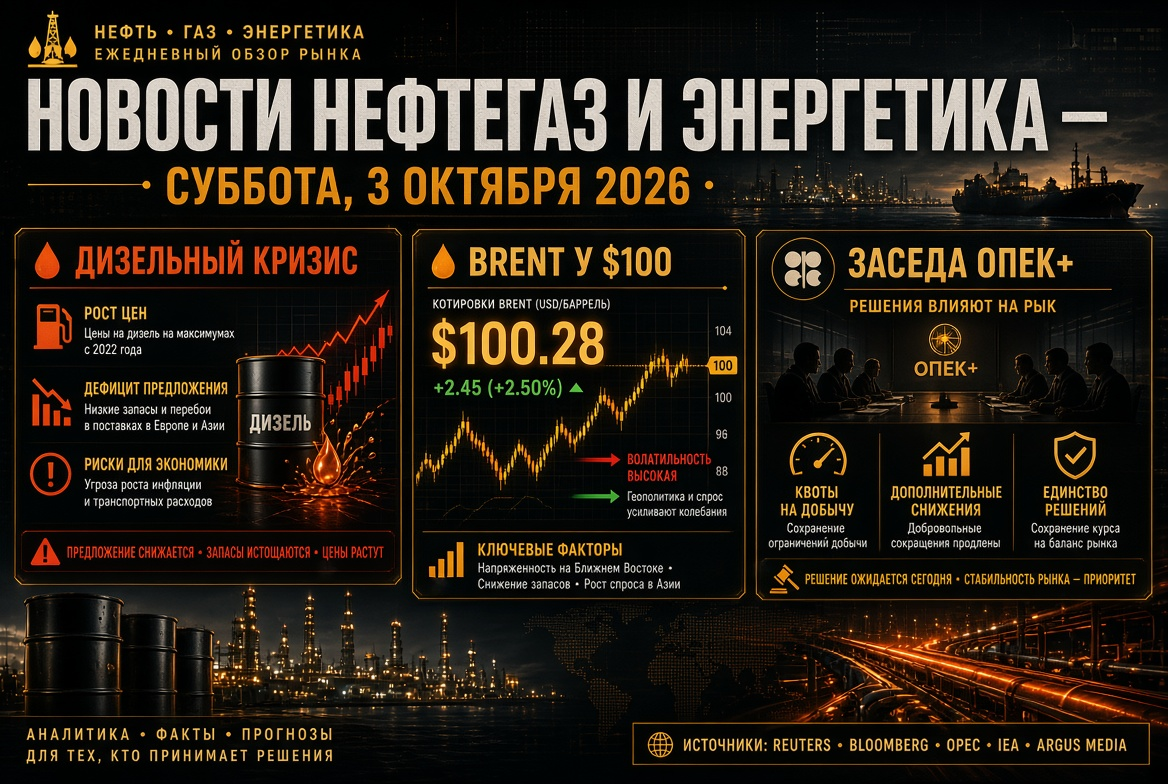
Latest Oil and Gas and Energy News as of 14 March 2026: Brent Oil Prices Surpass $100, Tensions in the Global Gas and LNG Markets, Situation in Power Generation, Refineries and Oil Products, Analysis of Key Events in the Global Energy Sector for Investors and Market Participants
The global energy sector enters mid-March amidst heightened turbulence. For investors, oil companies, refineries, traders, energy holding companies, and commodity market participants, the primary driver remains the sharp rise in geopolitical premiums in oil and gas. The oil market has reassessed supply risks, the LNG market is facing renewed nerves, and the energy sector in several countries is once again forced to balance between expensive gas, coal, nuclear generation, and accelerating investments in renewable energy.
Against this backdrop, the news in the oil and gas sector as of 14 March 2026 revolves around three key themes: the surge in oil prices, the restructuring of gas and power generation flows, and the changing behaviour of the largest raw material consumers in Asia, Europe, and the USA. For the global market, this signifies increased volatility, a greater role for reserves, shifting margins in the downstream segment, and a new round of discussion regarding the reliability of the energy transition.
Oil: The Market is Pricing in a Harsh Supply Scenario
The main topic of the day for the oil market is the rise in Brent prices above the psychologically significant level of $100 per barrel. For oil market participants, this has become not merely a short-term spike but a signal that the global supply system remains vulnerable to shocks in key export corridors. The rising cost of oil increases pressure on oil products, raises logistics costs, and alters the economics of refining across different regions.
- The geopolitical risk premium has once again become the key factor in pricing.
- Traders are pricing in the likelihood of prolonged disruptions in the supply of crude oil and oil products.
- Investors are increasingly evaluating the resilience of the Middle Eastern export infrastructure.
For oil companies and funds, this implies that the short-term dynamics of the oil market are now determined not only by the balance of supply and demand but also by the responsiveness of logistics chains, the insurance market, and strategic reserves.
OPEC+ and Supply: Formal Production Increase Fails to Alleviate Tensions
Even against the backdrop of previous decisions by OPEC+ to moderately increase production, the market does not feel a complete sense of calm. Formally, the alliance maintains a course towards managed stabilisation; however, the actual conditions in the global oil market have changed too sharply. If some supplies are disrupted or delayed, the additional volume from producers is no longer perceived as a sufficient compensator.
Currently, the following conclusions are vital for the oil and gas sector:
- OPEC+ remains a central tool for balancing the oil market, but its influence is limited by the physical availability of export flows.
- Even minor disruptions in the transportation of oil and LNG lead to disproportionately strong reactions in prices.
- The market increasingly distinguishes between 'paper supply' and oil that is actually available.
For investors, this heightens interest in upstream segment companies, export infrastructure, and those players that are capable of quickly redirecting flows of raw materials.
IEA and Strategic Reserves: The Market Receives Support, but No Turnaround
International energy institutions have moved from observation to active stabilisation measures. The use of strategic oil reserves shows that major economies view the current situation as a serious stress test for the global energy sector. However, the very fact of invoking reserves does not eliminate the underlying cause of volatility and therefore does not guarantee a swift rollback in oil and oil product prices.
For the market, this implies a dual effect. On one hand, reserves alleviate shortages and provide refineries with a temporary window for adaptation. On the other hand, they confirm the scale of the problem and maintain high nervousness across commodity platforms. As a result, oil, gas, and oil products remain sensitive to any new signals regarding supply routes.
Gas and LNG: Europe and Asia Compete Again for Molecules
The gas market is also rapidly restructuring. For Europe, the situation is complicated by the fact that the recovery in gas demand at the beginning of 2026 has encountered another price surge. For Asia, the key question is the security of LNG supplies before a period of high seasonal consumption. Consequently, the global gas market is returning to a model of fierce competition for available cargoes.
- Europe is striving to mitigate the impact on industry and power generation through discussions of pricing mechanisms and potential compensations.
- Asia is increasingly looking at a return to coal and enhancing the role of nuclear generation as a temporary solution.
- LNG remains the primary flexible balancing tool, but it is particularly responsive to geopolitical and logistical risks.
For gas companies, traders, and terminal operators, this creates opportunities for revenue growth, while simultaneously raising the stakes regarding contract discipline, supply insurance, and freight management.
Refineries and Oil Products: Refining Enters a Phase of New Margins
The oil refining sector is becoming one of the central elements of the current energy narrative. As raw materials become more expensive and access to supplies becomes more complicated, refineries are forced to swiftly alter their raw material mix, repair schedules, and product output. This is particularly evident in Asia, where some refiners are already reducing throughput to adapt to unstable imports.
For the oil products market, this implies:
- increased significance of diesel, jet fuel, and motor fuels as the most sensitive segments;
- heightened volatility of export and domestic fuel prices;
- emphasising the differences between regions with access to cheap raw materials and those reliant on costly imports.
This is particularly important for investors in the energy sector since the costs of refining, transporting, and storing now impact companies' financial results as much as the price of oil itself.
Electricity: Expensive Gas Alters the Generation Balance
The power sector is increasingly feeling the effects of high hydrocarbon prices. In several countries, rising gas prices are making gas generation less competitive, prompting energy systems to rely more on coal, nuclear energy, and backup capacities. Concurrently, interest in battery systems, network upgrades, and flexibility infrastructure is growing.
At a global level, several trends are emerging:
- Countries heavily dependent on LNG are seeking ways to limit the rise in electricity tariffs;
- Network operators are accelerating investments in reliability and capacity;
- In periods of price shocks, renewables do not negate the need for traditional generation but operate as part of a mixed energy balance model.
This sends an important signal to the market: the energy transition continues, but in a crisis moment, the priority once again becomes not only decarbonisation but also the physical availability of energy.
Renewables, Storage, and a New Logic of the Energy Transition
Amidst the instability of oil and gas, renewable energy and storage solutions receive additional investment arguments. For governments and corporations, renewables are becoming not only a climate strategy but also a strategic tool for reducing import dependence. However, the current situation simultaneously shows that without modernising networks, storage solutions, and backup capacities, the energy transition does not provide complete resilience.
This is why in 2026, the strongest positions will be held by those companies that operate at the intersection of generation, energy storage, network infrastructure, and digital load management.
What This Means for Investors and Participants in the Global Energy Sector
The oil and gas and energy news as of 14 March 2026 confirms that the global market is once again in a state of reassessing energy security. For investors and companies, this represents not only a period of risks but also a time for strategy reassessment.
- High volatility and the risk of price spikes persist in oil and oil products.
- Regional competition for gas and LNG is intensifying.
- For refineries, infrastructure operators, and traders, the importance of logistics and supply flexibility is increasing.
- In power generation, models that combine reliability, diversification, and technological adaptability are gaining ground.
- Renewables and storage receive additional impetus, but not as replacements for the entire system, rather as part of a more resilient energy balance.
If current tensions continue, the global energy sector will enter the second quarter of 2026 with more expensive oil, a rigid gas market, and an increased emphasis on energy infrastructure. For the global investment community, this means that the key asset in the coming weeks will not merely be raw materials but rather access to resilient supply chains, processing, and generation solutions.