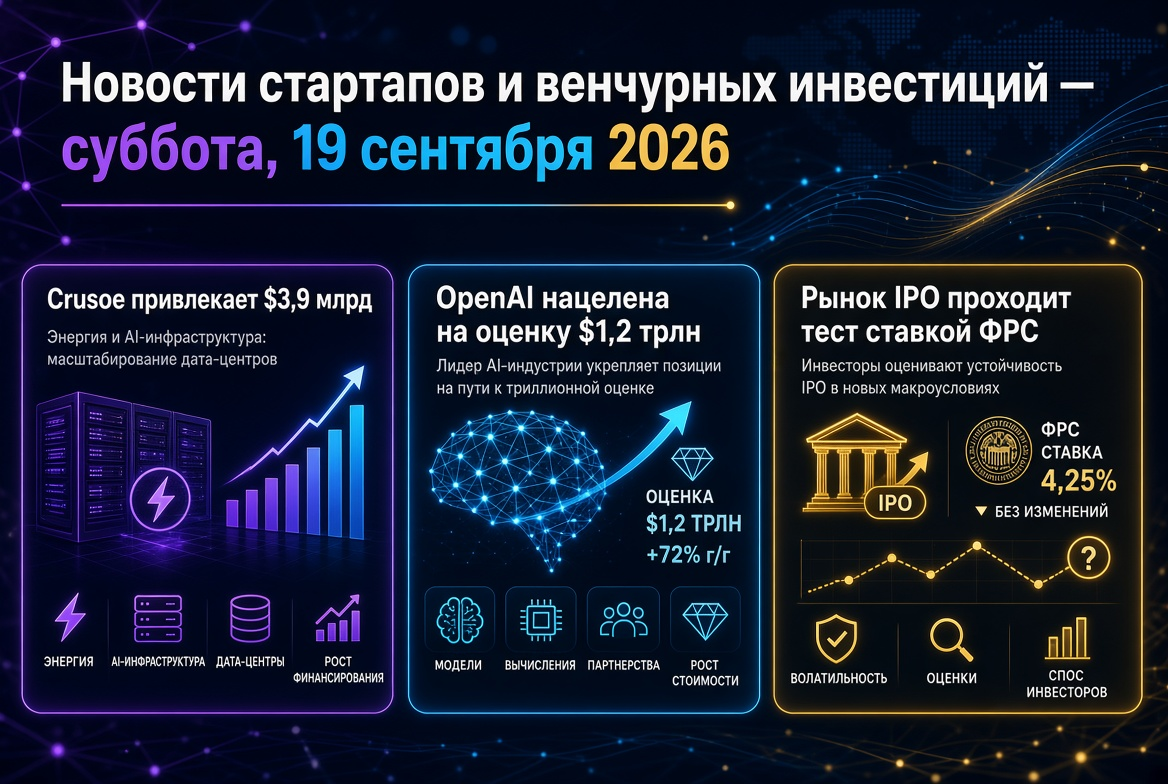
Startup and Venture Investment News for Friday, 23 January 2026: Record AI Rounds, the Return of Mega Funds, an Uptick in IPOs, and Increased Investment in Fintech, Biotech, and Climate Technologies
The global venture market is entering the end of January 2026 with a sense of cautious optimism. Following a period of risk reassessment during 2022–2024 and more selective funding in 2025, investors are once again ramping up their activity, particularly in segments that offer a clear path to scaling and monetisation. On the agenda are significant funding rounds, the relaunch of venture funds, an increase in M&A deals, and expectations of new public market listings. For venture investors and funds, the key question of the week is how to allocate capital among AI startups, fintech, biotech, and climate technologies in a changing interest rate environment and amidst competition for top talent.
Key Trends of the Day: Influencing Factors in the Startup Market in January 2026
Several sustained themes emerge in the news that set the tone for startup investments and impact company valuations worldwide:
- Capital Concentration around leaders: Venture investments are increasingly directed towards companies capable of quickly capturing market share and forming ecosystems.
- Shift Towards Infrastructure: Demand is rising for computing, data, security, and corporate platforms that support AI and digital transformation.
- The Return of Exits: A revival in IPOs in 2026 and an increase in M&A activities enhance liquidity opportunities for early investors.
- Geographical Diversification: The US remains a hub for mega deals, Europe strengthens its role in deep tech, Asia accelerates in corporate AI, and the Middle East actively participates as a source of capital.
AI Startups: Mega Rounds and the Infrastructure Battle
The AI startup segment continues to set the pace: significant funding rounds in generative AI, agent-based systems, corporate automation, and AI infrastructure are capturing the attention of global investors. Venture funds are increasingly considering not only applied products but also the infrastructure layer—models, data, training, computational optimisation, as well as compliance and security tools.
This is manifesting in two directions:
- Late-stage Investments: An increase in the proportion of large cheques for sales scaling, international expansion, and strengthening barriers to entry.
- Infrastructure Platforms: Demand for computing power and specialised solutions for corporate clients is leading to rising valuations of projects that reduce the cost of AI implementation.
For investors, it is crucial to monitor revenue quality and contract structures: long-term subscriptions, the proportion of enterprise clients, margins, and dependence on cloud providers become critical in assessing risk.
Venture Funds and “Big Money”: The Relaunch of Mega Funds
The beginning of 2026 is marked by intensified fundraising among the largest players. The return of mega funds increases competition for deals and may expedite the closing of funding rounds. Concurrently, the structure of new funds is changing; capital is increasingly segmented by focus areas (AI, defence and security, biotech, climate technologies), which simplifies positioning and helps limited partners manage risk more effectively.
Geographically, there are noticeable variations in motivations:
- US — concentration in AI and cybersecurity, a focus on rapid scaling, and readiness for IPOs in 2026.
- Europe — growing interest in industrial tech, deep tech, and defence technologies in response to government programmes and the demand for technological sovereignty.
- Asia — an acceleration of corporate strategies in AI and fintech, with large ecosystems providing quick market access.
- Middle East — a role as capital that supports large deals and the formation of new technology centres.
IPO 2026: A Broader Window for Public Offerings Opens
The revival of public markets enhances the value of the “growth story” for mature companies. Investors are once again willing to pay a premium for predictable revenue, high customer retention, and a clear path to profitability. For the startup market, this signifies a reinstatement of motivation for scaling and more proactive preparations for listings.
Companies considering IPOs in 2026 generally demonstrate:
- revenue with sustainable growth and transparent sales economics;
- clear unit metrics and a reduction in burn rate without a loss of momentum;
- diversification of customers across regions (US, Europe, Asia) and sectors;
- risk control regarding regulation and cybersecurity.
For venture investors and funds, this enhances exit prospects and increases the likelihood of secondary transactions when stakes are partially sold ahead of public offerings.
M&A and Consolidation: Corporations Accelerate Acquisitions
M&A deals are becoming one of the primary channels for liquidity, particularly in the segments of corporate software, cybersecurity, fintech infrastructure, and niche AI solutions. Major tech companies and industrial leaders prefer to acquire teams and products to shorten time-to-market for new solutions and strengthen competitive advantages.
Investors should consider the following when evaluating M&A probabilities:
- Strategic Compatibility of the product with the potential buyer's stack.
- Unique Data or technological barriers that are difficult to replicate.
- Legal Clarity: rights to code, patents, and compliance with data regulations.
- Quality of Implementations within large companies—pilot projects and contracts often precede acquisitions.
Fintech and Payments: A Focus on Profitability and Infrastructure
Fintech is returning to the venture investment agenda, albeit in a different capacity. Investors prefer models with higher resilience: payment platforms, B2B finance solutions, risk analytics, anti-fraud, and embedded finance. Focus is on companies that have demonstrated their ability to grow without excessive reliance on cheap capital.
Key performance indicators frequently discussed in funding rounds for fintech startups include:
- cost of funding and quality of the loan portfolio (if applicable);
- stability of commission income and the share of recurring revenue;
- regulatory readiness for scaling in the US, Europe, and Asia;
- integrations with corporate clients and partners.
Climate Tech and Biotech: Long Cycles, but Increasing Strategic Value
Climate technologies maintain their appeal, despite more stringent project economic requirements. Venture funds are increasingly opting for segments with clear commercialisation pathways: energy storage, infrastructure for power grids, industrial efficiency, carbon capture, and software platforms for ESG reporting. In biotech and medtech, there is a noticeable rise in interest in companies straddling AI and science—accelerating research, molecule design, and clinical trial data analysis.
For these areas, it is vital for investors to consider:
- the length of the revenue cycle and dependency on regulatory milestones;
- partnerships with corporations and government programmes;
- intellectual property protection and scientific quality;
- potential for international expansion (US, Europe, Asia).
What This Means for Venture Investors and Funds: Practical Takeaways
The agenda for Friday, 23 January 2026, confirms that the startup market is becoming more mature and structured. Venture investments are returning to growth, but capital is being allocated selectively, prioritising revenue quality, defensible advantages, and readiness for exits via IPOs in 2026 or M&A. In the coming weeks, investors should focus on the following actions:
- Review the portfolio by risk level: distinguish between companies requiring additional runway and potential candidates for secondary stake sales.
- Enhance expertise in AI: assess not just the product but also the value of infrastructure, access to data, and legal risks.
- Monitor the liquidity market: activity in public markets and M&A deals establish benchmarks for valuations and timing of exits.
- Diversify geography: the US, Europe, and Asia offer different growth profiles, while Middle Eastern capital is increasingly catalysing large deals.
In summary, the current startup news indicates that the window of opportunity for investments in startups in 2026 is widening—especially for teams that combine technological advantage, a clear monetisation strategy, and disciplined execution.