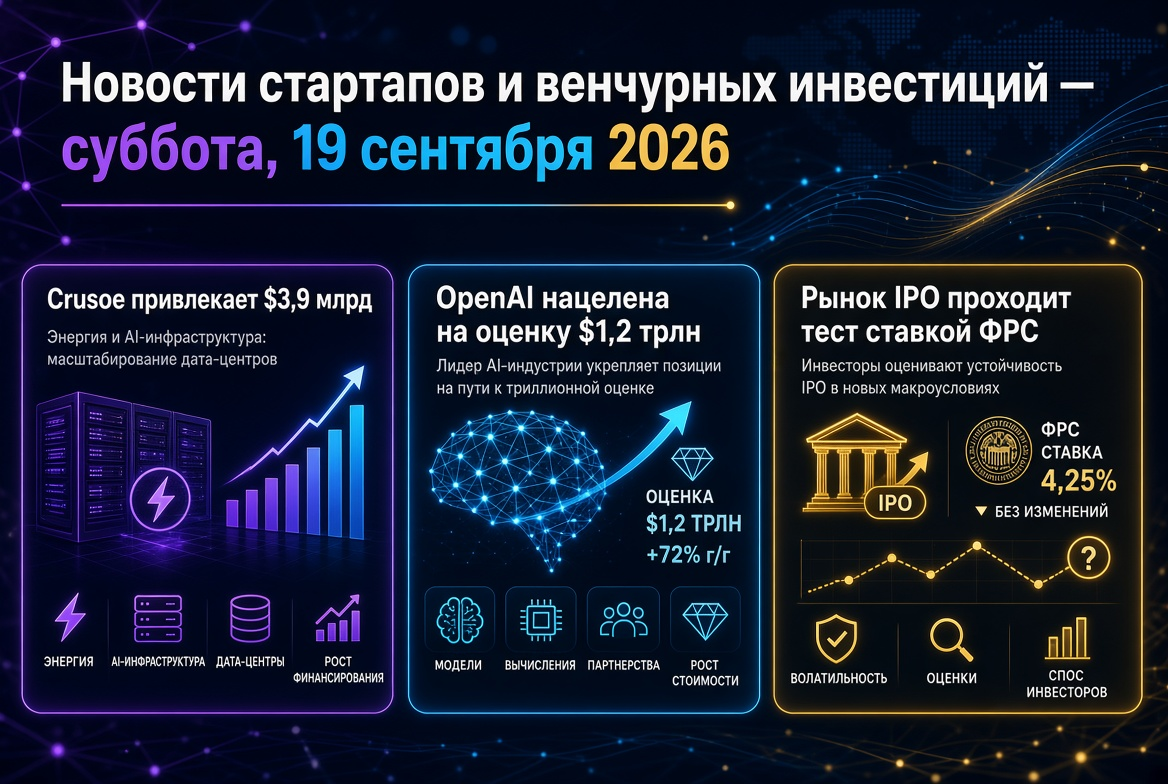
Current Startup and Venture Investment News as of 26 January 2026: The Return of Megafunds, Record Investments in AI, a New Wave of IPOs, Increased M&A Activity, Investment Diversification, and Local Initiatives.
At the beginning of 2026, the global venture capital market is experiencing a new upturn following a robust recovery last year. Investors worldwide are once again actively financing technology startups, with record deals being made and the prospect of companies returning to public markets capturing attention once more. Major players in the industry are back with large-scale investments, while governments and corporations are intensifying their support for innovation. As a result, significant private capital is flowing back into the startup ecosystem, setting a positive tone for the beginning of the year.
This resurgence in venture activity is observed across all regions. The United States has strengthened its leading position, particularly due to investments in artificial intelligence; the Middle East has doubled its venture capital inflow thanks to sovereign funds; and in Europe, a shake-up is taking place—Germany has overtaken the United Kingdom for the first time in terms of deal volume. India, Southeast Asia, and the Gulf countries are attracting record amounts of capital amidst a relative downturn in China. The startup ecosystems in Russia and other CIS countries are striving to keep pace with global trends despite external restrictions. A global early-stage venture boom is forming, although investors remain selective and cautious.
Below are key events and trends shaping the venture market agenda as of 26 January 2026:
- Return of Megafunds and Large Investors. Leading venture firms are raising record capital for new funds, once again saturating the market with liquidity and reigniting risk appetite.
- Record Rounds in AI and New Unicorns. Unusually large deals are pushing startup valuations to unprecedented levels, especially in the artificial intelligence segment.
- Revival of IPO Activity. Successful public offerings by several technology companies and new applications confirm that the long-awaited 'window' for exits remains open.
- Wave of Consolidation and M&A Deals. Numerous large mergers, acquisitions, and strategic investments are reshaping the industry landscape, creating opportunities for profitable exits and accelerated growth.
- Investment Diversification. Venture capital is flowing not only into AI but also into fintech, climate tech, renewable energy, biotechnology, defence projects, and blockchain startups.
- Local Focus: Russia and the CIS. Despite external limitations, new funds and initiatives aimed at developing local startup ecosystems are emerging in the region, gradually attracting investor attention.
Return of Megafunds: Big Money Back in the Market
The largest investment players are making a triumphant return to the venture arena, signalling a heightened risk appetite in the industry. In recent weeks, several top funds have announced the raising of record sums for new investment strategies. For instance, American Lightspeed Venture Partners has raised approximately $9 billion collectively across various funds, marking the largest venture capital round in 2025. It is joined by other megafunds: Dragoneer raised around $4.3 billion, Founders Fund secured $4.5 billion for a new growth fund, and giants like Andreessen Horowitz and General Catalyst closed funds worth $7–8 billion in 2024. These significant capital calls underscore the gap between elite 'heavyweights' in venture capital and the rest of the market, where the total number of new funds has fallen to a decade low.
Sovereign funds from the Gulf countries are also increasing their activity, investing billions into technology projects while launching state-backed mega-programmes to support startups and establish their own tech hubs in the Middle East. Japan's SoftBank, having recovered from past losses, has returned to making sizeable bets—at the end of 2025, it invested $40 billion in OpenAI (the largest private deal in history), and there are now discussions about its plans to finance a new wave of 'super startups' in AI. Around the globe, dozens of new venture funds are emerging (though fewer than before) that are managing to attract significant institutional capital for investment in high-tech fields.
In Silicon Valley, funds have amassed unprecedented reserves of uninvested capital—'dry powder' amounting to hundreds of billions of dollars, ready to be deployed as market confidence recovers. The influx of 'big money' is filling the startup market with liquidity, providing resources for new funding rounds and supporting the growth of promising companies' valuations. The return of megafunds and large institutional investors not only intensifies the competition for the best deals but also bolsters industry confidence in further capital inflows.
Record Investments in AI and a New Wave of Unicorns
The artificial intelligence sector is at the forefront of the current venture boom, demonstrating unprecedented levels of funding. Investors are eager to establish positions among the leaders of the AI race, directing colossal amounts of money into the most promising projects. In 2025, several companies raised multi-billion dollar rounds: OpenAI secured $40 billion at a valuation of approximately $300 billion (the largest venture round in history), Anthropic raised $13 billion (valuation of approximately $183 billion), and Elon Musk's startup xAI garnered around $10 billion. All of these deals were significantly oversubscribed, highlighting the frenzy surrounding AI companies.
Notably, venture investments are being directed not only into end-user AI applications but also into the infrastructure that supports them. For example, the new AI laboratory startup Humans& managed to secure approximately $480 million in seed funding—a record sum for a seed round—demonstrating the market's readiness to support even newcomers established by top experts in the field. Another example is American AI infrastructure developer Baseten, which raised $300 million at a valuation of around $5 billion with backing from investors like Nvidia, underscoring strong interest in the 'picks and shovels' for the new AI ecosystem. This current investment boom has given rise to a wave of new 'unicorns'—startups valued at over $1 billion. While experts warn of the risk of market overheating, investor appetite for AI startups remains strong.
IPO Market Revives: Window of Opportunity for Exits
The global market for initial public offerings (IPOs) is emerging from its quiet phase and is gaining momentum once again. In Asia, Hong Kong has sparked a new wave of IPOs: in recent months, several large technology companies have gone public, raising billions in total. For instance, Chinese electronics manufacturer Xiaomi successfully launched a secondary share offering, attracting around $4 billion, indicating regional investors' readiness to return to IPO transactions. Another example is one of the major electric vehicle companies that conducted a listing in Shanghai, raising approximately $3 billion.
In the United States and Europe, the situation is also improving: notable debuts of several unicorns took place in 2024–2025. American fintech giant Stripe, which had long delayed its listing, is preparing for an IPO in 2026 against the backdrop of successful offerings by its peers. In the cybersecurity sector, companies Rubrik and Netskope went public on NASDAQ with valuations of $8–9 billion, and their stocks saw significant gains in the initial days of trading, confirming strong investor demand. Even the design platform Figma chose the path of a standalone IPO instead of an acquisition, raising more than $1 billion, after which its valuation steadily increased.
The cryptocurrency industry is also trying to capitalise on the revival: fintech company Circle successfully conducted an IPO last summer (its shares then surged), while cryptocurrency exchange Bullish has filed for a listing in the U.S. with a target valuation of around $4 billion. The revival of IPO market activity is crucial for the venture ecosystem: successful public exits allow funds to realise profits and redirect freed-up capital into new projects, easing the onset of a new investment cycle.
Consolidation and M&A Deals: Growing Players
Sky-high valuations of startups and intense competition in the market are driving the industry towards consolidation. Major mergers and acquisitions are once again coming to the forefront, significantly reshaping the technological landscape. The year 2025 has been one of the highest on record for acquisition volumes: the total value of venture M&A deals worldwide approached historical highs, and in the U.S., this figure even surpassed the levels of 2021. The highlight was Google's acquisition of cyber security firm Wiz for approximately $32 billion—the largest acquisition of a venture startup in history.
Additionally, several multi-billion dollar exits have occurred across various sectors, where large corporations are acquiring promising projects. These deals include:
- Cryptocurrency exchange Deribit (Netherlands) — acquired by Coinbase.
- London-based fintech Hidden Road — acquired by Ripple.
- Oxford-based quantum startup Oxford Ionics — purchased by American firm IonQ.
- Barcelona's legal AI platform vLex — joined the Canadian company Clio.
The uptick in M&A activity provides venture funds with opportunities to exit investments profitably, while startups gain resources for expansion under the wings of larger partners. The consolidation of players through mergers and acquisitions accelerates the maturation of certain market segments and opens new niches for the next wave of startups.
Investment Diversification: Beyond AI
In 2025, venture investments began to encompass an increasingly broader range of industries, no longer limited solely to artificial intelligence. After a downturn in previous years, fintech is experiencing a resurgence—large funding rounds occurred not only in the U.S. but also in Europe and emerging markets, driving the growth of new financial services. Concurrently, interest in climate technologies, renewable energy, and agri-tech is increasing as part of the global trend towards sustainability—these areas are attracting record investments.
- Financial Technologies (Fintech): A return of substantial investments in payment services, neobanks, and other fintech startups worldwide.
- Climate and Green Technologies: A record influx of capital into renewable energy, waste disposal, and eco-friendly manufacturing projects.
- Biotechnology and Medtech: The emergence of new drugs and digital health services is again attracting capital as the sector emerges from a phase of declining valuations.
- Defence and Aerospace Developments: Amid growing attention to security, investors are backing startups in defense tech, as well as space projects and robotics.
- Blockchain and Cryptocurrencies: A partial restoration of trust in the cryptocurrency market has allowed some blockchain startups to secure funding once more.
Consequently, the broadening of sector focus makes the startup ecosystem more resilient and reduces the risk of overheating in specific segments. Funds are distributing capital across various directions, aiming to form a balanced portfolio in the context of a new market upturn.
Russia and the CIS: Local Initiatives Amid Global Trends
Despite external restrictions, recent weeks have seen a revival of startup activity in Russia and neighbouring countries. Several new venture funds with a total volume of approximately RUB 10-12 billion have been announced, aimed at supporting early-stage technology projects. Local startups are beginning to attract significant capital; for example, the Krasnodar-based foodtech project Qummy recently secured approximately RUB 440 million in investments at a valuation of roughly RUB 2.4 billion. Moreover, regulatory authorities have simplified rules for foreign investors from friendly countries, gradually bringing back overseas capital interest towards local projects.
Currently, the volumes of venture investment in the region remain modest compared to global levels, but they are growing steadily. Some large companies are contemplating taking their technology divisions public as market conditions improve—VK Tech has recently publicly hinted at the possibility of an IPO in the foreseeable future. New government support measures and corporate initiatives are designed to provide an additional impetus to the local startup ecosystem and integrate it within global trends.
Cautious Optimism and Quality Growth
At the beginning of 2026, the venture market is exhibiting moderately optimistic sentiments: successful IPOs and large deals indicate that the downturn period is behind us, although investors remain selective and prefer projects with sustainable business models. Significant capital inflows into AI and other sectors instil confidence, but funds are working to diversify investments and better manage risks to prevent a new upturn from turning into yet another overheating episode. Thus, the industry enters another phase of development with a focus on quality, balanced growth.