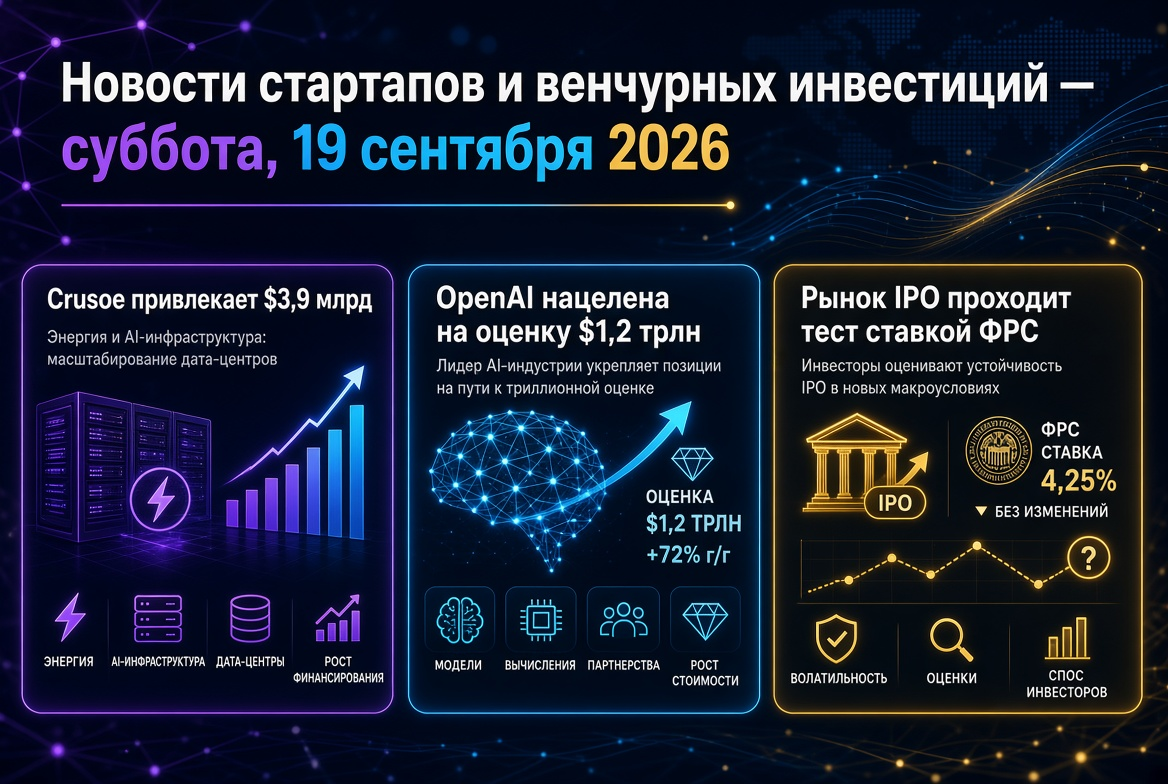
Startup and Venture Capital News for Monday, 9th February 2026: Major Rounds, Venture Fund Activity, Growth of AI Startups, Fintech and Biotech, Key Trends in the Global Venture Market.
As of early February 2026, the global venture capital market is steadily recovering from the downturn of recent years. Preliminary estimates suggest that 2025 was nearly a record year for startup investments, slightly behind the peak years of 2021–2022. Private capital is once again flooding into the technology sector, with investors worldwide actively financing promising companies, and unprecedented scale deals being made as startup plans for initial public offerings come to the forefront once again. Major players in the venture industry are launching new giant funds and investment programmes, while governments and corporations are ramping up support for innovation. As a result, at the start of 2026, the venture market is demonstrating positive momentum, instilling cautious optimism, even as investors remain selective in their assessment of projects and business models.
The growth of venture activity is characterised by global dimensions, although it is distributed unevenly. The United States remains the locomotive, with American startups accounting for a significant portion of large rounds, particularly in the field of artificial intelligence. In Europe, investment has continued to rise: by the end of 2025, Germany surpassed the UK for the first time in a decade in total attracted venture capital, strengthening the positions of European technology hubs. In Asia, the dynamics are mixed: the Indian ecosystem has reached a new level of maturity (with the emergence of the first "unicorns" of 2026 in January and the resumption of high-profile local IPOs), while in China, venture activity remains muted due to regulatory constraints and a shift in focus towards domestic priorities. Meanwhile, the Middle East has seen an acceleration, with funds from the UAE, Saudi Arabia, and Qatar pouring billions into technology companies both regionally and globally, betting on fintech, cloud services, and AI. The startup ecosystems of Russia and neighbouring countries are also striving to keep pace, launching local funds and support programmes, although venture investment volumes there remain significantly lower. Thus, the new venture uptick has a truly global scale, encompassing most regions.
Here are the key trends shaping the agenda of the venture market as of 9th February 2026:
- The Return of Mega Funds and Large Investors. Leading venture firms are raising record-sized funds and drastically increasing investments, once again saturating the market with capital and reigniting risk appetite.
- Record AI Mega-Rounds and a New Wave of Unicorns. Historically significant investments in the AI sector are pushing valuations of startups to unprecedented heights, giving rise to dozens of new unicorns with billion-dollar valuations.
- Climate Technologies and Energy Attracting Mega Deals. The sustainable energy sector and climate tech are coming to the forefront, driven by multi-million and even billion-dollar funding rounds globally.
- Consolidation in Fintech and a Wave of M&A. Mature fintech players are becoming targets for multi-billion-dollar acquisitions whilst some "unicorns" are expanding through strategic acquisitions.
- Revival of the IPO Market. Initial public offerings of tech companies are back in the spotlight: successful IPOs inspire new candidates to prepare for going public, confirming the opening of the long-awaited “window” for exits.
- Focus on Defence, Space, and Cyber Startups. Venture funds are reallocating capital into strategic sectors—from defence and space to cybersecurity—in response to new geopolitical challenges.
- Revival of Investment in Biotech and Digital Health. Following a prolonged downturn, the biotech and medtech sectors are again attracting substantial capital, buoyed by successful transactions and scientific breakthroughs in recent months.
Return of Mega Funds: Big Money Back in the Market
The largest investment players are triumphantly returning to the venture market, signalling a renewed appetite for risk. Global funds are announcing unprecedented capital-raising rounds. For example, American firm Andreessen Horowitz (a16z) has raised over $15 billion across several new funds, bringing their total assets under management to record heights. Japan is also keeping pace, with SoftBank launching its third Vision Fund of approximately $40 billion, concurrently strengthening its presence in the AI sector (at the end of 2025, SoftBank invested $22.5 billion in OpenAI—one of the largest single investments in the history of the startup industry). Other major players have also bolstered their "piggy banks": Lightspeed Venture Partners closed new funds totalling over $9 billion (a record in the firm's 25-year history), while Tiger Global, recovering from recent losses, has returned to the market with a $2.2 billion fund, reaffirming its ambitions.
The influx of such "big capital" is filling the market with liquidity and intensifying competition for the most promising deals. Sovereign funds from Gulf countries and government institutions worldwide are also pouring billions into technology projects, creating new mega-platforms for financing innovation. It is estimated that the total amount of dry powder with investors now amounts to hundreds of billions of dollars and is poised for investment as market confidence strengthens. The return of such substantial sums confirms the investment community's faith in the continued growth of the technology sector and the desire to seize the next major technological breakthrough.
The AI Boom: Mega-Rounds and New Unicorns
The artificial intelligence sector remains the main engine of the current venture uptick, displaying record financing volumes. Investors are eager to secure positions at the forefront of the AI revolution and are willing to funnel colossal amounts into the leaders of the race. In just the first weeks of 2026, unprecedented-scale deals have been announced. For instance, the Waymo project (Alphabet's autonomous unit) raised around $16 billion in new capital, valuing it at approximately $126 billion, making it one of the most expensive startups in history. Elon Musk’s startup xAI secured around $20 billion in investments with strategic involvement from Nvidia—a phenomenal amount for a private technology company. Industry leader OpenAI is reportedly negotiating to raise up to $100 billion at a valuation of around $800 billion—such a massive private round has never been seen before (with negotiations including SoftBank, as well as companies like Microsoft, Amazon, Nvidia and Middle Eastern funds). Competitor Anthropic is reportedly aiming to attract up to $15 billion at a valuation of around $350 billion.
Amid the excitement, new unicorns are rapidly proliferating: over the past few months, dozens of companies worldwide have exceeded valuations of $1 billion. In the US, startup projects in generative AI are achieving unicorn status at an astounding pace—from video services to voice assistants. For example, companies Higgsfield and Deepgram became unicorns in less than two years due to their successes in generative video and speech. Europe is also witnessing significant AI rounds (such as the German platform Parloa attracting around $350 million at a valuation of approximately $3 billion), confirming the global nature of the AI boom. Investor appetite for AI remains strong, even as experts warn of market overheating risks and inflated expectations. Notably, venture capitalists are now actively investing not only in applied AI products but also in the infrastructure for them—from powerful chips and data centres to security and control systems. This massive influx of capital accelerates progress in the industry, but necessitates careful scrutiny of business model viability to ensure that the current euphoria does not give way to a sharp cooling.
Climate Technologies and Energy: Mega Deals on the Rise
Against the backdrop of a global transition to sustainable energy, significant capital is also flowing into climate technologies. In 2025, the total funds raised by specialised climate venture funds exceeded $100 billion (most of this capital was concentrated in Europe), demonstrating unprecedented investor interest in “green” innovations. Large private funding rounds in this sector, amounting to hundreds of millions of dollars, have also ceased to be an anomaly. For instance, American startup TerraPower, developing compact nuclear reactors, secured around $650 million, and Helion Energy raised $425 million to develop the first commercial nuclear fusion reactor. Additionally, in January, Austin-based project Base Power, which is developing home battery networks and virtual power plants, raised approximately $1 billion (C round) at a valuation of about $3 billion, making it one of the largest deals in climate tech history.
Venture funds are increasingly betting on solutions capable of accelerating the decarbonisation of the economy and meeting the rising global demand for energy. Significant investments are being directed towards energy storage, new types of batteries and fuels, the development of electric mobility, carbon capture technologies, and climate fintech platforms for carbon credit trading and climate risk insurance. Whereas climate and energy projects were once deemed too risky for venture capital (due to long payback periods), both private and corporate investors are now willing to play the long game, anticipating substantial returns from innovations in this sector. Sustainable technologies are firmly establishing themselves among the priority areas of the venture market, bringing the “green” transition of the global economy closer.
Consolidation and M&A: The Size of Players is Increasing
The financial technology sector is witnessing a fresh wave of consolidation, signalling a maturing fintech market. Leading banks and investors are eager to integrate advanced fintech solutions, resulting in several high-profile deals announced in January 2026:
- Capital One has agreed to acquire fintech startup Brex (a platform for managing corporate expenses) for around $5.15 billion. This acquisition marks the largest “bank-fintech” acquisition in history, highlighting traditional financial giants' desire to embrace innovation.
- European fund Hg Capital is acquiring American financial platform OneStream for approximately $6.4 billion, purchasing stakes from previous investors (including KKR).
- Exchange operator Deutsche Börse has announced the purchase of investment platform Allfunds for €5.3 billion to strengthen its position in WealthTech.
- American bank US Bancorp is acquiring brokerage firm BTIG for around $1 billion, expanding its presence in the investment services market.
- In addition to acquisitions by corporations, the fintech “unicorns” themselves are entering the acquisition game. For instance, Australian payment service Airwallex is bolstering its business in Asia by acquiring Korean fintech company Paynuri (deal amount undisclosed).
Moreover, the consolidation extends beyond fintech alone: technology giants are also willing to spend tens of billions to keep pace in the race. For instance, Google is pursuing a record deal to acquire Israeli cloud cybersecurity startup Wiz for approximately $32 billion—one of the largest startup acquisitions in history. This surge in mergers and acquisitions indicates that as the industry matures, successful startups either fall under the wings of larger players or expand their influence through strategic acquisitions. For venture investors, this trend signifies new opportunities for lucrative exits, while for the market as a whole, it indicates the consolidation of key players and the emergence of multi-product platforms based on acquired projects.
The IPO Market Awakens: Startups Go Public Again
After a prolonged pause, the global market for initial public offerings of tech companies is steadily coming back to life. The year 2025 exceeded analysts' expectations in terms of high-profile IPOs: in the US alone, at least 23 companies with valuations exceeding $1 billion went public (compared to only 9 such debuts a year earlier), with a total market capitalisation of these offerings surpassing $125 billion. Investors are once again ready to welcome profitable and fast-growing companies to the public market, especially if the startup has a compelling story related to AI or other “hot” technologies. At the end of 2025, there were successful debuts by fintech giant Stripe and neobank Chime (Chime's shares rose about 40% on the first day of trading), restoring confidence and effectively opening a new “window of opportunities” for IPOs.
In 2026, this trend is expected to continue: several large startups are already subtly indicating preparations for share offerings. Among the most anticipated IPO candidates are:
- Leading fintech “unicorns”: payment platforms Plaid and Revolut;
- AI leaders: developer of AI models OpenAI, big data platform Databricks, and corporate AI startup Cohere;
- Other technology giants, such as space company SpaceX (if market conditions prove favourable).
Successful public exits of these companies could provide additional momentum to the market, although experts remind that volatility could suddenly close the current “IPO window.” Nevertheless, the activity of startups on the stock market reinforces the belief that investors are willing to reward companies with strong growth and profitability indicators, while venture funds are receiving the long-awaited opportunities for significant exits.
Defence, Space, and Cyber Startups in the Spotlight
Geopolitical tensions and new risks are reshaping the priorities of venture investors. In the US, the trend of American Dynamism is gaining traction—investments in technologies related to national security. Notably, some funds from the aforementioned mega funds (such as a16z) are specifically directed towards defence and deep tech projects. Startups developing solutions for the military, space, and cybersecurity are increasingly attracting nine-figure sums. For instance, California-based company Onebrief, creating software for military planning, recently secured around $200 million in investments at a valuation exceeding $2 billion and even executed an acquisition of a smaller relevant startup to enhance its platform's capabilities. Concurrently, specialised players are also gaining weight: for example, Belgian startup Aikido Security, offering a code and cloud service cybersecurity platform, reached a “unicorn” valuation (~$1 billion) in less than two years of development.
Such successes reflect the growing market demand for technologies that ensure defence and cybersecurity. Investments are being directed towards everything from supply chain protection (for instance, British project Cyb3r Operations raised ~$5 million for monitoring cyber risks) to the latest satellite reconnaissance tools. Moreover, support for defence and space startups is being bolstered not only by private funds but also by government programmes in the US, Europe, Israel, and several other countries eager to gain a technological advantage. Thus, dual-use technologies related to security have firmly established themselves in the focus of the venture market alongside traditional commercial projects.
A Resurgence of Investment in Biotech and Digital Health
Following several challenging years of “biotech winter” in the Life Sciences sphere, signs of warmth are emerging. Major deals at the end of 2025 restored investors' confidence in biotech: pharmaceutical giant Pfizer agreed to acquire Metsera (a developer of obesity treatments) for around $10 billion, while AbbVie announced the acquisition of cancer drug developer ImmunoGen for ~$10.1 billion. These acquisitions confirmed that demand for promising drugs remains high. Against this backdrop, venture investors are again ready to finance biotech startups with substantial amounts. In early 2026, early signs of a funding revival emerged: American startup Parabilis Medicines, developing innovative cancer drugs, raised approximately $305 million—one of the largest rounds for the sector in recent times.
Market experts note that in 2026, the Biotech/MedTech segment may gradually emerge from the crisis. Investors are diversifying their portfolios, focusing not only on traditional areas (oncology, immunology) but also on new niches—gene engineering, treatments for rare diseases, neurotechnology, and medical AI solutions. A surge in merger and acquisition activity is expected in biopharma, as large pharmaceutical companies experience a “hunger” for new products ahead of patent expirations. While the IPO market for biotech is not yet fully recovered, substantial late rounds and strategic transactions provide startups in this sector with the necessary capital to advance their developments. Thus, biotechnology and healthcare are once again becoming attractive areas for venture investments, promising significant growth potential for investors—provided that the projects demonstrate scientific viability.
Looking Ahead: Cautious Optimism and Sustainable Growth
Despite the rapid increase in venture activity at the beginning of the year, investors maintain a degree of caution, bearing in mind lessons from the recent market cooling. Capital has indeed begun to flow into the technology sector again; however, demands on startups have become noticeably stricter: funds are expecting clear business models, economic efficiency, and transparent paths to profitability from teams. Company valuations are rising once again (especially in the AI segment), but investors are increasingly focusing on risk diversification and long-term portfolio sustainability. The return of liquidity—from billion-dollar venture funds to new IPOs—creates opportunities for significant growth, but at the same time, intensifies competition for outstanding projects.
It is highly likely that the venture capital industry will transition into a phase of more balanced development in 2026. Financing for breakthrough areas (AI, climate technologies, biotech, defence, etc.) will continue, but there will be a greater emphasis on the quality of growth, transparency in management, and compliance of startups with regulatory requirements. This more measured approach should help the market avoid overheating and lay the groundwork for sustainable innovation development in the long term.