By mid-August 2026, the global venture market is operating in a two-speed mode. At the top are gigantic rounds for AI laboratories, trillion-dollar valuations, and preparations for historic initial public offerings (IPOs); below are a selective, disciplined market where investors fund only companies with technological barriers and clear economics. For venture funds, this is a time of record opportunities and equally record risks of concentration.
Key Themes for Venture Investors
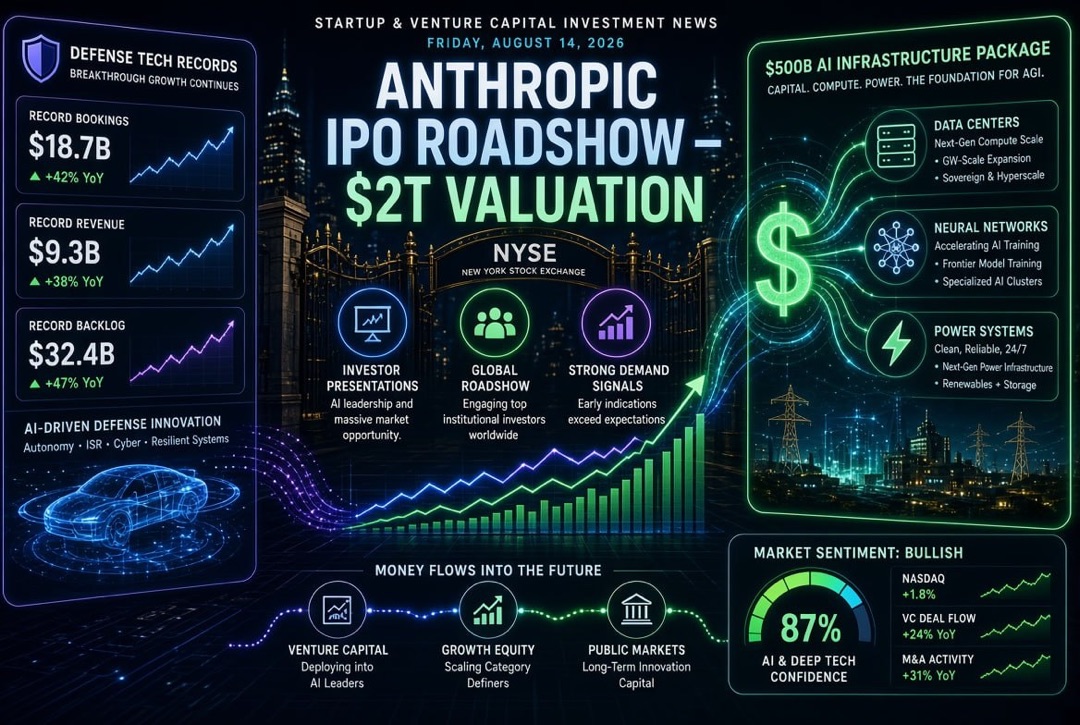
- IPO of Anthropic nearing completion: the company is meeting with institutional investors, and the offering may occur as early as September-October, with a target valuation of up to $2 trillion.
- Megapackage for AI Infrastructure: Apollo, Blackstone, BlackRock, Brookfield, Goldman Sachs and KKR are discussing a $500 billion funding scheme for data centres with Nvidia.
- Defence technologies — a new favourite: $12.3 billion in venture investments in the first half of the year — nearly double last year's level.
- Energy for AI: Billion-dollar rounds for Base Power and Valar Atomics confirm that electricity has become the main deficit in the tech economy.
- Capital concentration: Four mega-rounds accounted for approximately 63% of the global venture volume in the first quarter.
IPO of Anthropic: Countdown to the Largest Offering in History
The central theme of the venture agenda is Anthropic’s preparation for a public offering. The company, which confidentially filed its S-1 application on June 1, is holding meetings with potential investors and, according to business media reports, may launch its stock sale as early as September or early October. The discussed valuation reaches $2 trillion — double the valuation of its May Series H round, which closed at $965 billion.
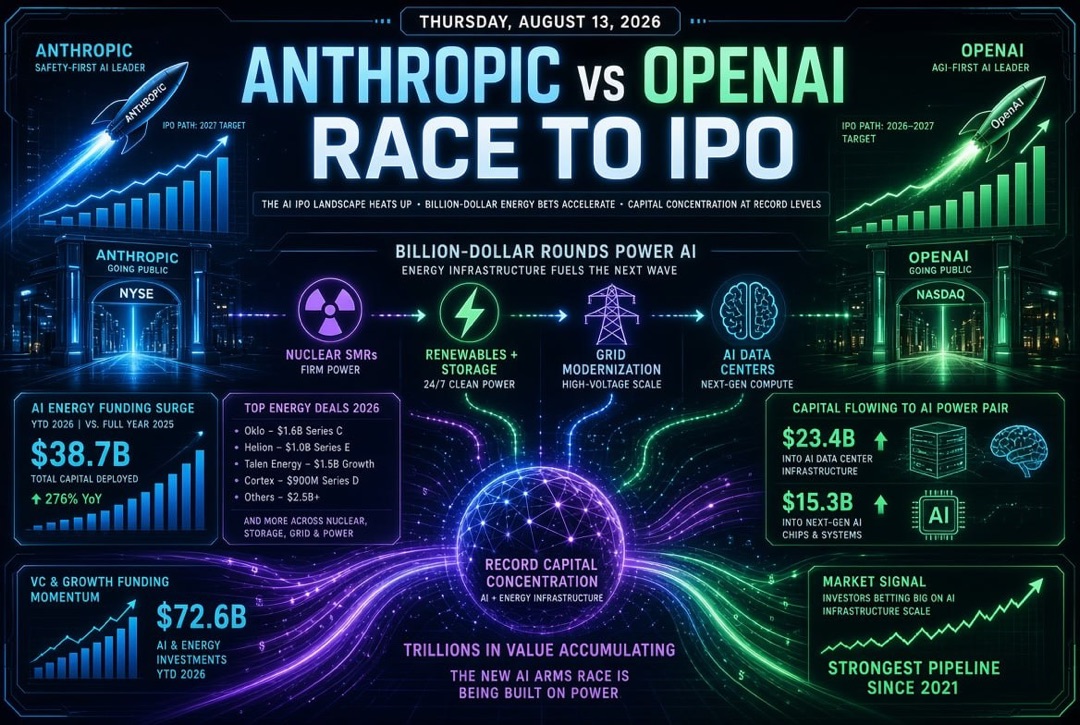
The fundamentals behind these figures are impressive: annual revenue exceeded $47 billion as of May, and independent trackers estimate the current figure at around $70 billion. In 2026, venture firms, sovereign wealth funds, and institutional investors have invested approximately $100 billion in the company. Competing OpenAI, which submitted its own application a week later, is reportedly leaning towards postponing its listing to 2027 — the race for the title of the first public AI company with a trillion-dollar capitalisation has essentially been decided in favour of Anthropic.
However, risks have not disappeared: pressure from cheap Chinese models, regulatory friction with the US administration, and a June pause in the export of flagship models remind investors that even sector leaders are vulnerable.
Infrastructure Supercycle: $500 Billion for Data Centres
Alongside the valuation race, an infrastructure story of unprecedented scale is unfolding. A consortium led by major private equity firms — Apollo Global Management, Blackstone, BlackRock, Brookfield, Goldman Sachs, and KKR — is collaborating with Nvidia on a $500 billion funding package for AI infrastructure. Specialist digital infrastructure funds have already raised $26 billion in 2025 — four times the average level of previous years.
A notable deal of the week involved Anthropic signing a long-term agreement worth $9.1 billion with Riot Platforms for the reservation of computing power, including a 20-year lease of a data centre with 191 megawatts. The signal for venture investors is clear: “picks and shovels” of the AI economy — energy, cooling, networking solutions — remain one of the most capital-intensive sectors.
Energy for AI: Billion-Dollar Bets on Electrons
The energy deficit has turned startups in the generation and storage of energy into targets for leading funds. Key deals in August include:
- Base Power — Series D round of $1 billion at a valuation of $13 billion led by Ribbit Capital, Addition, Valor Equity, and JPMorgan's venture arm; the company manufactures home energy storage systems and has already commenced production in the USA.
- Valar Atomics — $1 billion Series B led by Sequoia Capital plus a $200 million credit line from a JPMorgan syndicate; the startup is developing small nuclear reactors for the energy supply of computing clusters.
Record energy consumption in the USA and explosive demand from data centres have effectively made energy technologies a part of the AI investment thesis.
Defence Technologies: Doubling in a Year
The defence sector is experiencing a structural uptick: in the first half of 2026, venture funds directed $12.3 billion into defence tech — nearly double the amount from the previous year, and already exceeding the total for all of 2025. Capital is flowing into autonomous maritime platforms, drones, and combat AI. During the week, fresh rounds were closed by drone manufacturer Neros and air taxi developer Vertical Aerospace, which raised €86.6 million. Geopolitical tensions have transformed defence startups from niche bets into a mandatory part of major funds' portfolios.
The Broader Market: Fintech, Biotech, and Vertical AI
Beyond mega deals, capital is being distributed across industry niches with high entry barriers:
- Whatnot — $545 million in a Series G round for the development of a live-commerce platform;
- Erebor — around $1.5 billion to build a bank for the tech sector with participation from Lux Capital and Andreessen Horowitz — investors are effectively financing the reconstruction of the financial infrastructure of the startup economy following the collapse of SVB;
- inKind — $414 million funding from Citi and Cross River Bank for a B2B restaurant commerce platform;
- Vaderis Therapeutics — $152 million Series B for rare diseases led by Goldman Sachs Life Sciences;
- Zenity — $125 million Series C for securing AI agents with participation from the SoftBank Vision Fund 2.
The overall conclusion from industry analysts is that the gap between “funded companies” and “just interesting ideas” continues to widen. Money is flowing into projects with proprietary data, specialized infrastructure, and distribution channels that cannot be replicated overnight.
IPO Market: Activity is Rising, but the Lesson of SpaceX is Learned
The US initial public offering market remains vibrant: since the beginning of 2026, 226 companies have gone public — a 5.6% increase compared to the previous year, and over the current week, more than twenty pricings are planned. However, the story of SpaceX — the largest IPO in history, soaring to a $2.5 trillion valuation and subsequent correction after the first report — serves as a vaccine against market euphoria. Investors are willing to pay for growth but are rigorously reassessing companies at the first signs of disconnect between capital expenditures and revenue. The subsequent acquisition of Cursor by SpaceX for $60 billion became the largest acquisition of a venture-backed company in history and opened new exit channels for funds.
Russia and the CIS: Market Contraction and a Focus on Consolidation
The Russian venture market is moving against the global trend: in the first half of 2026, investments totalled 5.2 billion rubles — 39% less than the previous year, and the number of deals declined to 52. Two-thirds of capital is concentrated in Moscow. The market model is restructuring: instead of betting on exponential growth and international exits, funds are increasing their stakes in mature portfolio companies, consolidating local niches, and focusing on dividend yield. Market participants are pinning their hopes for recovery on a decrease in the key interest rate and new offerings on the Moscow Exchange in the second half of the year.
What This Means for Venture Investors: Key Takeaways
The agenda on August 14, 2026, records three defining trends. Firstly, the market is entering a phase of historic exits: the success of Anthropic's offering will set a price benchmark for the entire AI ecosystem for years to come. Secondly, the unprecedented concentration of capital in a narrow group of companies makes diversification—across sectors, stages, and geographies—the key risk management tool. Thirdly, investment logic has definitively shifted from “growth stories” to assets with physical and technological barriers: energy, infrastructure, defence, and specialised data. Funds that can combine access to mega deals with disciplined selection at early stages will prevail in this cycle.