Key Venture Market Events Overview as of 30 August 2026: Nvidia's Record Quarter and Hugging Face Acquisition, Anthropic's Public S-1, Megarounds in AI Inference, Technology Stack Consolidation, and New Vectors for Venture Investments — from Energy to Defence.
By the end of August 2026, the global startup and venture investment market is operating in a mode that seemed impossible just three years ago. Artificial intelligence has definitively transitioned from an investment theme to an industrial construction of planetary scale: capital is concentrating in the hands of a few leaders, corporations are acquiring key components of the AI stack, and the IPO market is gearing up for the largest placement in history. For venture funds, the past week has been one of the busiest of the year — setting the agenda for the entire autumn season.
Key events shaping the venture agenda for the weekend:
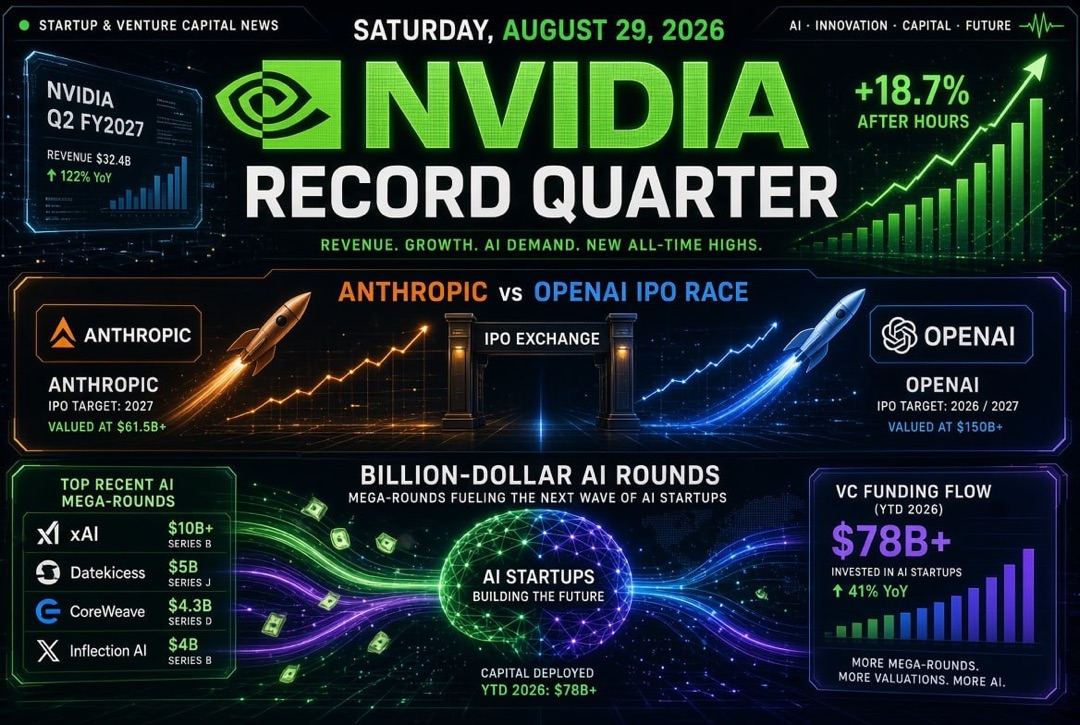
- Nvidia's Record Quarter — revenue of $96.2 billion (+106% year-on-year) confirms that demand for AI infrastructure is not slowing down.
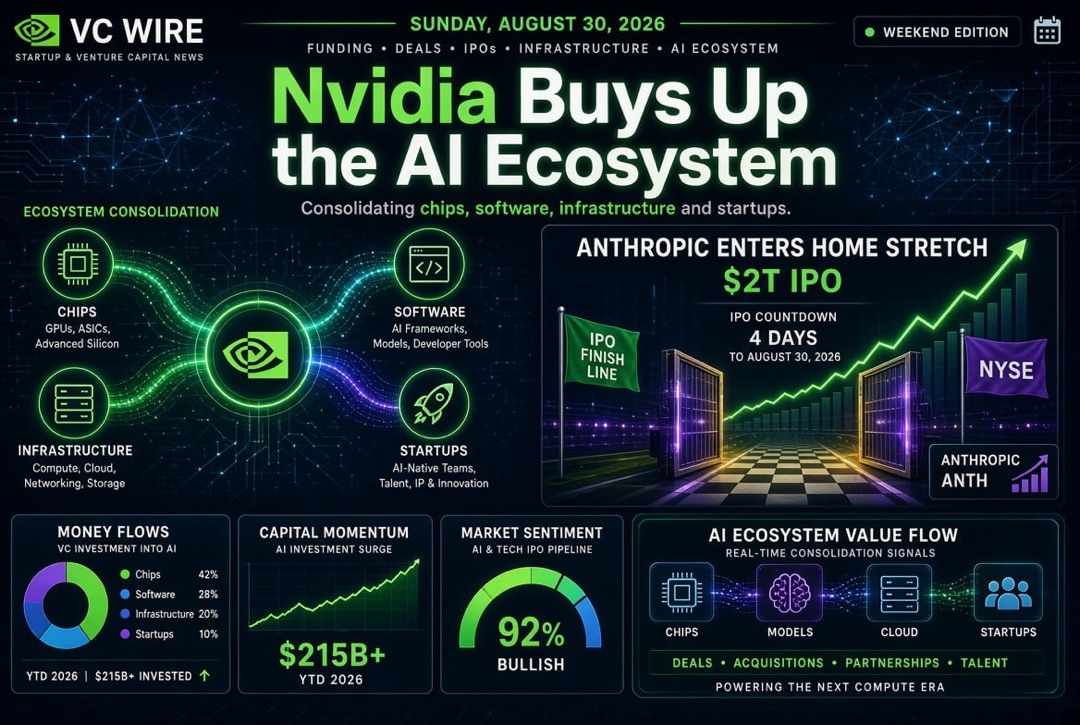
- Deal of the Century in Open Source — according to media reports, Nvidia has agreed to acquire the Hugging Face platform for $12.9 billion.
- Anthropic on the Brink of Public S-1 — investors are discussing an IPO with a valuation of up to $2 trillion, which would make it the largest in history.
- Race for Inference — chipmaker Etched raised $700 million at a valuation of $21 billion, doubling it in less than a month.
- Consolidation of the AI Stack — Stripe acquires the AI model gateway OpenRouter for over $8 billion.
- Diversification of Capital — billion-dollar rounds are occurring in energy, defence, space, and nuclear generation.
Nvidia's Quarter as a Barometer for the Entire Venture Market
Nvidia's report released on Wednesday was the main macro event of the week for the venture industry. Revenue for May–July reached $96.2 billion, more than doubling year-on-year, while net income amounted to $59.7 billion. The data centre segment brought in a record $89 billion, driven by the ramp-up of the Blackwell Ultra platform. The forecast for the current quarter — around $108 billion — exceeds analysts' consensus, and for the next financial year, the company is estimating growth of about 70%, with management stating that demand exceeds supply capabilities.
For venture investors, this is not just corporate reporting. CEO Jensen Huang articulated a thesis that funds will cite throughout the season: “compute equals revenue.” While the largest AI chip supplier demonstrates accelerating growth, the arguments of “bubble” advocates are sidelined, and valuations of AI startups in the private market are receiving fundamental justification.
Nvidia and Hugging Face: $12.9 Billion Deal Reshaping Open Source
Just hours after the report, the market learned of a potentially historic acquisition for Nvidia. According to business press reports, the company has agreed to acquire Hugging Face — a central platform for publishing and developing open AI models — for approximately $12.9 billion. In 2023, Hugging Face was valued at $4.5 billion, and its annual revenue today is around $150 million, meaning the deal's multiple exceeds 80x.
The strategic logic is clear: by owning the platform that hosts global open source, Nvidia strengthens its position against custom chips being developed by its largest clients. For venture funds, the deal carries a double signal. On the one hand, it represents a remarkable exit for early investors in the platform. On the other hand, it further confirms that the vertical integration of giants narrows the space for independent infrastructure startups.
Anthropic Prepares for Public S-1: Aiming for the Largest IPO in History
The main intrigue of autumn is the upcoming listing of Anthropic. The company submitted its S-1 draft confidentially on June 1, shortly after a Series H round at a $965 billion valuation, and the public version of the prospectus is expected in the coming days. Revenue for the developer of the Claude models reportedly surpassed $65 billion annually — more than seven times growth since the end of 2025.
Against this backdrop, investors are discussing a listing valuation in the vicinity of $2 trillion — which would surpass SpaceX's June IPO ($1.77 trillion) and become the largest in history. Caution is heightened by the SpaceX precedent: following its debut, the company's shares surged but then corrected after its first public report. Nevertheless, an open "window" for mega offerings is a crucial liquidity factor for the entire venture ecosystem: a successful Anthropic listing could thaw the queue of technology IPOs slated for 2027, including OpenAI.
Race for Inference: Etched Doubles Valuation in a Month
While training frontier models remains the domain of a few laboratories, venture capital is pivoting towards inference — the stage of industrial AI deployment. A symbol of this shift is the $700 million round raised by chipmaker Etched at a valuation of $21 billion — twice as high as a month earlier. The startup directly challenges Nvidia with specialised solutions for processing queries to trained models.
An adjacent trend is the energy of computation. Startup Emerald AI raised $150 million in a Series A round with participation from strategists ranging from Nvidia and Siemens to Aramco Ventures: its software manages the energy consumption of data centres based on grid conditions. Investors are increasingly recognising that the bottleneck in the AI economy is shifting from chips to electricity and the infrastructure between accelerators.
M&A Wave: Stripe Acquires OpenRouter, Stack Consolidates
Mergers and acquisitions in the AI sector are on the rise. Payment giant Stripe is acquiring OpenRouter — a gateway to AI models — in a deal valued at over $8 billion. Simultaneously, Nvidia continues its series of acquisitions, having added Groq, Kumo, and several other assets over the past year, reserving $18 billion for further venture investments by the end of the year.
For late-stage funds, this is a long-awaited exit channel: strategic buyers are willing to pay a premium for key nodes in the AI stack. For early investors, it is a reason to closely evaluate which niches will remain independent over the next two to three years.
Beyond AI: Energy, Defence, and Space are Garnering Billions
Although AI dominates the headlines, August confirmed that venture capital is actively working in "heavy" sectors as well. The largest rounds of recent weeks outside the nuclear AI segment include:
- Base Power — $1 billion in Series D at a valuation of $13 billion: home energy storage as a response to growing grid loads.
- Valar Atomics — $1 billion in Series B led by Sequoia: small modular nuclear generation for energy-intensive computations.
- Castelion — over $1 billion for hypersonic systems development, with participation from Carlyle, JPMorgan, and Andreessen Horowitz.
- Muon Space — $250 million in Series C for satellite infrastructure at a valuation of approximately $1.5 billion.
The common denominator of these deals is physical infrastructure: energy, security, and orbit are becoming an extension of the AI thesis rather than an alternative to it.
Capital Concentration: Figures That Cannot Be Ignored
Second-quarter statistics reveal unprecedented concentration: AI accounted for over 70% of global venture financing, while OpenAI and Anthropic together raised $217 billion — about 43% of all venture dollars during the period. For fund managers, this signifies a distortion of classic portfolio mathematics: median early-stage rounds are growing much slower than headline figures, while competition for quality deals outside the mega segment remains moderate — and it is precisely here that attractive entry valuations persist.
Emerging Markets: India Returns to Focus
A notable event of the week outside the US is the first institutional round for Indian fintech Navi at a valuation of approximately $1.3 billion. This deal lays the groundwork for the company's IPO on Indian exchanges and affirms the return of global capital to South Asian markets. In Europe, a series of robust mid-stage rounds continues — from the Madrid-based AI agent developer HappyRobot ($150 million) to Israeli Alice in the AI security segment ($140 million), indicating a gradual levelling of the geography of venture activity.
What This Means for Investors: Autumn Forecast
The venture market enters September with three working assumptions. First, the publication of Anthropic's S-1 will serve as a stress test for public market appetite for AI assets — its outcome will determine the exit calendar for the year ahead. Second, the consolidation of the AI stack by corporations will accelerate, increasing the value of startups with unique technological positions and data. Third, capital will continue to flow from “models” to “physics” — energy, inference chips, data centres, and defence technologies. A cautious conclusion of the week: the boom is real and supported by cash flows, but the premium for selectivity for the investor today is higher than ever.