Global Startup and Venture Investment News for 9 December 2025: Record AI Rounds, New Unicorns, Mega Fund Activity, Venture Market Trends, and Key Deals. Analytics for Investors and Funds.
By the end of 2025, the venture capital market demonstrates steady growth following several years of decline. According to analysts, in Q3 2025, the investment volume in technology startups reached approximately $97 billion – nearly 40% higher than the previous year. This trend can be attributed to the return of large funds to the market, a revival in stock exchanges, and increased support for innovation from governments and corporations. Investors are acting selectively, but the willingness to invest in promising projects is rising again, stimulating the launch of significant rounds and increasing the number of IPOs and M&A deals. Below are the key trends shaping the investors' agenda:
- The return of mega funds and large investors.
- Record rounds in AI and a wave of new unicorns.
- Revival of the IPO market: new exit opportunities emerge.
- Diversification of investments: fintech, biotech, medtech, climate technologies.
- Mergers and acquisitions: strategic deals by major players.
- Global expansion: increased activity in Asian and Middle Eastern markets.
- Startups from Russia and the CIS: local initiatives and development.
- Interest in crypto startups and digital assets.
The Return of Mega Funds and Large Investors
The largest investment players are making a triumphant return to the venture arena. For instance, the SoftBank conglomerate led a massive funding round for OpenAI amounting to up to $40 billion and is now preparing to launch its new Vision Fund III. Sovereign wealth funds from Gulf countries are pouring billions of dollars into technology companies and creating their own government programmes to support the IT sector. Numerous new venture funds focusing on AI, climate technologies, fintech, and biotech are being launched worldwide. American funds have amassed an unprecedented reservoir of "dry powder" – hundreds of billions of uninvested capital – which is poised to be deployed as the market stabilises. The influx of "big money" saturates the startup ecosystem with liquidity, boosts company valuations, and intensifies competition for the best investment opportunities.
Record AI Rounds and New Unicorns
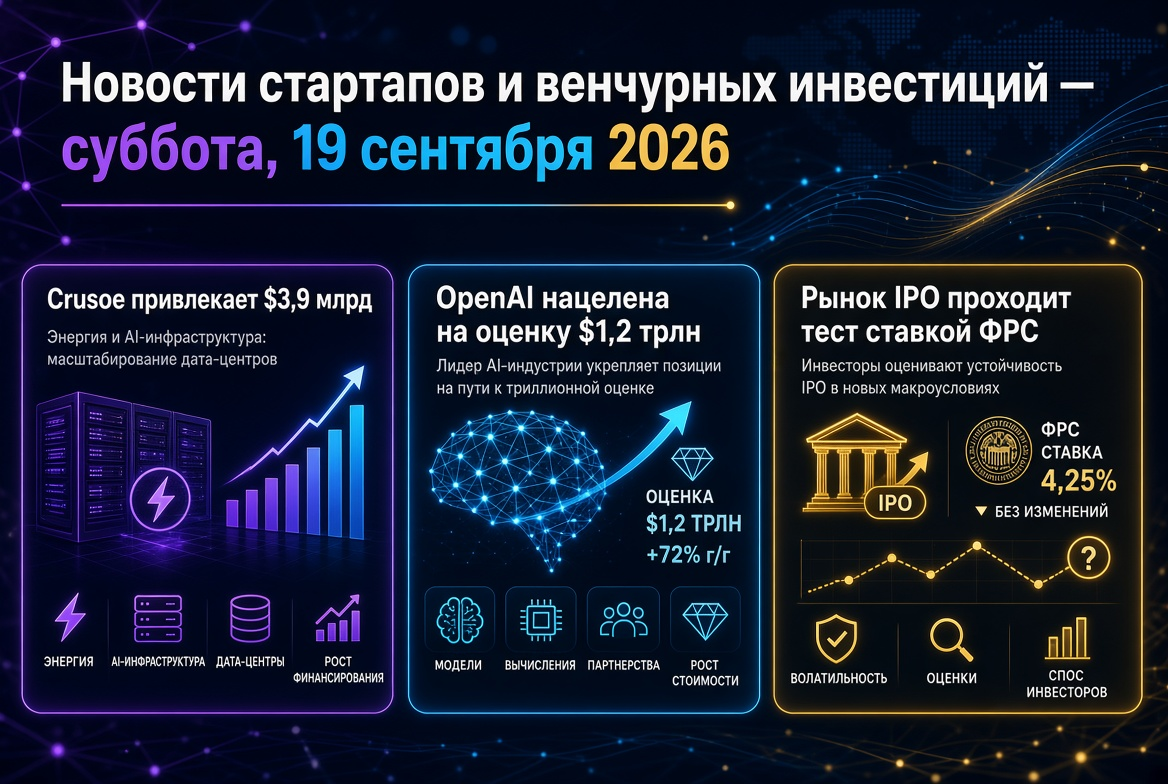
The artificial intelligence sector remains the primary driver of the venture rebound. In recent weeks, an unprecedented round was recorded: the new AI startup Prometheus (a Jeff Bezos project) attracted approximately $6.2 billion in its very first round. For comparison, another generative AI innovator, Anysphere, secured $2.3 billion, while AI data centre provider Lambda raised $1.5 billion. Earlier this year, Elon Musk raised over $10 billion for xAI, and OpenAI attracted around $8.3 billion (each time the rounds were oversubscribed). This investment boom has fostered a wave of new unicorns: expert estimates suggest that in 2025, at least 80 startups worldwide reached valuations exceeding $1 billion. Most operate in AI infrastructure and cloud services, but the list also includes companies from biotech, medicine, logistics, fintech, and aerospace.
Revival of the IPO Market: Opportunities for Exits
The initial public offering (IPO) market is showing signs of revival. As of 8 December 2025, 325 IPOs have taken place in the US – a 55% increase compared to the same period in 2024. Several large startups and unicorns have announced upcoming listings. Technology companies with robust business models are going public, and regulators are gradually easing conditions for long-term investments. Activity in IPOs in Asia is also on the rise, although public offerings in China remain under regulatory scrutiny. Overall, the heightened interest in IPOs is driven by an improved macroeconomic environment and the need to diversify capital sources for companies following tumultuous rounds of venture financing.
Diversification of Investments: Fintech, Medtech, and Climate
Investors are expanding their portfolios beyond pure AI technologies. In the fintech sector, for instance, the startup Portal to Bitcoin (USA) raised $25 million to develop a cryptocurrency trading platform, while venture firm Paradigm invested $13.5 million in the Brazilian stablecoin Crown, backed by bonds, valuing the startup at $90 million. In healthcare, significant rounds have been secured by engineering solutions for health insurance: San Francisco-based Angle Health raised $134 million, and Austin's insurance company Curative attracted $150 million for corporate client services. The biotech segment is also making headlines: American SciNeuro Pharmaceuticals obtained $53 million for developing treatments for neurodegenerative diseases. Meanwhile, climate and energy startups continue to attract investors: startup ZincFive (NiZn batteries) closed a round at $30 million. Thus, venture capital is being distributed across diverse sectors – from logistics and edtech to healthtech and greentech – creating additional opportunities for investors.
Mergers and Acquisitions: Strategic Deals
Consolidation in the technology market is gaining momentum, with major companies acquiring promising startups. For instance, media giant Meta acquired startup Limitless, which develops AI gadgets for recording and transcribing conversations, bolstering its line of wearable devices. Meanwhile, OpenAI announced the acquisition of the Polish startup Neptune.ai, which provides monitoring and analysis tools for machine learning. These deals reflect the struggle of tech giants for talent and technology: integrating ready-made solutions accelerates development and market introduction of new products.
Global Expansion: New Venture Markets
Investment activity is growing across nearly all regions. The USA remains the leader (especially in AI), but investment volumes in the Middle East have increased dramatically over the past year. In Europe, for the first time in many years, Germany surpassed the UK in total venture capital raised in Q3 2025. Asia shows uneven trends: India, Southeast Asia, and the Gulf states are attracting record investment flows, while activity in China has somewhat cooled. Governments in various countries are launching national programmes and incentives to stimulate the startup market: for example, the Make in India 2.0 initiatives and ASEAN Tech Blueprint are being signed, while the EU expands funds to support innovation. This indicates the emergence of a more diversified global venture capital ecosystem.
Startups from Russia and the CIS: Local Initiatives and Growth
The Russian venture sector is witnessing a revival amid global trends. According to the Moscow Innovation Cluster, in the first half of 2025, Russian technology startups raised $87 million across 74 deals – an 82% increase compared to the previous year. Technological clusters are developing not only in Moscow and St. Petersburg but also in Kazan, Yekaterinburg, Novosibirsk, and other cities. Meanwhile, both the government and private players are creating new support mechanisms: special venture funds are being registered, tax incentives for investors are being introduced, and measures to develop the secondary market for startup debts and shares are actively discussed. Local syndicates and business angels are gradually expanding their portfolios, while large corporations are increasingly turning to domestic startups for innovative solutions. Overall, the Russian and regional markets are striving to keep pace with global trends, leveraging their own scientific and technological potential.
Renewed Interest in Crypto Startups
Cryptocurrency and blockchain projects are once again capturing the attention of venture investors. For instance, venture fund Paradigm invested $13.5 million in the Brazilian startup Crown, which issues the BRLV stablecoin (pegged to the real and backed by government bonds). American Portal to Bitcoin (San Francisco) raised $25 million to develop a secure cryptocurrency trading platform. These transactions indicate that despite the intense volatility of recent years, investors maintain interest in decentralized financial instruments and see potential for further capitalisation. Projects in digital assets are gaining access to venture funding, which accelerates innovation in fintech and smart contracts.
Overall, the end of 2025 marks a revival of the startup market: large funds are increasing budgets, top projects are attracting record investments, and new platforms for capitalisation are emerging. The main drivers remain unchanged – artificial intelligence and related technologies – although the role of other sectors such as healthcare, finance, and energy is growing. This situation signals the beginning of a new investment cycle, where the focus will shift from passive expectation to active financing of promising ideas. The upcoming six months promise to be eventful: investors worldwide are preparing for a new wave of deals and exits, and the observed trend of "big money" is unlikely to weaken anytime soon.