Current Startup and Venture Investment News as of 22 March 2026: Growth in the AI Sector, Mega Funds, Infrastructure Race, New Trends in Robotics, Defence Tech, and the IPO Market
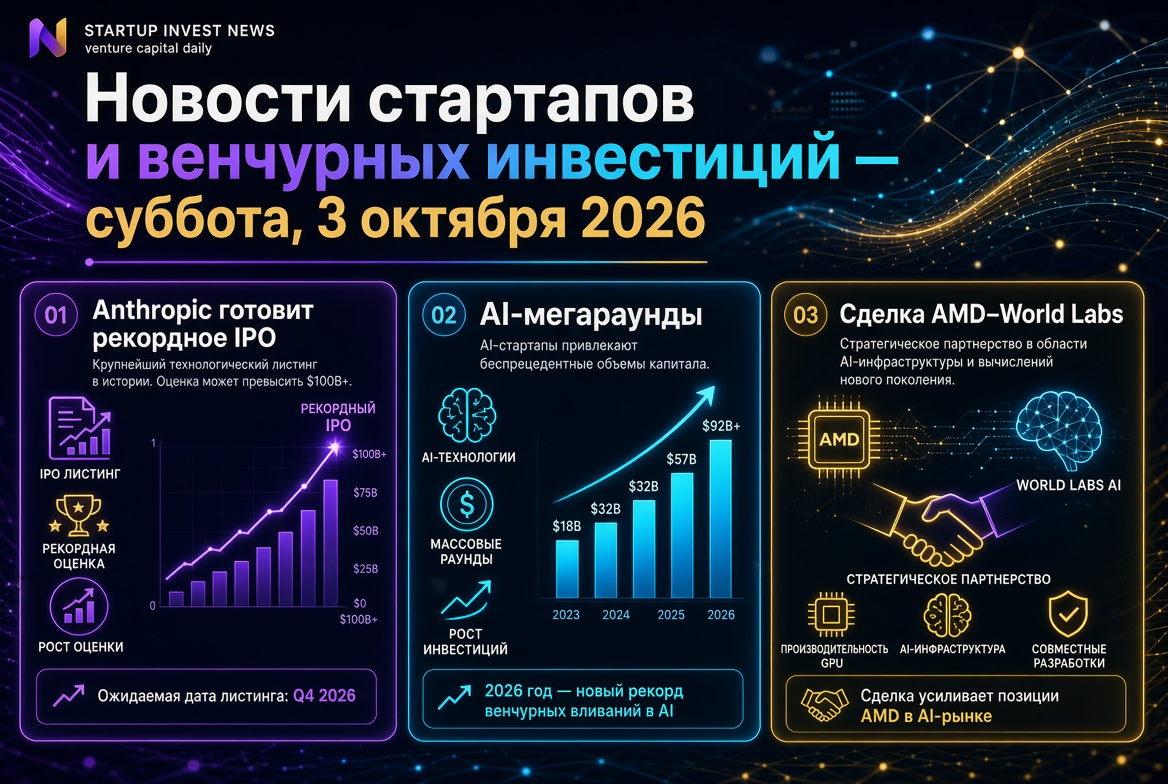
By the end of March 2026, the global startup and venture investment market remains active, but the structure of this growth has become noticeably more concentrated. A significant portion of capital continues to flow into artificial intelligence, with investors increasingly betting not only on applied AI products but also on infrastructure: computing power, corporate platforms, robotics, industry-specific AI solutions, and data layers for autonomous systems. For venture funds, this means the market is once again ready to finance large growth stories; however, the demands on team quality, speed of commercialisation, and product defensibility have markedly increased.
For the global audience of venture investors and funds, this is a crucial moment. The market is simultaneously witnessing:
- capital concentration around AI and adjacent segments;
- the return of very large funds and platform investors;
- growing interest in defence tech, industrial tech, robotics, legal tech, and healthtech;
- an ongoing opportunity for IPOs, but only for the strongest issuers;
- a selectiveness in late stages and more stringent evaluation scrutiny.
Below are key themes shaping the startup and venture investment landscape for tomorrow, 22 March 2026.
AI has definitively become the primary capital attraction
The main takeaway from recent weeks is straightforward: venture investments are becoming increasingly concentrated around artificial intelligence. While the market had previously debated the sustainability of the AI boom, the question has now shifted: who will be best positioned within the value creation chain? Investors are actively segmenting the market not into "AI or not AI", but into several distinct clusters:
- foundation models and research labs;
- infrastructure and computing;
- vertical AI for specific industries;
- robotics and agentic systems;
- enterprise AI for large companies.
This is why startups that can demonstrate not just technology but a scalable revenue architecture are gaining access to capital even amid fiercer competition for LP funds. For venture funds, this signals a return to the "barbell strategy": large cheques for leaders in the AI segment while concurrently making more cautious bets on early-stage teams with high technological uniqueness.
The infrastructure race is becoming as vital as the model race
One of the most prominent trends is the acceleration of the battle for AI infrastructure. The market increasingly understands that the winners of the next cycle may include not only the creators of the most prominent models but also companies controlling access to computing resources, corporate distribution, and specialized hardware-software stacks.
Against this backdrop, startups related to computational infrastructure, robotics, and enterprise deployment are receiving an additional premium on their valuations. This represents a significant shift for the venture market: capital is flowing into the "pickaxes and shovels" of the AI era as actively as into applications. This dynamic enhances interest in the following areas:
- AI compute and specialised chips;
- robotics platforms;
- corporate AI deployment platforms;
- middleware for autonomous agents;
- energy and data infrastructure for scaling models.
Therefore, for startups, today it is particularly crucial to possess not just a model and product but also control over scarce resources: compute, distribution, compliance, and enterprise access.
Large rounds confirm the strength of vertical AI
The latest venture agenda indicates that the market is increasingly financing not abstract AI, but applied industry solutions. The most indicative segments are legal tech, accounting tech, mental health, and industrial automation. This means that capital seeks startups addressing specific costly problems and swiftly translating AI into measurable ROI for corporate clients.
For investors, this is especially important because vertical AI often provides clearer unit economics, reaches revenue more quickly, and is better protected from direct competition from foundation model providers. Currently, the most attractive categories appear to be:
- legal AI for law firms and in-house teams;
- financial and accounting AI;
- healthtech and mental health platforms;
- industrial software and automation;
- AI in enterprise workflows with high ARPU.
In these segments, venture investments are increasingly guided by the logic of "software plus workflow capture", rather than merely "another AI interface".
Mega funds and platform investors are again shaping the market
The startup and venture investment market in 2026 is characterised by the return of large funds and institutional capital. This is not merely an issue of the volume of money. Larger funds are increasingly creating ecosystemic demand: they offer startups capital, corporate distribution, infrastructure partners, and a longer support horizon.
This approach alters the mechanics of deals. Now, the winner of a funding round is not solely the investor willing to offer the highest valuation but also the one who can assist the company with:
- access to large corporate clients;
- infrastructure and computing power;
- hiring rare engineering teams;
- international expansion;
- preparation for late stages or IPO.
For founders, this raises the value of "smart capital". For LPs, it confirms that the market is becoming fund-intensive again, particularly in AI, defence, industrial, and climate tech.
Defence tech and industrial tech are moving from niche to mainstream
Another significant shift is the rising interest in defence tech and industrial tech. These segments had recently seemed too complicated, capital-intensive, and regulatory-sensitive for the broader mass of venture funds. Yet in 2026, the situation has changed. Investors are increasingly viewing defence and industrial startups as a strategic asset class, especially if they operate at the intersection of AI, autonomous systems, sensors, robotics, and supply chain resilience.
The reasons for this pivot are clear:
- government budgets for security and technological sovereignty are increasing;
- corporations are seeking new industrial solutions to enhance efficiency;
- many defence products have dual-use potential;
- the market remains relatively less saturated with capital compared to classic software AI.
For venture funds, this creates a rare opportunity to enter segments where competition for deals is still lower and the strategic significance of the product is higher.
The IPO window is ajar, but the market remains selective
The topic of IPOs is once again centre stage; however, the public offerings market remains highly sensitive to macro conditions, volatility, and the quality of the issuer. In other words, the "window" for going public exists but is accessible only to a select few. Investors are willing to support offerings from strong companies with clear economics, scale, and a compelling growth story, but they are not ready to unconditionally accept inflated valuations.
For late-stage businesses, this translates to:
- startups need to better prepare their equity story;
- the market demands more realistic multiples;
- pausing or postponing IPOs has become a normal tool rather than a sign of weakness;
- quality private rounds may still be preferable to a hasty listing.
From the perspective of venture funds, this is a positive signal: the exit market is reviving, but discipline in valuation is returning. This increases the importance of asset selection and reduces the likelihood of unfounded overheating in late stages.
The geography of capital is expanding: the USA leads, but Asia and Europe are strengthening
Although the USA maintains its lead in capital volume and largest AI deals, the global map of venture investments is becoming broader. Europe is strengthening its position in defence tech, climate tech, and B2B software. India is attracting attention both through its IPO pipeline and sizeable growth stories. The Middle East continues to play an increasingly important role as a source of capital and an independent centre of technological ambition.
For global investors, this indicates that capital distribution in 2026 needs to be more flexible. It is no longer sufficient to focus solely on Silicon Valley. Promising deals and future leaders can be formed in several regional hubs simultaneously.
What this means for funds and venture investors
As of 22 March 2026, the startup and venture investment market can be characterised as follows: there is abundant capital, but it is being allocated increasingly selectively. Capital has not exited the market—it has become more discerning. Companies that possess technology, a commercial trajectory, a scarce asset, and a clear strategic position will prevail.
For venture funds and professional investors, it is currently most prudent to:
- maintain a strong focus on AI but avoid overpaying for "general" stories lacking competitive safeguards;
- seek vertical AI with rapid enterprise adoption;
- explore robotics, defence tech, industrial software, and climate infrastructure;
- evaluate the startup's access to compute, distribution, and strategic partners;
- prepare for the possibility that the exit market will open unevenly.
The bottom line for the audience of funds and investors is as follows: the venture market is once again offering opportunities for significant returns, but the era of indiscriminate valuation growth is receding. In the coming months, the best results are likely to be achieved by those funds that can combine discipline in deal selection with a readiness to make substantial bets on genuinely strategic segments of the new technological wave.