The State Duma approved these amendments on Wednesday to stimulate domestic gasoline supply in Russia and support oil refineries (refineries) impacted by attacks from Ukrainian drones. The corresponding document was published on the website of the lower house of parliament.
- Incentives for gasoline supplies to Russia from EAEU countries and abroad will be enhanced through increased payments under the import damping mechanism;
- Companies will be allowed to earn damping payments for gasoline produced by blending straight-run gasoline with other components;
- The duration of modernization agreements for major refineries will be extended.
All changes related to additional fuel supply for the domestic market will apply to legal relations arising from 1 June 2026, and for refinery modernization - from 1 January 2026.
The bill was approved by the State Duma's Budget and Taxation Committee the day before, on 23 June.
Economy
The fuel market has been under heightened scrutiny since spring. Since May, the Federal Antimonopoly Service (FAS) has been sending recommendations to oil company leaders to adhere to principles of responsible pricing for petroleum products (the latest such letter was reported by the service on 24 June). Meanwhile, the Ministry of Energy stated that the situation in the domestic fuel market remains stable and controllable. The Kremlin also observed no risks in fuel supply to the regions.
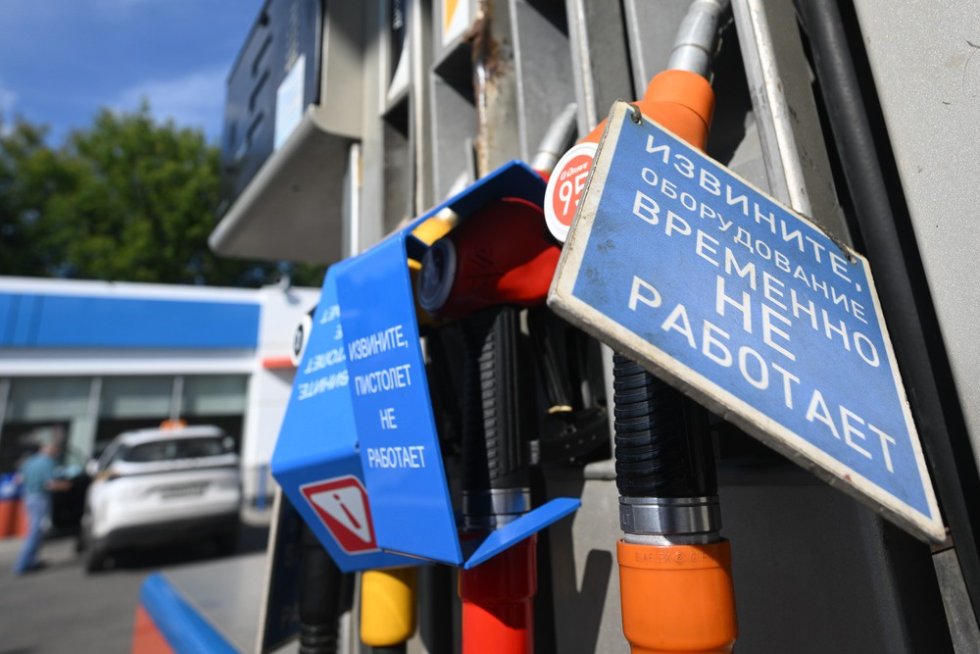
However, a number of regions and oil companies have been forced to introduce restrictions on fuel dispensing at petrol stations. On 24 June, Rosstat reported that the index of petroleum product production in Russia (a component of the overall industrial production index) decreased by 13.5% in May 2026 compared to May 2025. In April, the year-on-year decrease was 9.1%. On a month-on-month basis (compared to April 2026), petroleum production fell by 2.3%. Consequently, the total index for January to May dropped by 4.9% compared to the same period last year.
The Purpose of the Damping Mechanism
The essence of the fuel damping mechanism lies in the government's payments to refiners, which incentivise oil producers to supply more gasoline and diesel to the domestic market rather than for export. If selling fuel abroad is more profitable than domestically, the damping mechanism compensates oil companies for the export price difference, thereby stabilising price dynamics. However, if domestic fuel prices exceed certain thresholds, the damping payments are nullified.
Nullification occurs with overly sharp price fluctuations. According to the Tax Code, if wholesale (exchange) prices for fuel deviate from the established indicative prices by more than 20% for gasoline and 30% for diesel over an average month, the damping payment for that month is not granted. The indicative prices for 2026 are set at 62,300 rubles per ton for AI-92 gasoline and 58,950 rubles per ton for diesel fuel.
Prices for gasoline in Russia increased by 0.9% in May compared to April, according to Rosstat data. On a year-on-year basis, the increase accelerated to 12.9% compared to 12.3% the previous month. According to the agency's statistics, gasoline prices have risen by 4.6% since the beginning of the year. The average consumer price for gasoline in Russia reached 67.7 rubles per litre by the end of May. The cost of AI-92 gasoline was 64.04 rubles, AI-95 - 69.65 rubles, and AI-98 and above - 94.25 rubles per litre.
Increasing Subsidies for Imports
The mechanism for receiving dampening payments for processing Russian crude oil abroad, followed by the import of refined fuel back into Russia, was legislated back in November 2025. Since then, processing Russian crude overseas has become economically comparable to processing within the country. Until now, this tool was primarily aimed at supplies from Belarus. The authorities are now substantially expanding its application and the scale of payments. A corresponding directive from Deputy Prime Minister Alexander Novak was reported by RBC on 1 June.
The amendments secure the possibility of receiving damping payments for imported gasoline by government-sanctioned organisations. For fuel produced in EAEU countries, the KAB_KOMP coefficient (one of the parameters in the compensation calculation formula for automotive gasoline) will be set at 0.85 in 2026, and will further reduce to 0.33 in 2027. "Currently, coefficients of 0.68 (for gasoline) and 0.65 (for diesel) are used, and introducing an increased coefficient of 0.85 for gasoline importers essentially means subsidising fuel imports from abroad," explains Sergey Tereshkin, CEO of the Open Oil Market fuel marketplace.
A separate compensation calculation mechanism for gasoline produced outside the EAEU will be introduced. This will be based on the import parity price, which comprises the indicative price of AI-92 gasoline in the Indian market and the cost of transport from Indian ports to Russia. This figure will be determined by the Federal Antimonopoly Service (FAS).
Experts consulted by RBC note that the new regulations do not automatically imply the commencement of fuel imports from India, but they create economic conditions for the importation of gasoline from abroad when necessary.
Selecting the Indian market as a benchmark indirectly indicates that Russia will import petroleum products from India, which has become one of the largest importers of Russian oil since 2022, according to independent energy expert Kirill Rodionov. He believes that fuel imports from abroad are quite likely, as Belarus, which began increasing fuel supplies to Russia since 2024, will be constrained by its refining capacity.
Another potential supplier of petroleum products among EAEU countries could be Kazakhstan; however, the country is currently unable to significantly boost exports. Significant volumes of Kazakh fuel supplies will only be feasible after the commissioning of a fourth large-capacity refinery with a design capacity of up to 10 million tonnes of fuel per year, Rodionov believes. A decision on project investments is expected to be made by the end of this year. On 24 June, the agency Reuters, citing sources, reported discussions between Russia and Kazakhstan. However, agency sources assert that Moscow and Astana are only talking about importing approximately 50,000 tonnes of AI-92 gasoline. Moreover, the Kazakh side previously denied receiving such a request.
At the same time, India is not the only potential fuel supplier to Russia, says Dmitry Kasatkin, managing partner at Kasatkin Consulting. "The Indian market has been chosen because it is one of the largest centres for refining and trading petroleum products outside the western framework, and it actively engages with Russian oil. The indicative price is used not so much as a mere signal of a specific physical supply source, but as a calculation base for an alternative external price,” he explains.
This sentiment is echoed by Tereshkin. He further adds that the calculation of parity is generally carried out considering transportation costs, which, in the case of India, are significantly higher than those for the Dutch port of Rotterdam, which had been previously considered in the damping calculations.
China is also viewed as a potential fuel supplier to Russia, according to Tereshkin. In recent years, new refining capacities have been commissioned there, alongside the electrification of passenger vehicles and the gasification of freight transport. Consequently, in the future, the country may release surplus fuel volumes.
According to analysts, stimulating fuel imports will assist in saturating the market during a crisis period; however, the scale of the effect will largely depend on the speed of recovery of Russian refineries, the absence of logistics issues, and the control of fuel distribution across regions. Kasatkin argues that the import damping mechanism serves as a temporary safety measure. Once the operations of Russian refineries stabilise and fuel reserves are replenished, the demand for it should diminish; otherwise, the mechanism could distort the internal processing economy.
Additional questions arise concerning the very methodology for calculating compensations. As noted by senior lawyer at "Rustam Kurmaev and Partners" Vladislav Gates, the damping amount for gasoline outside the EAEU becomes a function of import parity, which the FAS calculates based on the indicative Indian price and transport costs from Indian ports. "This means that a significant element of the tax deduction is determined not by law, but by the methodology of a single regulator, directly affecting the principle of legal certainty: taxes and terms of their calculation must be articulated so that the taxpayer understands their rights and duties in advance, with ambiguities interpreted in their favour," he explains.
Gates further points out that until the FAS methodology is published and validated, importers will be unable to model the amount of payments, thereby increasing the likelihood of disputes regarding the accuracy of the indicator itself.
How Authorities Plan to Rapidly Increase Gasoline Production
Another significant innovation in the Tax Code relates to gasoline production through the blending of straight-run gasoline with other components. The amendments allow it to be included in the overall volume of gasoline produced and to receive damping payments for it, as well as exempting excise tax from the cost of straight-run gasoline used for blending. Companies are given three months to gather documentation confirming that high-octane gasoline has been produced from straight-run gasoline by blending.
According to Kasatkin, permitting the inclusion of gasoline produced through the blending of straight-run gasoline will serve as a crucial support for the market during periods of high seasonal demand and unplanned refinery repairs. This technology is widely used in the industry and does not present issues for vehicles. However, this mechanism may raise questions regarding the traceability of component origins and the quality of the final product. Strict laboratory accounting, digital tracking of batches, matching raw material and finished fuel volumes, and random independent testing will be necessary.
The main legal risk lies in the fiscal domain, Gates adds. The excise tax deduction for straight-run gasoline makes it attractive to establish "paper" blending without actual production of high-octane gasoline solely to obtain the deduction.
Oleg Abelyev, head of the analytics department at investment company "Rikom-Trast," reminds us that some control tools already exist. "There are GOST standards that define control methods and fuel compatibility when blending. However, the key factor is state control by Rosprirodnadzor and Rosstandart to ensure that the volumes of substandard fuel do not increase," the expert believes.
To ensure the scheme functions effectively as an incentive, stringent control throughout all stages is critically important, adds Vasily Kutyin, Head of Analytics at Ingo Bank. It is necessary to verify that companies are indeed producing high-octane gasoline and are not attempting to exploit the mechanism. Hence, the amendments stipulate that companies must provide confirmation within three months that high-octane gasoline has been produced from straight-run gasoline to receive the excise tax deduction. Additionally, a rule has been introduced: if the buyer returns said gasoline, the paid excise tax will not be reimbursed. "However, it is evident that totally eliminating the human factor or technical glitches in control is impossible, so oversight remains an important element," he concluded.
Why Authorities are Extending Modernisation of Refineries
Another set of amendments pertains to oil refineries investing over 100 billion rubles in modernisation. For these refineries, the duration of the modernization agreements between oil companies and the government has been extended to 31 December 2026. Previously, the agreements, which included tax incentives for investors, were set to expire in January this year.
This is not about a new incentive, but rather an attempt to preserve already launched investment projects that have been threatened by external factors, experts explain. "Major projects at refineries have objectively been postponed due to supply chain restrictions, the import substitution of technological solutions, project cost inflation, and unforeseen maintenance after attacks on infrastructure," says Kasatkin. According to him, the government aims to preserve the investment cycle in oil refining.
Abelyev adds that the delay will allow companies not to lose their right to tax incentives when parts of their refining capacities are halted for unscheduled maintenance. It is expected that this will enable the completion of deep processing projects and increase the output of light petroleum products, reducing the market’s dependency on emergency crisis solutions.
However, experts agree that the current package of measures can only temporarily alleviate market tension. "Regulators are using the tools available here and now. These measures will increase subsidies for the sector and may calm the market somewhat, but they will not change the overall situation, as everything hinges on the dynamics of supply from refineries," summarises Tereshkin.
Source: RBC