The Global Startup and Venture Capital Market on 12 November 2025: New Mega-Rounds in Artificial Intelligence, Launch of Mega Funds, Market Growth and IPO Plans. A Detailed Overview for Investors and Funds.
The global venture capital sector continues to show signs of robust recovery. By mid-November 2025, the startup market has witnessed an uptick in transactions and capital inflow – significant funding rounds and the launch of mega funds signal a renewed risk appetite among investors. While artificial intelligence startups remain in the spotlight, considerable investments are also being drawn to projects across other sectors – from healthcare to energy technologies. Let us explore the key news and trends in the venture capital market as of Wednesday, 12 November 2025.
The Global Venture Capital Market: Sustainable Recovery
In the third quarter of 2025, global venture investments grew by approximately 38% year-on-year, reaching $97 billion – the highest level since 2022. Mega rounds exceeding $500 million accounted for roughly a third of the market, with nearly 46% of all funding directed towards AI startups. Thus, venture capital is steadily returning to the global market. Large investments are concentrated in the most promising sectors, while financing for early-stage projects is gradually increasing as well. Investors are once again ready to allocate significant sums, particularly to industry leaders.
AI Investment Boom
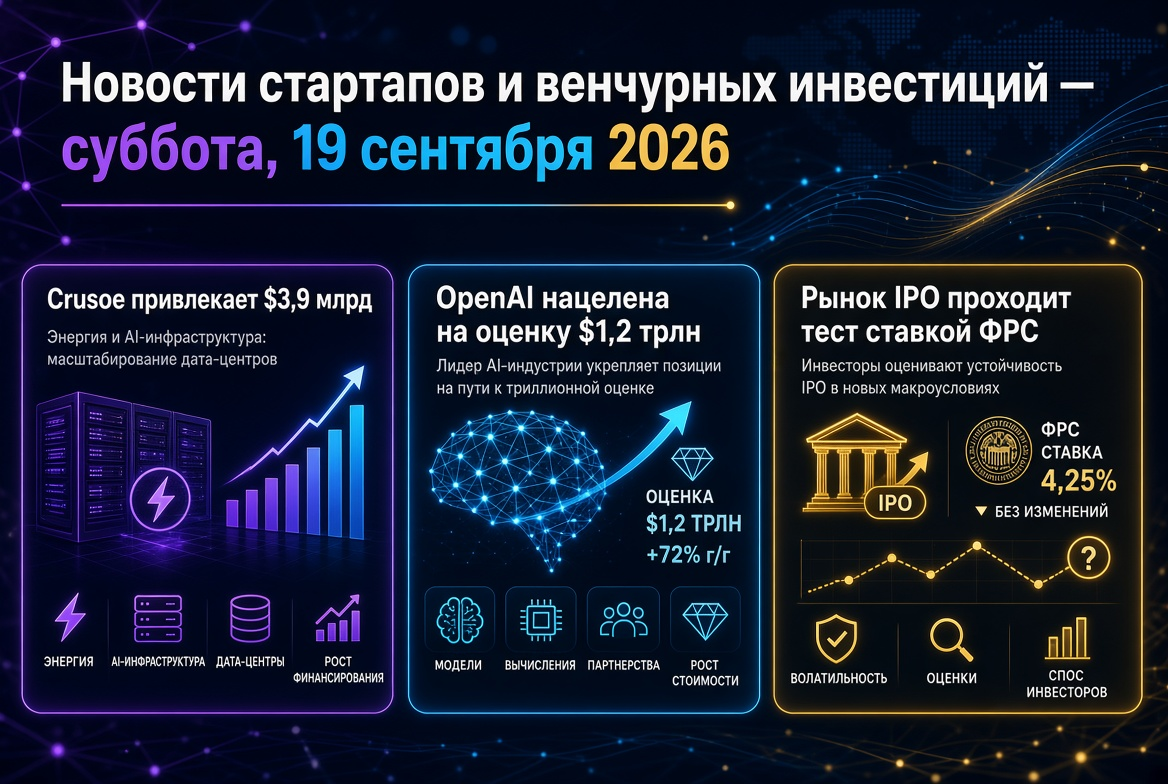
The artificial intelligence sector continues to attract record levels of funding. AI startups are securing rounds of unprecedented scale – for example, Anthropic raised a record $13 billion, while Elon Musk's xAI garnered $5.3 billion. Investors are eager to establish positions in the AI race, directing capital to both fundamental model developers and creators of applied AI services.
A telling example of the excitement surrounding AI is the startup Hippocratic AI, which combines medical technology with generative AI. This week, the company secured $126 million at a valuation of $3.5 billion. The round, led by Avenir Growth, nearly doubled Hippocratic AI's valuation since the start of the year. This underscores that investors are willing to appraise AI-focused companies in the billions due to their rapid growth and potential to transform industries.
Moreover, the excitement encompasses not only neural network developers but also infrastructure projects. Startups working behind the scenes of the AI industry – whether hardware solutions or cloud platforms for AI tasks – are also receiving substantial funding. Thus, the investment boom in artificial intelligence continues across the entire technology stack.
Healthcare and New Unicorns
Beyond the digital sector, large capital is flowing into biomedicine and healthcare – an industry that emerged as the third largest in venture capital funding in the third quarter (approximately $15.8 billion in Q3). This week, a notable deal highlighted the attractiveness of medtech for investors. American startup Forward Health, specialising in preventive medicine, raised $225 million in a Series D round led by SoftBank and Founders Fund. This elevated Forward's valuation above $1 billion, making it a new "unicorn" on the market. Forward focuses on personalised preventive medicine, with the funds enabling the expansion of its clinics across the United States.
Overall, venture funds continue to actively support healthcare technologies, particularly at the intersection with AI. In addition to Forward, several other medtech startups have garnered substantial funding this year. This interest can be attributed to sustained demand for remote and personalised medical services in the post-pandemic period. The success of companies like Forward and Hippocratic AI confirms that innovations in healthcare remain a priority, and new unicorns in this space continue to emerge.
Diverse Transactions: Automotive Tech, Robotics and Fintech
Beyond AI and healthcare, venture investments are spanning a wide range of industries. This week saw significant deals across various sectors:
- Automotive Technologies and Mobility: American startup Metropolis raised approximately $1.6 billion (including $500 million in a Series D round) at a valuation of around $5 billion to develop an AI platform for automated parking payments. The system recognises vehicles and automatically deducts fees without tickets or cashiers; the capital will facilitate service expansion into drive-thru restaurants and gas stations.
- B2B Services (SaaS): News has emerged from Silicon Valley regarding the launch of the startup Reevo, which aims to unite disparate sales and marketing tools on a single AI platform. Emerging from "stealth mode," Reevo secured an unprecedented $80 million in seed funding – such a large initial round indicates strong investor confidence in a new revenue management model for B2B companies.
- Robotics: The hardware segment is also breaking records. Californian startup Figure, which is developing humanoid robots for work and household tasks, secured over $1 billion in funding this year, achieving a valuation of approximately $39 billion. This capital will allow Figure to scale production and advance the commercial deployment of humanoid robots, demonstrating fund interest in deep technological innovations.
Additionally, activity continues across other niches. Fintech companies collectively received around $12 billion in global investments in Q3 2025 (4th place among industries) – despite a decline in enthusiasm, fintech continues to attract significant capital, particularly in sustainable payment and financial business models. Furthermore, investors are showing interest in climate technologies: startups in renewable energy and eco-tech continue to secure funding amid heightened attention to the ESG agenda. Thus, alongside the dominance of AI, venture capital is being distributed across a variety of sectors – from transport services to industrial technologies, indicating numerous growth points on the startup scene.
Major Venture Funds Expanding Opportunities
The influx of capital into startups is supported not only by transactions but also by the emergence of new large venture funds. This week, Silicon Valley's fund TCV announced the raising of $4 billion for its 11th fund – a record amount in the firm's 25-year history. This indicates that leading market players are building up "dry powder" for investments in the coming years. TCV plans to deploy these funds in promising segments – from fintech and educational technologies to digital entertainment, doubling down on the most successful areas of its portfolio.
There is also growth among specialised funds. For instance, the American firm CMT Digital recently closed a crypto fund worth $136 million to invest in blockchain startups – a signal that even amid cryptocurrency market volatility, niche investors are prepared to support this sector. Meanwhile, in Africa, one of the most active local funds, the Nigerian Ventures Platform, is attracting $75 million for its second fund – confirming the global nature of venture capital expansion. These examples illustrate that the formation of an investment pool is taking place globally, aimed at a new phase of startup development. Major funds – from global mega funds to regional and industry-specific ones – will provide startups with significant resources and intensify competition among investors for the most promising deals.
Corporates as Investors: Alliances and Strategic Deals
Major technology corporations are increasingly participating in the venture market. Rather than pursuing acquisitions, they are forging strategic alliances or investing minority stakes in startups. For instance, Snap Inc. invested $400 million in the AI startup Perplexity AI and is integrating its search technology into its service – this move strengthens Snapchat's AI capabilities and provides Perplexity with access to a multi-million audience. Overall, Microsoft, Google, Amazon, and other giants have invested billions in young AI companies over the past few years, while industrial corporations are ramping up deals through their venture divisions (especially in robotics, drones, and transport). This approach allows corporations to access early-stage innovations while enabling startups to tap into the resources and markets of large businesses.
Exits and IPO Prospects
The exit market is also showing signs of revival. In the third quarter, significant exits occurred (for example, the IPO of an automotive manufacturer and the sale of the design service Figma), and several large startups are again planning public offerings (including the fintech unicorn Klarna). At the same time, investors are now betting on profitability and sustainable growth, meaning that only the most prepared companies will make it to the public market. Successful exits are funneling substantial capital back into circulation, completing the venture investment cycle.