Current Startup and Venture Investment News as of 5 March 2026: Mega-Rounds in AI, Defence Technologies, Deeptech in Europe, Fintech, and Exits
The key signal from recent days is that capital is once again concentrating where technological advantages can be rapidly monetised through scalable channels: defence contracts, corporate AI infrastructure, autonomous mobility, and deep supply chains (chips, energy efficiency, logistics). Concurrently, Europe Inc. continues to build its own 'sovereign' frameworks - from dual-use funds to state-supported fundamental AI research.
- Defence tech and autonomous systems are emerging as leaders in growth rate assessments: a new major round for Anduril is under discussion.
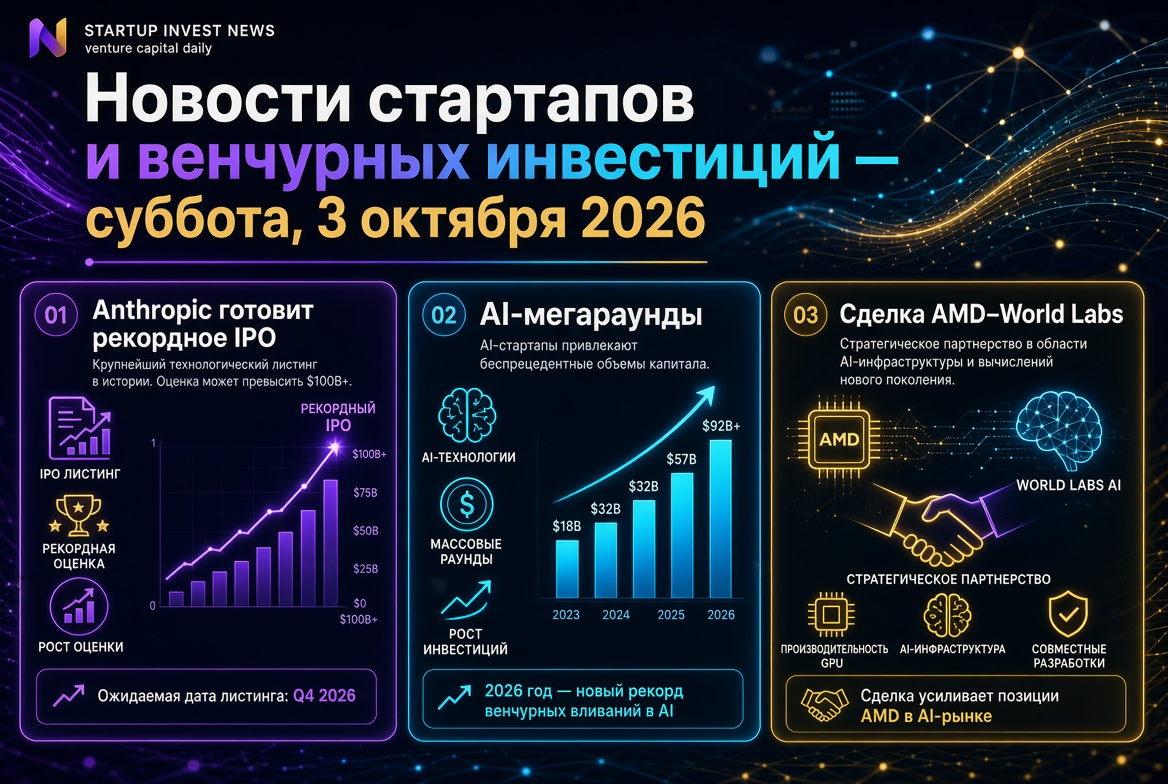
- AI remains the centre of gravity for venture investments: the mega-round for OpenAI and significant rounds for Anthropic and Waymo consolidate the trend of capital concentration.
- ‘Picks and shovels’ for AI (optics, interconnects, inference chips, edge) are receiving a valuation premium once again.
- European deeptech is accelerating: space, energy storage, and biomaterials are securing notable Series A–C rounds.
- Fintech exits are reopening the 'window of opportunity': parameters for a major IPO in India are being discussed in the market.
- M&A and PE transactions in logistics and enterprise software strengthen the 'build-to-buy' argument for B2B startups.
Today's Main Topic: Defence Tech, Dual-Use, and Autonomous Platforms — Anduril Targets New Round
The defence sector is changing the fastest: demand for autonomous systems, sensors, drone 'swarms', and management software in electronic warfare is reshaping the venture thesis. According to business media reports, Anduril is discussing raising approximately $4 billion, which suggests a near doubling of its valuation from $30.5 billion in the previous round. For the market, this is not just 'another mega-round'; it marks the transition of defence budgets and long-term contracts into a distinct asset class at the intersection of VC and growth/private equity.
Europe is responding with its own capital instrument. The European Investment Fund has announced a €50 million commitment to the third fund of Join Capital (target size €235 million) with a mandate for early deeptech focused on defence, security, and space. Strategically, this means fewer 'concepts', and more engineering industrialisation and supply chains within the region.
- Europe (UK): Mutable Tactics raised approximately $2.1 million (pre-seed/seed) for a software 'decision layer' for coordinating drones during signal loss.
- Central and Eastern Europe: the region is witnessing deals where defence and dual-use projects are competing in round sizes with classic SaaS.
Mega-Rounds in AI and Capital Concentration: OpenAI, Anthropic, and Waymo Set the Scale
The paradox of the 2026 venture market: risk appetite has grown, but it is distributed extremely unevenly. The spotlight is on OpenAI, which has announced $110 billion in new funding with a $730 billion pre-money valuation (and approximately $840 billion post-money). Major strategic investors are involved in the deal, and the capital is increasingly tied to access to computing resources and distribution channels for corporate products and 'AI agents'.
At the market level, this enhances the 'gravity effect'. According to industry reviews, global venture investments reached a record volume in February, with three companies — OpenAI, Anthropic, and Waymo — capturing a dominant share of all raised funds. For funds, this shifts benchmarks: a 'mega-round' is no longer an exception at the top of the pyramid but remains inaccessible for the overwhelming majority of startups without infrastructure advantages.
- For growth funds: competition for stakes in several 'compounding' categories is intensifying, where capital becomes a lever for accessing compute resources and contracts.
- For early-stage: the value of projects that are not tied to expensive compute infrastructure and can rapidly achieve margin-positive B2B revenue is increasing.
- For corporates: the logic of 'build + partner' is returning: it is simpler to invest in the ecosystem than to attempt to reproduce the best models internally.
'Picks and Shovels' for AI: Optics, Interconnects, and Inference Chips Receiving Premiums
In the shadow of mega-rounds for model developers, the hardware and infrastructure 'layer' is experiencing a significant revival. Ayar Labs, which is developing optical interconnects between computing and memory chips to accelerate data transfer, announced a $500 million Series E round at a valuation of approximately $3.75 billion. The rationale is clear: bottlenecks are not only about GPUs, but also about 'data transport' within data centres, as well as energy consumption and cooling.
Europe is also advancing its own chip agenda for inference. Dutch company Axelera AI reported raising $250+ million with participation from a large institutional player and European funds, promoting the thesis of energy-efficient inference on edge devices. This is crucial for markets where latency, privacy, and cloud costs become barriers to the adoption of AI in manufacturing, robotics, and defence scenarios.
- Thesis of 2026: training remains a showcase, but money is flowing into infrastructure for mass inference.
- Operational KPI: the cost of a single 'useful solution' (inference/agent) is more important than the model size.
Autonomy and Industrial AI: Oxa, Waymo, and the Transition from Prototypes to Deployment
The shift in autonomous mobility is becoming more pragmatic: fewer 'dream robotaxis', more industrial autonomy in controlled environments — ports, airports, warehouses. British company Oxa raised $103 million in Series D funding, including $50 million from the UK National Wealth Fund, along with participation from NVentures and bp ventures. The company emphasises its focus on 'industrial mobile autonomy', where implementation cycles are shorter, and the economic impact is easier to quantify.
On the other side — the scaling of robotaxis as an infrastructure service. Waymo closed a round of $16 billion at a valuation of approximately $126 billion, confirming that autonomous mobility (with regulated access and a built-up safety stack) is becoming a new vertical for significant growth capital rounds. For venture investors, the takeaway is straightforward: it is not the one who shows the prettiest pilot that wins, but the one who reduces operating costs and expands geographical deployment.
European Deeptech and Climate: Space, Seasonal Energy Storage, and Materials
The European agenda this week is noticeably 'industrial'. Spanish company PLD Space closed a €180 million Series C round led by Mitsubishi Electric, with participation from Spanish public support mechanisms and private investors. The key focus is on transitioning to commercial launches and infrastructure deployment, making spacetech closer to a model of 'infrastructure asset' rather than a venture experiment.
In climate technology, the focus is shifting from 'green promises' to energy-intensive realities. Norwegian firm Photoncycle raised €15 million in Series A funding for seasonal storage: the idea of storing excess solar energy in summer for use in winter is a rare example of clear consumer value in Europe with its energy prices. At the materials level, London-based Shellworks closed a $15 million Series A to scale Vivomer — an alternative to plastic, betting on cost-competitiveness and production in local regions (USA/EU/UK).
- Spacetech: capital is flowing into launch infrastructure and manufacturing capabilities, not just payloads.
- Climate tech: investors demand measurable effects on cost and supply chains.
B2B-SaaS and Vertical AI Products: LegalTech, Compliance, and ‘Agentic’ Automation
In applied B2B AI, 'verticalisation' continues — products that integrate into existing processes and save hours of costly specialists are emerging as winners. In France/Europe, the platform DeepIP raised $25 million in Series B funding, positioning itself as a workflow-native solution for the full lifecycle of patents — from early development to portfolio support and enforcement. In the US, the 'agentic' thesis is also supported in the professional services market: Basis raised $100 million in Series B at a valuation of $1.15 billion, focusing on autonomous agents for accounting.
In fintech compliance, London-based Diligent AI closed $2.5 million in seed funding for AI agents in KYC/AML, aimed at reducing the burden due to the increasing number of sanctions regimes and the speed of digital payments. This is crucial for global banks and fintechs in the US, Europe, the Middle East, and Asia: compliance is becoming a point where AI delivers rapid ROI without the risk of 'hallucinations', as quality metrics (false positives/false negatives, processing time) are relatively formalisable.
Exits, IPOs, and M&A: PhonePe in the IPO Market and Consolidation in Logistics
On the exits side, a key story is emerging from India. According to Reuters, Walmart-backed PhonePe is eyeing an IPO with a valuation of approximately $9–10.5 billion and deal size of around $900 million – $1.05 billion, with existing shareholders expected to sell their stakes. The very fact of active preparation for a large fintech listing in Mumbai/India has global significance: it brings back the public market as a pricing mechanism for late-stage companies and alleviates some pressure on secondary transactions.
Meanwhile, M&A and private equity are forming 'comps' for B2B. Thoma Bravo announced an agreement to acquire WWEX Group, which will subsequently merge with Auctane to create a large technological platform in logistics and delivery. For venture funds, this confirms that buyers are willing to pay for data, automation, and end-to-end visibility 'from checkout to doorstep', especially when the solution is simultaneously software-based and operationally scalable.