In September, payments to oil producers under the damping mechanism reached a record 305.5 billion roubles, as reported by the Ministry of Finance. This amount is only 32.5% lower than the net revenue of the budget for the same month derived from the entire oil and gas sector.
The damping mechanism consists of budget payments to oil refineries (ORFs) for supplying products in Russia at prices below export levels. This mechanism compensates for part of the difference between the indicative wholesale prices (set by the government annually) in Russia and the cost of fuel in foreign markets. Since June this year, the damping payments have also been extended to petrol importers, and from July, to diesel fuel (DF). The aims of the mechanism are to minimise the impact of fluctuations in fuel prices in external markets on the domestic market and to support local oil refining. In most cases, the damping mechanism also keeps fuel prices in Russia lower than in other countries.With the introduction of the damping mechanism, the mineral extraction tax (MET) for oil companies was increased, which funded these payments. It is important to note that all oil extraction companies pay the MET, while damping payments are only received by those owning the largest refineries. Thus, viewing the damping mechanism as "taking money" from other sectors of the economy is not entirely accurate. The current situation this year is characterised by decreased oil and gas revenues and a rise in damping payments.
Throughout last year, payments under the damping mechanism totalled 881.8 billion roubles. Over the first nine months of this year, the sum has already exceeded 1.2 trillion. High payments were also observed in 2022 and 2024, but during these years, oil and gas revenues were at record levels. As a result, for the first nine months of this year, the treasury received 17.2% less from the sector compared to the same period of the non-record year 2025.
In total, in September, the budget received 870.9 billion roubles in oil and gas taxes, but only 452.4 billion roubles made it to the revenue part. The remaining 418.5 billion roubles were returned to oil producers in the form of compensations and subsidies, a significant portion of which was accounted for by the damping mechanism.
Despite the record damping payments in September, according to Rosstat, retail petrol prices continued to rise, increasing by more than 1% for the month (21.2% since the beginning of the year). The situation with diesel is better, as it dropped nearly 2% over the month, but since the start of the year, the price increase reached 14%. Inflation since the beginning of the year by the end of September stood at 4.93%. In September, trading on the exchanges saw a significant drop in petrol and diesel quotes (by 6-10%) compared to the peaks in August, yet this decline did not reflect in retail prices.
Diesel prices at filling stations fell almost by two per cent in SeptemberAs noted in a conversation with "RG" by Yuri Stankevich, Deputy Chairman of the State Duma Committee on Energy, the damping mechanism compensates for the difference between internal and external prices specifically at the wholesale level. However, the price at petrol stations (PS) is composed not only of the cost of procuring fuel. It also includes logistics, rising costs for equipment maintenance, electricity, payroll, and the margin for the PS chain itself. Moreover, PSs incur costs to maintain prices from previous months at the expense of their profits.
Damping payments are received by ORFs, not PSs. Therefore, the influence on retail pricing is only indirect. That said, given the record size of the payments, a greater impact on PS prices was anticipated. However, this did not occur for several reasons.
According to Sergey Frolov, Managing Partner at NEFT Research, the rise in fuel prices in Europe (based on Rotterdam prices for the damping calculations) and the increase in petrol imports were contributing factors. As a result, the price is ultimately higher than the European price, as logistical costs and premiums for sanctions and other risks are added to high prices in the global market. Under these circumstances, the damping mechanism on imported supplies falls short. This means that trading leads to losses. Such a situation is unsustainable for independent operators (PSs not owned by large oil companies). The price increase at these independent or franchise PSs mainly drives the growth of the average price index, the expert highlights.
Stankevich believes that the impact of fuel imports should not be overstated. The cause of increased damping payments is not importation, but a sharp rise in global oil and petroleum products prices. In September 2026, against the backdrop of rising global quotes and a weaker rouble, export prices for fuel became abnormally high compared to the regulated domestic market, leading to the historic record of compensations. Fuel imports, in this case, are not a driver of payments.
The average price of A-92 gasoline in Rotterdam in August 2026 increased by 2% compared to the previous month, while DF rose by 10%, reported Sergey Tereshkin, General Director of Open Oil Market. However, due to the weakening rouble, the export alternative price (export price minus costs) rose even more: for A-92 gasoline, it increased by 9%, while for DF, it surged by 19%.
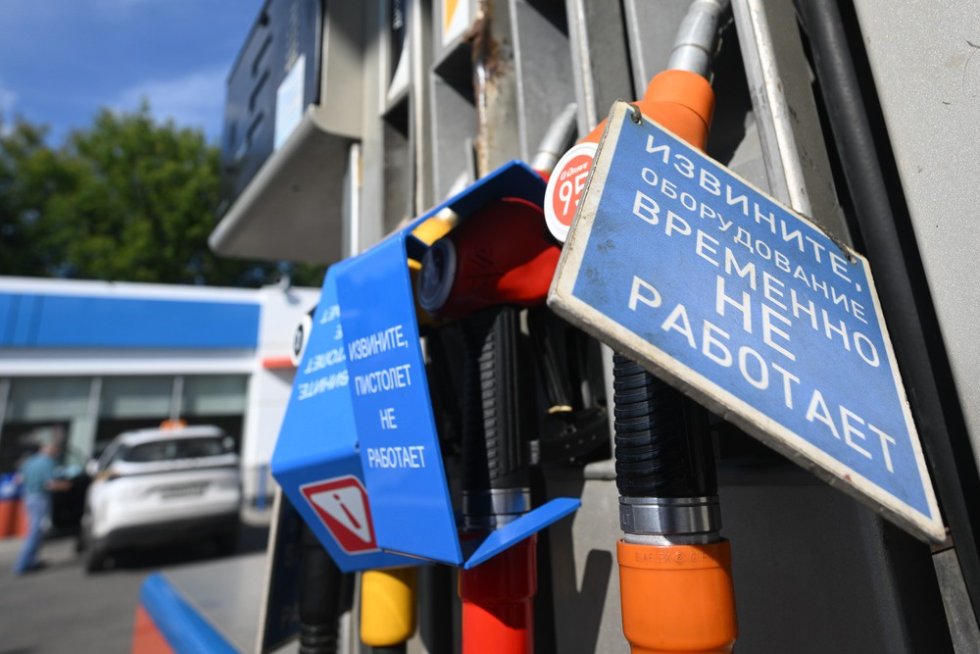
The influence of fuel imports on rising prices at filling stations was minimalThe expert is confident that if it weren't for the rouble's depreciation, damping payments calculated with a monthly lag would not have exceeded 300 billion roubles.
He does not rule out that in October 2026 (payments will be for September), damping payments could increase even further, as the average exchange rate last month was 85.1 roubles per dollar compared to 83.2 roubles in August and 77.9 roubles in July. Tereshkin does not anticipate a significant reduction in retail petrol prices but allows for some stabilisation, as is already occurring with diesel prices.
According to Dmitry Gusev, Deputy Chairman of the Supervisory Board of the "Reliable Partner" Association and a member of the expert council of the "Petrol Stations of Russia" competition, the key issue in the sector currently is the volumes of oil refining, not prices. He believes there are no incentives for building new ORFs, including in areas where they are desperately needed—such as in the east of the country. Taxes from the oil sector are collected at the extraction stage, export duties have been zeroed, and thereafter, companies can do as they see fit with this oil—export or refine, Gusev noted.
A Rostov motorist demanded that one of the filling stations refund her overpayment for fuel, and her demands have already been supported by the antimonopoly service. If the filling station does not refund her money, the Rostov resident is prepared to pursue justice through the courts.
In August, Irina Yakimiv faced a dilemma: fill up at reasonable prices, having first waited in line, or fill up freely but at a high price.
"I was in a hurry and stopped at one of the filling stations. The price for A-92 petrol was over one hundred roubles, but I had to refuel. There were also some utterly outrageous prices—180, 200 roubles per litre," Irina recounted.
The Rostov resident decided not to leave the matter as it was and wrote a request to the FAS asking them to investigate what she perceived as illegitimate price hikes for fuel.
In her appeal, Irina Yakimiv indicated that she deemed the increase in fuel prices in Rostov-on-Don to be unwarranted, particularly citing occurrences at the filling stations of the "Ajax" company in the Rostov region.
Ultimately, her claims were validated: the Regional FAS reported that it continuously monitors pricing in the oil products market and had already identified instances of inflated fuel prices at two regional filling stations. They received official warnings, requiring corrective action.
However, this outcome only partially satisfied Yakimiv. "I prepared a pre-trial claim requesting compensation for my losses. We took the average price for the region and the price charged at the filling station. It came to around one thousand roubles overpayment," she told "RG".
At the same time, the woman emphasises that her issue isn't about the amount but about the principle: she aims to set a precedent so that unscrupulous filling stations stop artificially inflating prices.
If "Ajax" does not seek an amicable resolution, the Rostov woman intends to continue her pursuit for justice in court. "Who guarantees that they won't revert to this practice in the future?" Irina Yakimiv questions.
Source: RG.RU