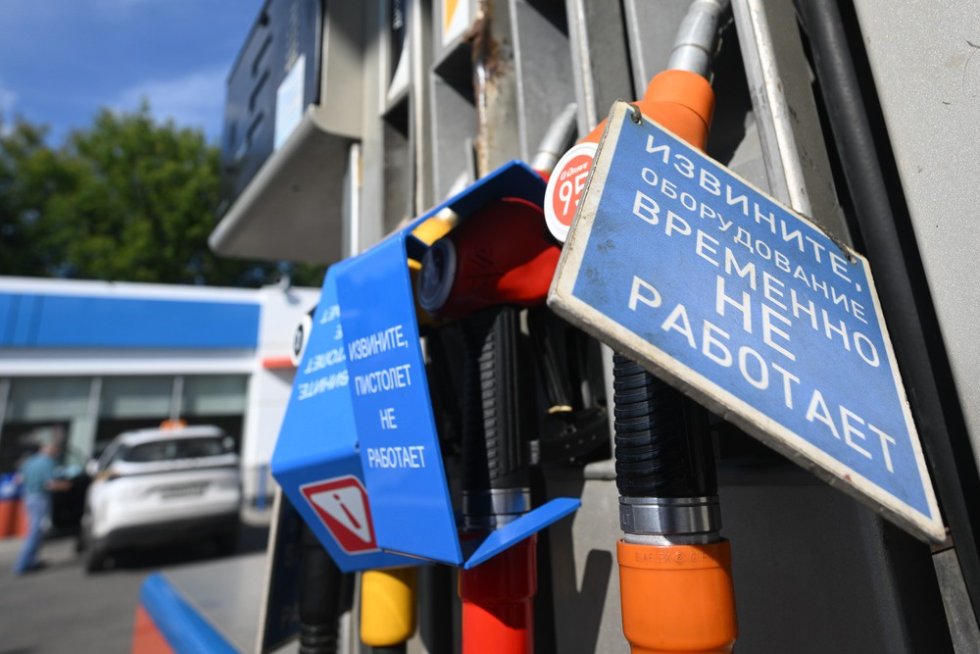
The average price of oil for the most widely traded Russian grade, Urals, reached $77 per barrel by the end of March, according to the Ministry of Economic Development. This compares to $44.59 in February. The good news is that this nearly twofold increase translates into enhanced budget revenues for the country from oil production in April. The downside is that domestic oil refineries (refineries) have also seen rising oil costs, which may affect prices at petrol stations.
Experts consulted by "RG" are confident that wholesale fuel prices will rise, albeit not as sharply as the increase in oil prices. The rise in retail prices will likely be in line with inflation levels. However, the profitability of oil refining and retail fuel sales will decrease.
The increase in the price of Russian oil does not necessarily imply that Russian oil companies are selling it to domestic refineries at $77 per barrel. The price mentioned by the Ministry of Economic Development is used for tax calculations for oil companies, which are based on the total amount of oil produced in the country during the previous month.
Payments for March will be made in April. This clarification is not incidental. At a Urals price of $77, the share of tax payments that companies must remit per barrel is around 65-68%. This means that the tax component of the Urals price in April alone amounted to $50, more than the total Urals price a month earlier. Therefore, the primary increase in oil prices in the domestic market is expected to occur this month.
According to Reuters, referring to data from traders, the cost of a tonne of West Siberian oil, supplied to the Russian domestic market, surged in April by an average of 32,600 roubles compared to March, reaching a level of 59,000-60,000 roubles per tonne.
So far, there has been no significant reaction on the exchanges to this increase. The prices of AI-92 and AI-95 petrol are close to their year-to-date highs, although they remain below the peaks seen last autumn. Given that April has only just begun, the rise in domestic oil prices may yet be reflected in trading.
In Russia, the share of oil in the price of a litre of petrol ranges from 15% to 35%. The higher the price of oil, the greater its share. However, the increase in export prices for crude oil and refined products does not directly translate into equivalent increases in wholesale and retail petrol or diesel prices, due to the domestic tax system.
Russia operates a reverse excise tax mechanism for oil supplies for refining within the country. This mechanism partially compensates for tax payments made by refineries. The reverse excise scheme includes a damping mechanism, which acts as a partial budget compensation for oil producers supplying fuel to the domestic market at prices lower than export levels. The amount of compensation under this damping system is directly proportional to the difference between the export alternative (the price in Europe) and the indicative price set by the state for the domestic market. The damping can also be negative, meaning that when the export price of fuel falls below the indicative prices, producers must pay the budget the resulting difference. This occurred in January and February (with payments made in February and March). Oil producers incurred losses of 33.8 billion roubles due to the damping during these two months. However, for March (in April), they are expected to receive about 150 to 200 billion roubles from the budget, though it remains uncertain whether these payments will cover past losses and decreased refining profitability.
As noted by Yuri Stankevich, Deputy Chair of the State Duma Energy Committee, in conversations with "RG," if the price of oil supplied to refineries rises significantly, the margins for those plants, without compensation mechanisms, diminish sharply. To restore those margins, refineries tend to increase their wholesale prices for petrol and diesel. Therefore, in the short term, upward pressure on wholesale and small wholesale prices is inevitable. Retail prices tend to react more slowly, lagging behind due to the damping mechanism and an unofficial directive to keep socially sensitive prices in check. Moreover, the high share of taxes in the price per litre (60-70%) makes the final price less volatile in relation to raw material prices.
According to Sergey Tereshkin, General Director of Open Oil Market, three-quarters of Russian oil refining occurs within vertically integrated oil companies (VINC), which control the entire fuel production and supply chain—from well to petrol station. Oil extraction companies are unlikely to base their pricing for raw material sold to their refinery subsidiaries on global prices, even with tax control over transfer pricing.
Higher raw material procurement costs typically apply to independent refineries, but these account for only a quarter of primary oil refining, with an even smaller share in petrol and diesel production. Therefore, despite rising global prices, experts believe the situation for Russian oil refining should not be overly dramatized.
Dmitry Gusev, Deputy Chair of the supervisory board of the "Reliable Partner" association and a member of the expert council for the "Russian Petrol Stations" competition, opines that retail prices will continue to align with inflation, while wholesale prices will certainly see an increase. Despite export bans and geopolitical tensions, we remain part of the global oil and petroleum products market, and this market continues to influence ours. It is this influence that reduces the damping effect.
Stankevich specifies that the damping effect merely softens external market pressures but does not eliminate them. In the face of sustained oil price increases, it is difficult to completely restrain wholesale price rises. Moreover, the damping mechanism does not always fully compensate for raw material price increases, as there are coefficients in its formula that may lead to "under-compensation" in peak moments.
Previously, assessments indicated that the damping system begins to struggle with compensating for oil companies' costs when the price of Russian oil exceeds $90 per barrel. However, the Urals price has not reached that level yet. The question remains as to whether it is possible to liberate domestic prices from the influence of external prices. Europe is an importer of oil and petroleum products, and the costs of domestic crude and fuel production are effectively tied to its prices.
From the perspective of Sergey Frolov, managing partner of NEFT Research, such liberation is impossible under the current tax system. The tax manoeuvre—eliminating export tariffs on oil and oil products while increasing the mineral extraction tax (MET)—was a mistake that simplified tax deductions from the sector, but in essence, put Russian oil refining on the brink of profitability. In recent years, profits have been substantially derived from damping payments, which were initially a temporary measure designed to function effectively within a narrow range of external and internal conditions, necessitating constant adjustments.
Stankevich believes that under a zero export tariff regime and the current MET formula, a complete detachment of domestic prices from global prices is virtually impossible without reverting to a stricter system of state regulation or market segmentation.
Currently, for oil production companies, it is economically indifferent whether to sell oil for export or on the domestic market; they base their decisions on the global price minus logistics and tariffs. To "untie" domestic prices, it is necessary either to introduce regulated (administrative) oil prices for refineries, drastically alter the MET to detach it from global prices, or implement a differentiated tax policy for oil supplied to the domestic market. All three options entail a loss of budget revenues or their redistribution, distorting incentives for extraction, and increasing risks of shortages or cross-subsidisation.
Vladimir Michenko, head of the Centre for Analysis of Strategies and Technologies for Energy Development, asserts that we must focus on creating our own market and direct pricing mechanisms disconnected from international oil price benchmarks. In developing these mechanisms, it is important to remember that the domestic market should take precedence in the current situation. Certainly, we must enhance oil export supplies, but only after meeting the demands of the domestic economy. This raises the recurring question of the equal profitability of exports versus domestic market supplies, as traditionally the industry operates on the principle of "export alternatives," whereby supplies to domestic refineries should not be less beneficial to oil companies than exports.
According to the expert, it is not entirely right to rely on administrative measures and state regulations to create our own market. We need the conditions to establish our own pricing mechanisms—the export price of Russian oil and the domestic market price. In this pairing, a new tax system must balance export and domestic supplies to be equal in profitability for refineries. This new system needs to be designed correctly and implemented step by step, avoiding excessive administrative regulatory principles and listening to the market. Only then will it be protected from shocks, like the current global energy crisis.
Source: RG.RU